

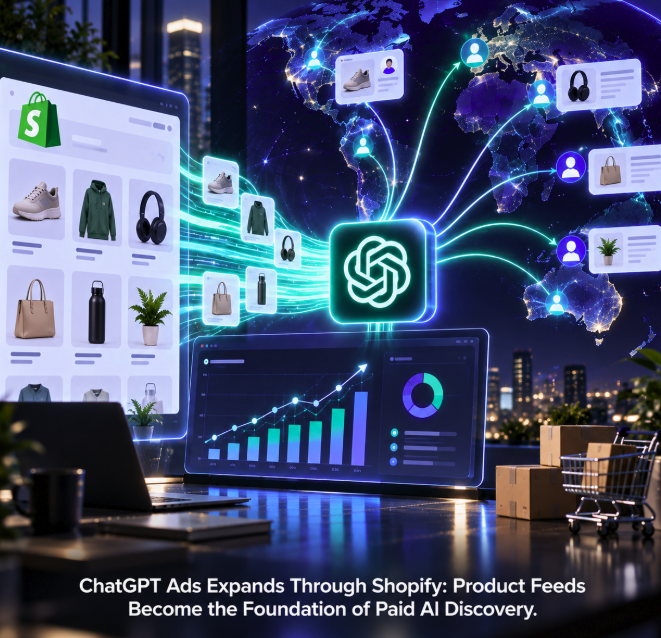

OpenAI is expanding its ChatGPT Ads integration with Shopify beyond the United States on September 23, turning existing ecommerce catalogs into ready-made inputs for paid discovery inside ChatGPT. The international rollout means eligible Shopify merchants in markets where ChatGPT Ads is available can connect their stores, synchronize products, create campaigns and measure results without rebuilding their catalog inside a separate advertising system.
The source is OpenAI itself. In its September 16 advertising announcement, the company said U.S.-based Shopify merchants could begin using the new ChatGPT Ads app immediately and explicitly set September 23 as the international launch date in markets where ChatGPT Ads is available. The app is developed by OpenAI and distributed through the Shopify App Store.
The integration is strategically more important than a convenient campaign-management plugin. It makes the merchant’s existing product catalog the bridge between ecommerce operations and paid AI discovery. Product titles, descriptions, inventory and other structured commerce information can flow from Shopify into ChatGPT Ads Manager, where the merchant can turn the same catalog into advertising without manually recreating every product.
OpenAI set September 23 as the international launch date
OpenAI announced the Shopify integration on September 16 as part of a broader expansion of its advertising platform. The company described Shopify as its first ecommerce partner and said U.S.-based merchants could use the app immediately to integrate their product catalogs and measurement tools with ChatGPT Ads.
The same announcement contains the key rollout detail: the app would launch internationally in markets where ChatGPT Ads is available on September 23. That moves the integration beyond its initial U.S. availability and connects it to OpenAI’s rapidly expanding advertiser footprint.
OpenAI has already expanded ChatGPT Ads across Europe and other international markets. In Europe, the company announced availability across 31 countries and subsequently opened self-service Ads Manager access across those markets. That means the Shopify integration arrives into an advertising platform that is no longer confined to a small U.S. pilot.
NetContentSEO recently documented how ChatGPT Ads Manager opened self-service access in Italy, allowing eligible businesses to create and manage campaigns directly. The Shopify app reduces the operational work required for ecommerce merchants entering that paid layer.
The merchant does not need to rebuild the product catalog
OpenAI’s Shopify setup documentation says the app connects a store’s product catalog and commerce-event data to ChatGPT Ads Manager. Its purpose is to help merchants create ads faster, keep inventory information aligned with Shopify and measure campaign performance with less manual configuration.
The Shopify App Store listing makes the workflow explicit. Merchants can connect an existing ChatGPT Ads account or create one from Shopify, automatically synchronize the Shopify catalog to Ads Manager and build advertisements and campaigns using existing product information.
That eliminates a familiar source of ecommerce advertising friction. Retailers often maintain separate feeds, imports and campaign structures for each advertising platform. Every additional copy of the catalog creates another place where titles, pricing, inventory or product metadata can become stale.
With the ChatGPT Ads app, Shopify remains the commerce source while the integration carries the catalog into OpenAI’s advertising environment. The merchant can use the data it already maintains for the storefront as the foundation of a new paid discovery channel.
Product feeds are becoming AI advertising infrastructure
Structured product data has long powered Shopping ads, marketplaces and comparison engines. AI discovery raises the stakes because the advertising surface is increasingly conversational rather than a fixed grid of product listings.
A ChatGPT user can describe a need, compare alternatives, refine constraints and move through a decision over several turns. OpenAI’s advertising system can evaluate the intent and context of that conversation when determining whether an advertisement is relevant.
For ecommerce advertisers, a synchronized catalog gives the platform a structured inventory of products that can participate in those commercial moments. Instead of manually designing a separate campaign asset for every SKU, the product feed becomes the scalable layer from which advertising can be built.
This is similar to the transformation that occurred in search and social commerce, where feed quality became inseparable from paid performance. The difference is that the destination is now an AI conversation whose understanding of user intent can be richer than a conventional keyword query.
The app combines catalog sync with conversion measurement
The Shopify integration does more than export products. OpenAI says merchants can set up conversion measurement and track campaign performance without leaving Shopify.
The official app listing says campaigns can run using a Shopify pixel and conversion events. In responses to merchants in the Shopify App Store, OpenAI has also described the integration as automatically setting up a Shopify server pixel, effectively providing server-to-server conversion event infrastructure.
This matters because a product feed alone can create ads but cannot tell the merchant whether those ads generated commercial outcomes. By connecting both catalog data and commerce events, the integration closes the loop between what is advertised and what happens after a user interacts with the campaign.
Advertisers can therefore evaluate performance using ecommerce outcomes rather than treating ChatGPT Ads as a pure awareness channel. The exact economics will vary by merchant and market, but the technical path from catalog to campaign to conversion measurement is increasingly packaged into the Shopify integration.
Campaign management can stay inside Shopify
OpenAI’s Shopify listing says merchants can create advertisements from their product catalog, run campaigns and track performance without leaving Shopify. That lowers the learning and workflow cost of adopting another advertising platform.
For smaller ecommerce teams, platform fragmentation is a practical constraint. Every new channel can require another account, interface, product-feed setup, pixel implementation and reporting workflow. Integrating ChatGPT Ads into Shopify moves part of that work into the system merchants already use to manage products and orders.
OpenAI framed the partnership in exactly those terms in its September announcement: adopting a new advertising channel should not require businesses to rebuild the way they work. Shopify is the company’s first ecommerce partner in that strategy, while HubSpot became its first CRM partner.
The common principle is that ChatGPT Ads is being embedded into existing business systems rather than forcing every advertiser to operate exclusively from OpenAI’s own Ads Manager.
International expansion makes catalog readiness more valuable
The September 23 rollout matters because ChatGPT Ads has already moved into a broad set of international markets. OpenAI announced a 31-market European expansion in August and subsequently opened self-service Ads Manager access across those countries.
For Shopify merchants operating across several supported markets, the app creates a more repeatable entry point into ChatGPT advertising. A retailer already maintaining localized product data in Shopify does not need to begin with an empty advertising account and manually reconstruct its catalog for each expansion.
Availability still depends on where ChatGPT Ads itself is supported and on advertiser eligibility. The international launch should therefore not be interpreted as universal Shopify availability in every country. OpenAI’s own wording limits the expansion to markets where ChatGPT Ads is available.
The relevant change is that U.S. residence is no longer the defining requirement for the Shopify integration as the scheduled international rollout begins.
Paid AI discovery now has a feed optimization problem
As product catalogs become direct inputs to ChatGPT advertising, feed quality becomes part of AI advertising quality. Incomplete titles, ambiguous variants, poor product descriptions, stale inventory and weak images can limit what an advertising system understands about an item before bidding or creative strategy is even considered.
OpenAI’s ad-selection system also looks beyond the feed. NetContentSEO has reported that ChatGPT Ads uses conversation intent, landing-page information and advertiser bids when determining which eligible ads appear. Product data therefore becomes one component in a larger relevance system rather than a substitute for strong landing pages and campaign strategy.
That creates a layered optimization problem. The catalog needs to describe the product accurately, the landing page needs to support relevance and policy validation, and the campaign needs to compete economically for the commercial opportunity.
Retailers that already treat product-feed optimization as a serious discipline for Google Shopping, marketplaces and social commerce may have an advantage because the same underlying catalog hygiene now supports another discovery environment.
OpenAI’s ads crawler makes product infrastructure part of campaign eligibility
ChatGPT Ads also has technical crawling requirements that make ecommerce infrastructure relevant to campaign delivery. OpenAI recently documented a dedicated advertising crawler, OAI-AdsBot, used to access and validate landing pages submitted with ads.
For advertisers using product feeds, OpenAI recommends allowing OAI-SearchBot to access product-image URLs as well. NetContentSEO’s analysis of the new OpenAI advertising crawler found that blocked images or restrictive CDN and firewall configurations can interfere with feed processing.
This means catalog integration does not eliminate technical advertising work. A merchant can synchronize Shopify products successfully while still creating problems downstream if OpenAI cannot validate landing pages or retrieve the assets needed to process the feed.
The emerging ChatGPT Ads stack therefore resembles mature ecommerce advertising systems: feed quality, crawl accessibility, conversion tracking and campaign management all contribute to whether paid product discovery works reliably.
Shopify is becoming a distribution layer for AI commerce
The OpenAI partnership also fits Shopify’s broader strategy of making merchant catalogs available to AI-driven discovery and transaction systems. Rather than requiring every merchant to build direct integrations with every AI platform, Shopify can act as an intermediary that standardizes product and commerce data.
That position becomes increasingly valuable as AI interfaces fragment. A merchant may want products discoverable in ChatGPT, Google AI experiences, Meta agents and other emerging systems without maintaining a separate technical stack for each one.
The ChatGPT Ads app is specifically an advertising integration rather than a universal agentic checkout layer, but the underlying logic is the same: the Shopify catalog becomes reusable infrastructure for distribution beyond the merchant’s own storefront.
For retailers, this changes the strategic value of catalog maintenance. Product data is no longer merely content for a website. It can determine how products are represented across organic AI discovery, paid AI advertising and increasingly agentic commerce environments.
The feed becomes the bridge between organic and paid AI visibility
AI visibility is developing two distinct layers. A brand or product can appear organically because a model retrieves, cites or recommends it, and it can appear through paid advertising selected by a separate ad system.
The Shopify integration strengthens the paid side by making structured product data directly reusable for ChatGPT Ads. But the same catalog quality can also support broader machine understanding across commerce systems.
Advertisers should still measure paid and organic presence separately. Buying ChatGPT Ads does not make a product more likely to appear in the assistant’s organic answer, and OpenAI says advertisements do not influence ChatGPT responses. The two systems can coexist in the same decision journey without sharing ranking logic.
What they increasingly share is the need for machine-readable, accurate commerce information. Product feeds are becoming the common substrate through which retailers expose inventory to automated discovery systems.
ChatGPT Ads is moving into the ecommerce operating system
The international Shopify rollout is a sign that OpenAI no longer wants its advertising platform to live only inside Ads Manager. It is embedding campaign creation and measurement into the systems where businesses already manage products and customers.
For Shopify merchants, that means a new ChatGPT advertising campaign can begin with assets they already have: the catalog, product information and commerce-event infrastructure. The integration can synchronize those inputs, create campaigns and report performance without requiring the merchant to rebuild the product layer from scratch.
The September 23 expansion extends that workflow beyond U.S.-based merchants into other markets where ChatGPT Ads is available. As the geographic footprint grows, the practical barrier to testing paid AI discovery becomes lower for ecommerce businesses already operating on Shopify.
The larger shift is that product feeds are becoming more than ecommerce plumbing. They are becoming the foundation on which AI systems can discover, advertise and eventually transact products. ChatGPT Ads through Shopify is one of the clearest examples yet of that infrastructure moving directly into a conversational advertising channel.