
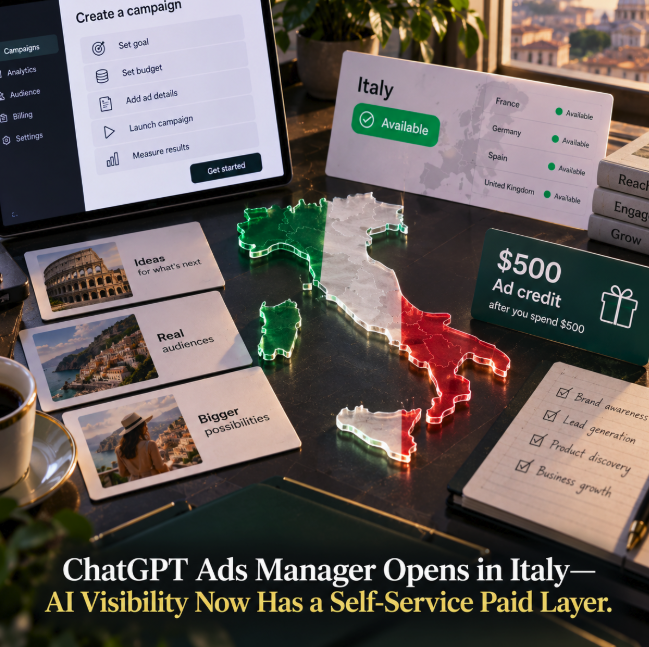
ChatGPT advertising has crossed an important operational threshold in Italy. OpenAI now lists Italy as Available for self-service Ads Manager access, allowing eligible Italian businesses to create advertising accounts and campaigns directly rather than relying exclusively on an OpenAI sales team, agency or technology partner.
The change appears in OpenAI's official Ads Manager availability documentation, updated on September 18, 2026. Italy is now listed alongside France, Germany, Spain, the United Kingdom and numerous other European and international markets with self-service availability. OpenAI's Ads Manager site also invites new advertisers to sign up directly and currently advertises a promotion offering $500 in ad credit after $500 in qualifying ad spend.
For marketers, the significant part is not simply that ChatGPT now carries advertising. That transition was already underway. The new development is that access to the paid layer is becoming operationally accessible to businesses in Italy without requiring a managed onboarding relationship.
Italy is officially marked Available for self-service access
OpenAI distinguishes between advertiser account creation and self-service campaign availability. Businesses can sign up for Ads Manager, but whether they can directly create and run campaigns depends on the country where the legal entity that will advertise and be billed is based.
Italy is now explicitly marked Available. The same status currently appears for a broad group of European countries including Austria, Belgium, Bulgaria, Croatia, Cyprus, the Czech Republic, Denmark, Estonia, Finland, France, Germany, Greece, Hungary, Ireland, Latvia, Lithuania, Luxembourg, Malta, the Netherlands, Norway, Poland, Portugal, Romania, Slovakia, Slovenia, Spain, Sweden, Switzerland and the United Kingdom.
This matters because OpenAI's documentation still distinguishes the new European markets from advertisers working through the OpenAI Ads team or approved partners. Self-service removes that requirement for eligible businesses: they can sign up directly through Ads Manager.
Advertisers can now build the campaign themselves
OpenAI describes a familiar self-service workflow. After creating an Ads Manager account, advertisers can create campaigns, set a budget and campaign goal, add ad details, launch the campaign and measure results. Ad information can be created directly in the interface or uploaded in bulk.
That moves ChatGPT closer to the operating model marketers already know from mature digital advertising platforms. A company does not need a bespoke sales arrangement merely to experiment with the channel. The barrier shifts from gaining platform access to deciding whether the audience, economics and measurement justify the spend.
Larger advertisers with more complex requirements can still request sales support from OpenAI. Self-service therefore expands the entry path rather than eliminating managed advertising relationships.
OpenAI is offering $500 in credit after $500 in spend
OpenAI's advertising site currently promotes an introductory incentive for new ChatGPT advertisers: spend $500 and receive $500 in ad credit. The offer is presented directly on the official Ads Manager landing page.
Businesses considering the promotion should still review the terms presented during signup and account creation rather than treating the headline credit as universally unconditional. Eligibility, timing and account requirements can be governed by the applicable offer terms.
The presence of the incentive nevertheless reinforces the current stage of the product. OpenAI is not merely making an advertising interface technically available; it is actively encouraging new advertisers to begin testing it.
ChatGPT now has an organic and a paid visibility layer
For NetContentSEO, the development creates a useful distinction. Visibility inside AI systems has largely been discussed through organic mechanisms: whether a brand is retrieved, cited, mentioned, reconstructed or recommended in an answer. ChatGPT Ads adds a separate paid surface.
Those two layers should not be conflated. OpenAI says advertisements are clearly labeled and remain separate from ChatGPT's responses. Buying an ad does not mean buying inclusion in the assistant's organic answer, and the company says advertisers cannot use the advertising system to alter those responses.
The practical result is a dual visibility environment. A company can attempt to earn organic visibility by making its information discoverable, useful and retrievable, while separately paying for an advertising placement in eligible commercial contexts.
Paid visibility does not replace GEO or AI-search visibility
The availability of self-service advertising may tempt marketers to collapse every ChatGPT visibility problem into a media-buying problem. That would misunderstand how the product is currently structured.
Organic answers and paid placements serve different functions. Organic AI visibility depends on the systems, sources and retrieval processes behind the assistant's response. Advertising provides a clearly identified commercial opportunity adjacent to that experience.
A brand can therefore appear in one layer and not the other. It can be organically discussed without advertising, advertise without being organically cited, or participate in both. Measurement frameworks should preserve that distinction rather than reporting all ChatGPT exposure as a single metric.
The advertising opportunity begins when users are already explaining intent
OpenAI positions ChatGPT advertising around a distinctive signal: conversations often contain more context than a short search query. Users may describe constraints, compare alternatives, explain what they are trying to accomplish and refine a decision over several turns.
OpenAI says this richer context allows advertising to appear while people explore options, compare choices and make decisions. The company frames that as a move beyond conventional keyword-only signals toward advertising informed by the context of the conversation.
That does not automatically make every impression more valuable. Advertisers still need evidence that the placement reaches an appropriate audience and contributes to meaningful outcomes. But it changes the environment in which paid discovery occurs: the ad can appear after the user has already articulated a relatively detailed need.
Italy joins a much broader European self-service expansion
The Italian rollout should not be viewed as an isolated country launch. OpenAI's current availability table marks a large set of European markets as available at the same time, suggesting a broader expansion of the self-service advertising infrastructure.
That makes cross-border testing more practical for European advertisers whose legal entities are based in supported markets. It also means agencies managing campaigns for multiple European businesses may increasingly encounter ChatGPT Ads as another platform that clients can access directly.
Availability is tied to the advertiser's legal and billing entity, however, not simply to the geographic audience a marketer wants to reach. Businesses should therefore check the official country list for their own entity rather than assuming availability from campaign targeting alone.
Self-service access changes who can experiment
Managed advertising tends to favor organizations with larger budgets, established agency relationships or direct platform contacts. A self-service interface lowers the operational threshold for testing because smaller businesses and independent marketing teams can create an account and work directly in the campaign tool.
That does not mean ChatGPT Ads will necessarily be appropriate or economical for every small advertiser. OpenAI's platform is still developing, and advertisers need to evaluate pricing, targeting, conversion measurement and incremental value against established channels.
What has changed is access. Italian businesses no longer need to wait for the platform to be marked Coming Soon before they can evaluate the self-service product firsthand.
The paid layer is developing while ChatGPT experiments with more native ad formats
NetContentSEO recently examined how OpenAI is testing advertising that can turn a click into a branded conversation inside ChatGPT. That reported experiment points beyond conventional ads that simply send a user to an external landing page.
Self-service Ads Manager provides the infrastructure for advertisers to enter the platform today, while more conversational formats suggest how the commercial layer could evolve. The two developments should be distinguished: Italy's self-service availability is official and current, while newer click-to-chat formats remain early experiments rather than a universal campaign option.
Together, however, they show the direction of travel. OpenAI is building both the buying infrastructure familiar to performance marketers and ad experiences designed specifically around conversational AI.
AI visibility now needs separate organic and paid reporting
For brands measuring ChatGPT exposure, the Italian launch adds a practical reporting requirement. Organic mentions, citations and recommendations should remain analytically separate from ad impressions, clicks and conversions.
That separation is important not only for attribution but also for understanding what a brand's underlying information ecosystem is accomplishing. If paid campaigns increase exposure while organic presence remains weak, the two results answer different strategic questions. Conversely, strong organic visibility does not tell a marketer whether paid ChatGPT campaigns can generate incremental commercial value.
The emergence of a self-service paid layer therefore expands AI visibility rather than replacing its existing components.
ChatGPT Ads Manager is now a platform Italian marketers can actually test
Until self-service availability arrives in a market, discussion of a new advertising platform remains partly theoretical for many businesses. Italy has now crossed that line. Eligible legal entities can sign up, create campaigns and begin evaluating ChatGPT Ads directly.
The rollout should not be interpreted as proof that ChatGPT Ads will outperform search, social or other established channels. OpenAI's platform still has to earn advertiser budgets through measurable results, useful targeting and reliable reporting.
But the strategic change is concrete. ChatGPT visibility in Italy now includes a self-service paid layer alongside the organic answer layer. For marketers studying how brands appear during AI-assisted discovery and decision-making, that creates a new surface to measure — and, as of September 18, one they can access without waiting for a managed-sales invitation.