

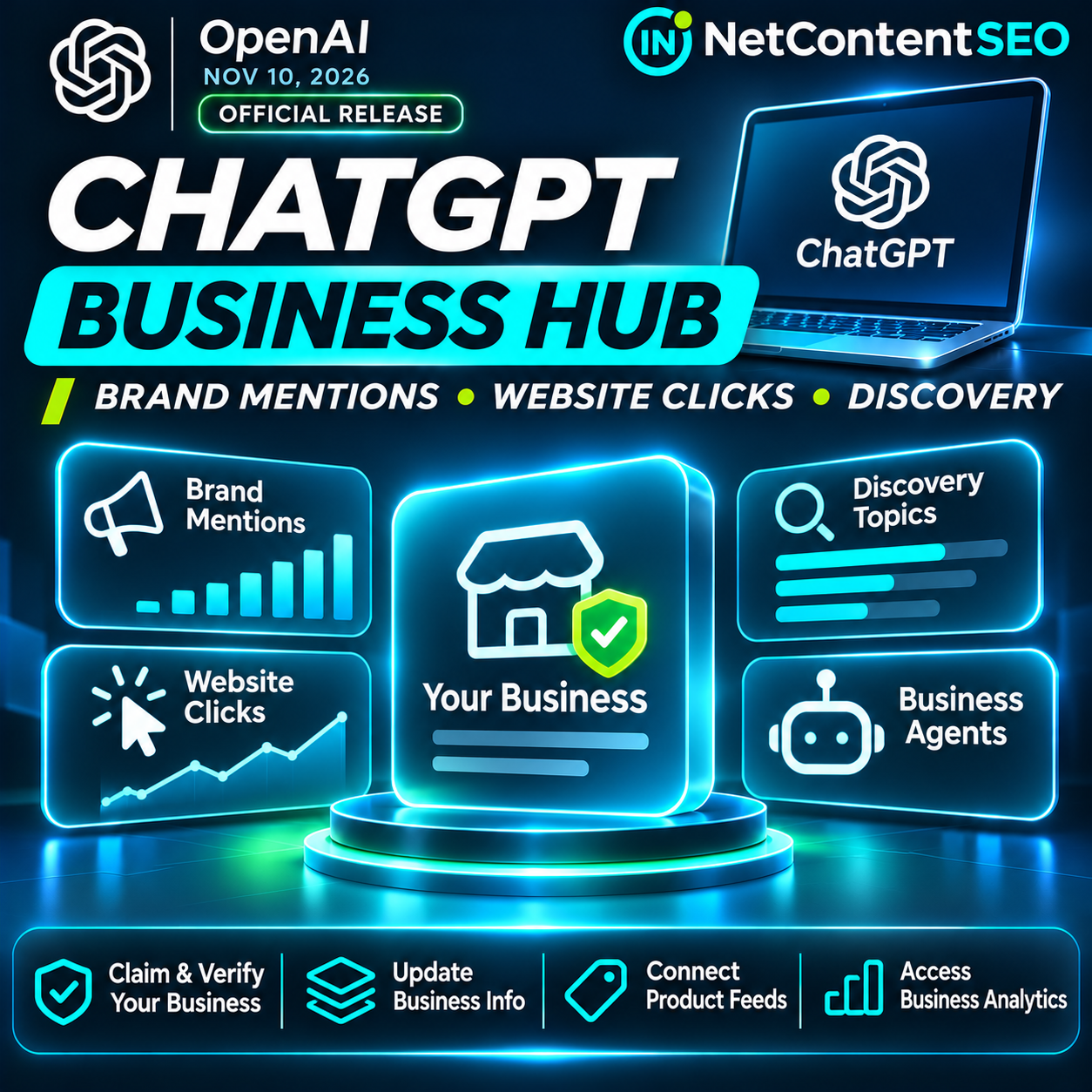

OpenAI has officially launched Businesses in ChatGPT in beta, introducing a Business Hub where eligible organizations can claim their business, update information and see how people engage with them in ChatGPT. Announced on November 10, 2026, the release introduces something SEO and Generative Engine Optimization (GEO) teams have been asking for: first-party aggregated metrics on brand mentions, clicks to websites and the topics through which businesses are discovered.
This is a substantial step toward measurable AI visibility. But it is not a ChatGPT equivalent of Google Search Console in every respect. The available analytics are privacy-thresholded, do not reveal individual conversations and do not provide a complete list of user prompts, competitors or ranking positions. A verified business profile also does not guarantee that ChatGPT will recommend or cite the business.
What OpenAI officially launched on November 10
In its official announcement, OpenAI introduced two related products: Businesses in ChatGPT, accessed through Business Hub, and Business Agents for eligible organizations. Business Hub is the management and insights environment; Business Agents are a separate way for customers to hold a business-specific conversation.
OpenAI says the beta provides a way for businesses to claim their organization, manage current details, supply product information and understand how they appear in ChatGPT. The announcement describes ChatGPT as reaching 1.2 billion weekly users, a company-reported platform figure rather than an estimate of people searching for any particular brand.
What Business Hub analytics actually measure
OpenAI identifies three especially relevant insight categories:
- Brand mentions: the number of mentions a business receives in ChatGPT.
- Website clicks: recorded clicks on links to a business's website in ChatGPT.
- Discovery topics: common themes across conversations where the business's website is cited.
These are materially different signals. Mentions indicate appearances in responses, while website clicks measure a user interaction with a link. Discovery topics offer thematic context rather than a complete transcript or keyword report. Teams should not combine them into a single invented visibility score without a documented methodology.
Search Engine Roundtable's November 10 coverage reports that the click metric's interface describes recorded link clicks and cautions that a click does not confirm a completed website visit or conversion. A browser may fail to load, analytics may block a session, or attribution may differ. This makes reconciliation with web analytics essential.
Privacy thresholds: why some businesses may see little or no data
OpenAI states that it does not share users' individual ChatGPT conversations or Business Agent chats with businesses. Insights are aggregated and become available only when conversation or interaction volume meets unspecified thresholds.
That means an empty analytics screen is not proof that a business was never mentioned. It could reflect insufficient activity, privacy thresholds, account eligibility or reporting availability. OpenAI has not published a universal minimum number of mentions required for every metric.
For smaller publishers and regional businesses, this limitation matters. External prompt-testing tools may show appearances that Business Hub does not display, while Business Hub may report aggregated interactions that a small manual prompt sample fails to capture. The datasets measure different things.
How to claim and verify a business in ChatGPT
OpenAI says any eligible business located where ChatGPT is available can claim its business through Businesses in ChatGPT and Business Hub. Eligibility should be checked in the live product rather than inferred from the organization's country or industry alone.
- Open the official Businesses in ChatGPT page and follow the link to Business Hub.
- Sign in and search for the organization you want to claim.
- Choose the available ownership-verification method and follow the on-screen instructions.
- Complete verification before attempting to manage the profile or inspect its insights.
- Review the business's name, website, description and other supported details for accuracy.
- If relevant and supported, connect product information or a self-service feed with accurate prices and availability.
- Check which insights appear and document any missing metrics or eligibility messages.
Barry Schwartz reports that the verification flow offered phone, text-message and DNS options, and that he completed verification using DNS. Available methods can vary by organization and account. Shopify merchants may connect their store through Business Hub or Shopify administration, while existing OpenAI Enterprise customers and advertisers may work through their OpenAI representative.
Only authorized owners should complete verification. DNS changes should be performed through the organization's legitimate domain administrator; they should not be delegated to untrusted third parties.
What businesses can update—and what they cannot control
After verification, OpenAI says organizations can update key business information and add self-service product feeds that include pricing and availability. This can help keep the information available to ChatGPT current, particularly when product details change frequently.
It does not mean the organization controls ChatGPT's independent recommendations. A company-supplied description is one source of business information, not an entitlement to favorable placement. The launch does not establish that claiming a profile increases rankings, citations or recommendation frequency.
Publishers should therefore distinguish information management from visibility optimization. Accurate, consistent facts are useful, but any effect on organic discovery must be measured rather than assumed.
Business Agents: a new conversation layer for eligible US businesses
OpenAI also introduced Business Agents, which eligible organizations can build, test and launch after claiming their business. When someone encounters a business in a ChatGPT response, they may open its profile and, where available, choose to speak with the business's agent to explore offerings and ask follow-up questions.
The Business Agent conversation is clearly identified and separate from the original ChatGPT conversation and from ChatGPT's independent answers. OpenAI says organizations can also sponsor a Business Agent as a destination for ChatGPT advertising, with sponsored placements labeled separately.
Availability is narrower than the broader claim-and-insights beta: Business Agents initially support eligible ecommerce and online-service businesses in the United States. OpenAI says it plans to expand to additional markets and business categories, but has not promised specific dates for every country.
A Business Agent should not be confused with a guarantee of autonomous checkout, booking or unrestricted access to a company's internal systems. Actual actions depend on the available product capabilities and integrations.
Why this matters for GEO: first-party measurement changes the evidence
Until now, much AI visibility measurement has relied on running selected prompts, counting citations or mentions and extrapolating from samples. Those methods can be useful for comparing representative questions, but they cannot reliably reveal every real-world interaction with a brand.
Business Hub adds a different layer: aggregated data reported by the platform itself. That is potentially more direct evidence of actual mentions and link clicks, although privacy thresholds and metric definitions still limit interpretation.
For the first time, a business may be able to examine whether its ChatGPT mentions and website clicks move over time without treating repeated synthetic prompts as equivalent to user demand. The key word is may: access, data volume and the precise reporting interface will vary.
Business Hub is not yet a full Search Console for ChatGPT
The analogy with Google Search Console is understandable but incomplete. Search Console offers query and page performance reports, impressions, clicks and technical indexing tools for Google Search. OpenAI's announced Business Hub offers aggregated mentions, website clicks and discovery topics, alongside business-profile management.
OpenAI has not announced a complete searchable list of ChatGPT prompts, per-query rankings, a competitor visibility table, universal citation logs, crawl diagnostics or indexing coverage reports. It would be misleading to promise these features or to infer them from early screenshots.
Business Hub is best described as a new first-party business discovery and engagement analytics product, not a complete replacement for search analytics, server logs or carefully designed external GEO testing.
How to combine ChatGPT metrics with GA4 and Search Console
Organizations should build a measurement framework that keeps three layers distinct:
- ChatGPT-native discovery: mentions and discovery topics from Business Hub, subject to availability and privacy thresholds.
- ChatGPT-native engagement: website link clicks reported by Business Hub.
- On-site outcomes: landing sessions, engaged visits, leads, sales and conversions measured through analytics and first-party systems.
Google Search Console should remain the source for Google Search performance. GA4 or another analytics system can help identify referral traffic and on-site outcomes, but differences in attribution, tracking prevention, time zones and metric definitions can make counts diverge.
Do not calculate a definitive ChatGPT conversion rate by dividing GA4 conversions by Business Hub clicks unless the numerator and denominator cover the same eligible traffic and period. A directional comparison may still be useful if the limitations are explicit.
A practical GEO measurement plan for the first 30 days
Week 1 — Verify and document. Claim the business if eligible, complete verification, record supported profile fields and take a baseline of available mentions, clicks and discovery topics. Note whether data is unavailable or privacy-thresholded.
Week 2 — Audit entity consistency. Compare the business name, domain, offerings, geographic coverage and key facts across the official website, structured data, relevant directories and third-party references. Correct factual inconsistencies at their source.
Week 3 — Investigate discovery topics. If topics are available, group them by user intent: informational, comparison, purchase, local or support. Review whether the website actually answers the questions those topics imply. Use external prompt tests only as a complementary sample.
Week 4 — Review outcomes. Compare the available Business Hub trends with site referrals, leads and sales. Identify which changes are observed, which are only hypotheses and which require more time or data. Avoid attributing every fluctuation to a content update.
For low-volume businesses, a longer observation period may be necessary before meaningful patterns appear.
What NetContentSEO and WikiSardinia should check
NetContentSEO should first determine whether its publishing organization is eligible for a business claim. If verified, it could monitor whether ChatGPT cites the website around SEO, AI Search, GEO and model developments, and whether any reported clicks align with referral traffic. The availability of these exact topics depends on what the dashboard exposes; they are not guaranteed categories.
WikiSardinia should likewise check whether its organization or website can be claimed. Discovery themes might include Sardinia travel planning, Alghero, beaches, transport and local experiences, but those are proposed audit categories, not observed dashboard results. A verified profile should be treated as a source of accurate business details, not a promise of additional travel recommendations.
Neither site's current eligibility, verification status or Business Hub metrics has been checked through an authenticated account in this analysis. The appropriate next step is to inspect the live claim flow for each organization.
Does claiming a profile improve AI citations?
No such improvement is guaranteed. OpenAI presents Business Hub as a way to provide accurate information and understand engagement, while ChatGPT's independent answers remain separate from business-controlled conversations and sponsored placements.
The sensible hypothesis is that consistent business information may reduce factual errors and support more useful interactions. Whether it changes mention frequency, citation rates or qualified visits is an empirical question that each business must test.
Frequently asked questions
When did OpenAI launch Businesses in ChatGPT?
OpenAI officially announced the beta on November 10, 2026.
What does Business Hub show?
OpenAI lists aggregated brand mentions, website clicks and discovery topics, alongside business-profile management capabilities.
Can businesses see users' ChatGPT conversations?
No. OpenAI says it does not share individual conversations or Business Agent chats with businesses. Insights are aggregated and privacy-thresholded.
Does a recorded click equal a website visit?
No. A recorded link click does not prove that a website loaded successfully or that the user converted.
Can a business outside the United States claim a profile?
OpenAI says eligible businesses located where ChatGPT is available may claim a profile. Business Agent availability is initially more restricted, starting with eligible US ecommerce and online-service businesses.
How is ownership verified?
Reported options include phone, text and DNS verification, with additional paths for some Shopify merchants and existing OpenAI business relationships. The available method should be confirmed in the live interface.
Does verification guarantee more ChatGPT recommendations?
No. The announcement does not promise a ranking, citation or recommendation boost.
Can Business Hub replace external GEO tools?
Not completely. First-party aggregates are valuable, but they do not provide full prompt-level visibility, competitor rankings or every diagnostic needed to understand why a brand appears.
Are Business Agents available to all businesses?
No. The initial launch is limited to eligible ecommerce and online-service businesses in the United States, with broader expansion planned.
Why might an analytics panel be empty?
OpenAI applies privacy thresholds and eligibility conditions. Missing data should not automatically be interpreted as zero mentions or zero interactions.
The bottom line
Businesses in ChatGPT is one of the clearest signs yet that AI discovery is becoming a measurable business channel rather than only a collection of anecdotal chatbot screenshots. The November 10 launch introduces first-party brand mentions, website clicks and discovery topics, alongside profile management and a separate Business Agent experience.
For GEO professionals, the next challenge is methodological: combine these new platform metrics with external visibility tests and real business outcomes, without treating a mention as a click, a click as a visit, or a verified profile as a ranking advantage. The opportunity is significant precisely because the new data makes those distinctions easier to investigate.
Sources
- OpenAI — Introducing Businesses in ChatGPT (November 10, 2026).
- OpenAI — Businesses in ChatGPT: information and access.
- Search Engine Roundtable — Businesses in ChatGPT Business Hub Live With Click Data (November 10, 2026).
- Search Engine Roundtable — Earlier reporting on experimental ChatGPT business tools (November 6, 2026).