

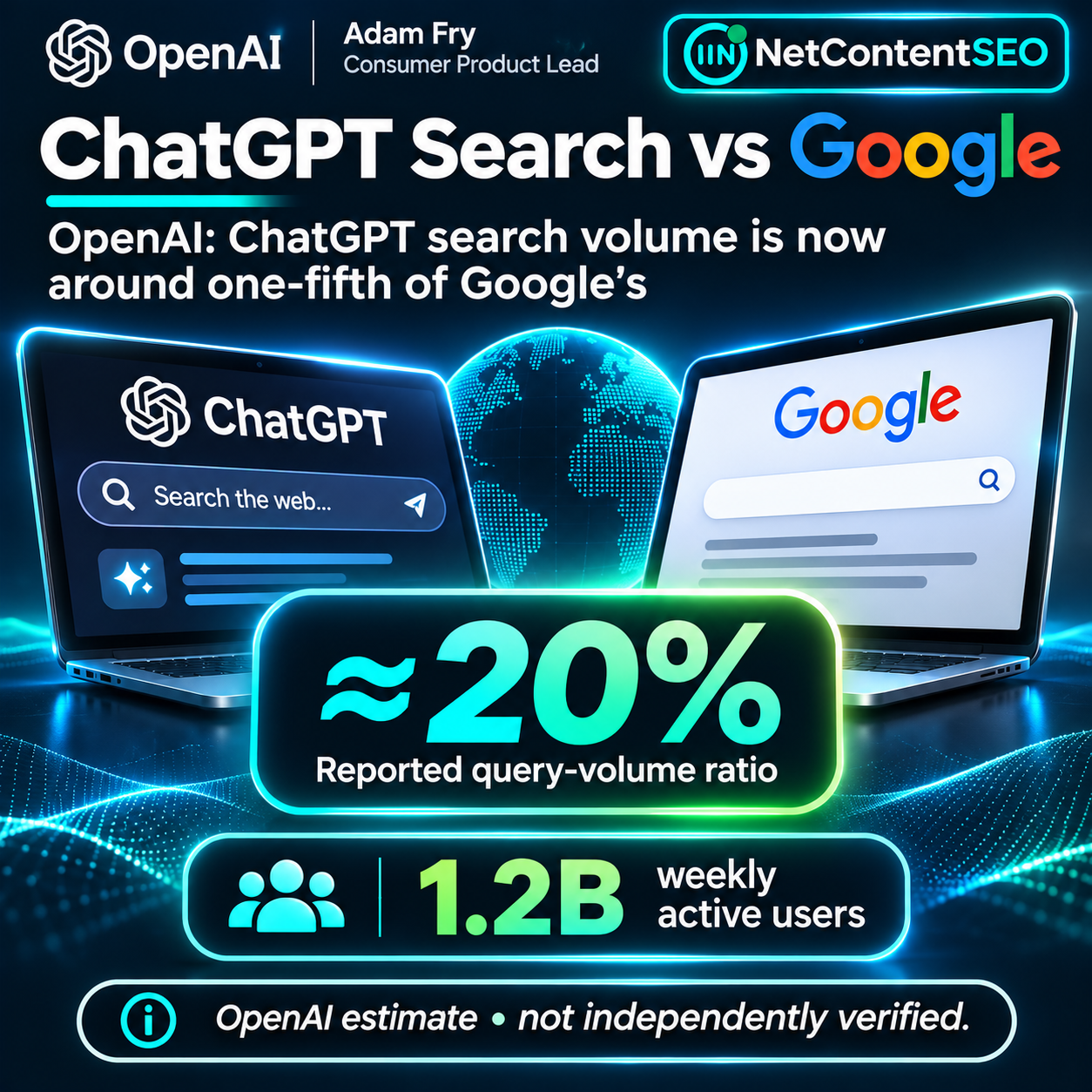

ChatGPT is now handling search-like queries at a volume equivalent to roughly one-fifth of Google's, according to OpenAI consumer product lead Adam Fry. The claim, made at an OpenAI-hosted event in New York on November 2, 2026 and reported by Alex Kantrowitz of Big Technology on November 3, marks a significant moment in the conversation about AI search. It does not, however, mean that ChatGPT has captured 20% of the search market or that it sends publishers 20% as much traffic as Google.
Fry also said ChatGPT had reached 1.2 billion weekly active users, up from 1 billion roughly two months earlier. These figures are company statements, not an independently audited dataset. Understanding the difference between query volume, audience size and referral traffic is essential for SEO and AI visibility teams.
What OpenAI actually claimed
In an interview with Alex Kantrowitz of Big Technology, Fry described ChatGPT's search-like query volume as roughly one-fifth of Google's query volume. The Verge and Search Engine Journal subsequently explored what OpenAI meant by a search. According to those accounts, OpenAI counts questions that cause ChatGPT to search the web, rather than treating every message sent to the chatbot as a conventional search query.
That is an important boundary, but it still leaves unanswered questions. OpenAI has not published an absolute number of ChatGPT searches, a measurement period, a geographical breakdown or the source and period of the Google denominator. Without those details, outsiders cannot reproduce the 20% calculation or compare it cleanly with other market estimates.
Twenty percent of Google's volume is not 20% market share
Suppose Google processes 100 searches during a defined period and ChatGPT handles 20 search-like queries during the same period. ChatGPT would have a volume equivalent to 20% of Google's, but that would not mean it has a 20% share of the combined 120 interactions. In that simplified two-service example, ChatGPT's share of the combined total would be about 16.7%.
The real market is more complicated because users may consult multiple products for the same task, one ChatGPT conversation can include several web lookups, and some chatbot questions would never have been entered into a traditional search engine. The headline ratio is therefore best described as a comparison of two activity volumes under OpenAI's definition, not a conventional search-market-share statistic.
What counts as a ChatGPT search?
ChatGPT can answer many prompts using the model alone, but it can also retrieve information from the web when a question requires current or externally sourced details. Fry's explanation focuses on those web-search-triggering interactions. For example, asking for today's information about a public company or an upcoming event may trigger retrieval; asking for a rewrite of an email may not.
Yet even this definition does not make every ChatGPT lookup equivalent to a Google search. A conversational exchange may involve multiple follow-up questions, refinements and tool invocations. Users can ask for synthesis or analysis across sources, rather than selecting from a conventional list of results. OpenAI has not disclosed enough methodological detail to determine how multiple lookups within one conversation are counted in the headline figure.
For comparison purposes, researchers would need consistent definitions of a query, session, retrieval event and search intent. Otherwise, two products may appear numerically comparable while measuring different behaviors.
1.2 billion weekly users: a separate metric
Fry's second headline figure was 1.2 billion weekly active users, reportedly 200 million more than two months earlier. The increase illustrates the scale of ChatGPT's consumer adoption, but it does not establish how many of those users perform web searches or how often they do so.
Weekly active users count people active during a week under the company's methodology. Search-like query volume counts interactions. A single user might generate many searches; another might use ChatGPT exclusively for writing, coding or document analysis. Dividing one figure by the other without matching periods and definitions would produce an unreliable estimate of searches per person.
Search volume and referral traffic tell different stories
For publishers, the most commercially important distinction is between queries handled by a platform and visits sent to external websites. An AI answer can satisfy a user without requiring a click to the original source. ChatGPT may also provide source links that users choose not to open. Conversely, a recommendation may influence a later direct visit that web analytics cannot attribute to ChatGPT.
Search Engine Journal's November 2026 analysis stresses that the query-volume ratio should not be confused with website traffic. In one Ahrefs tracking sample discussed by the coverage, ChatGPT accounted for a small fraction of site visits compared with Google. Such referral studies have their own coverage, sampling and attribution limitations, but they make the central point: a high share of search-like activity does not translate into a similar share of outbound clicks.
There is no contradiction in ChatGPT approaching a fifth of Google's reported query volume while Google remains overwhelmingly larger as a source of measurable visits to many websites. The two statements concern different denominators and user behaviors.
Why independent estimates disagree
External researchers have produced lower estimates using different approaches. Ahrefs previously estimated ChatGPT's search volume at about 12% of Google's, while seoClarity has published a model-based estimate closer to 7.5% for October 2026. These should not be treated as direct measurements that disprove Fry's claim: they rely on different definitions, datasets and assumptions.
Equally, OpenAI's 20% statement cannot be taken as more precise merely because it comes from the operator of ChatGPT. OpenAI has direct knowledge of its own product activity, but has not disclosed the Google comparison methodology. Transparent definitions, consistent periods and reproducible calculations are needed before any estimate can be evaluated on equal terms.
What the shift means for SEO
The strongest implication is not that Google has lost a specific percentage of searches. It is that more information-seeking behavior now occurs in interfaces that can synthesize answers before a user visits a website. That changes the journey from discovery to traffic and conversion.
Traditional SEO remains essential for crawlability, relevance, content quality and organic search demand. But reporting that focuses only on Google rankings and clicks may overlook whether users encounter a brand in AI-generated answers. The solution is not to merge every metric into one vague visibility score. It is to measure the stages separately.
A more useful AI visibility measurement framework
Search-like activity measures how frequently people use a platform to seek information. The 20% claim belongs here. It is a platform-scale usage estimate, not a brand-level KPI.
Brand mentions and citations measure whether a company or source appears in answers to representative prompts. A brand can be mentioned without a link, while a page can be cited without generating a visit. These outcomes require prompt-level monitoring with transparent sampling and repeatable methodology.
Referral visits measure traffic that analytics tools can attribute to ChatGPT or other AI products. This is narrower than exposure because referrer information can be missing and users may visit later through another channel.
Business outcomes measure what those visits or influenced users ultimately do: subscribe, purchase, request a quote or complete another valuable action. These metrics matter most commercially but are also hardest to attribute across multi-step AI-assisted journeys.
Tracking all four levels allows teams to distinguish rising AI exposure from actual traffic or revenue. It also prevents a misleading interpretation of platform growth as a guaranteed publisher benefit.
What about Google's own AI search products?
The competitive comparison is not simply ChatGPT versus ten blue links. Google itself increasingly incorporates AI-generated answers and conversational features into its search ecosystem. Users can interact with AI Overviews and AI Mode while remaining within Google products. Therefore, the growth of AI-style information seeking does not map neatly onto a transfer of users from one company to another.
Moreover, a user might use Google to discover a source, ChatGPT to synthesize information and a brand's website to complete a transaction. Treating these steps as mutually exclusive market choices obscures how discovery actually works.
What publishers and marketers should do now
First, establish a consistent baseline for AI referral traffic in analytics, acknowledging the limitations of referrer-based measurement. Second, monitor a carefully chosen set of informational, commercial and brand prompts to observe citations and mentions. Third, compare those observations with Google Search Console data rather than assuming that falling clicks must be caused by ChatGPT.
When reporting externally, label the 20% statistic as an OpenAI estimate and explain that it compares search-like query volume with Google's search volume. Do not present it as independently verified market share, a traffic share or proof that one in five Google searches has migrated to ChatGPT.
The bigger picture
OpenAI's announcement is meaningful because it places ChatGPT at a reported scale that makes AI search impossible to ignore in digital discovery planning. But the missing methodological details limit what the exact percentage can prove. For SEO and GEO professionals, the more actionable question is not whether ChatGPT has reached a particular fraction of Google's volume. It is whether a brand is discoverable, correctly represented, cited and able to turn AI-mediated attention into measurable business value.
The takeaway: OpenAI says ChatGPT now handles search-like queries equivalent to about 20% of Google's volume, alongside 1.2 billion weekly active users. Both figures are company-reported. Query volume, search market share, citations and publisher referrals are distinct measures—and treating them as interchangeable leads to the wrong conclusions.