

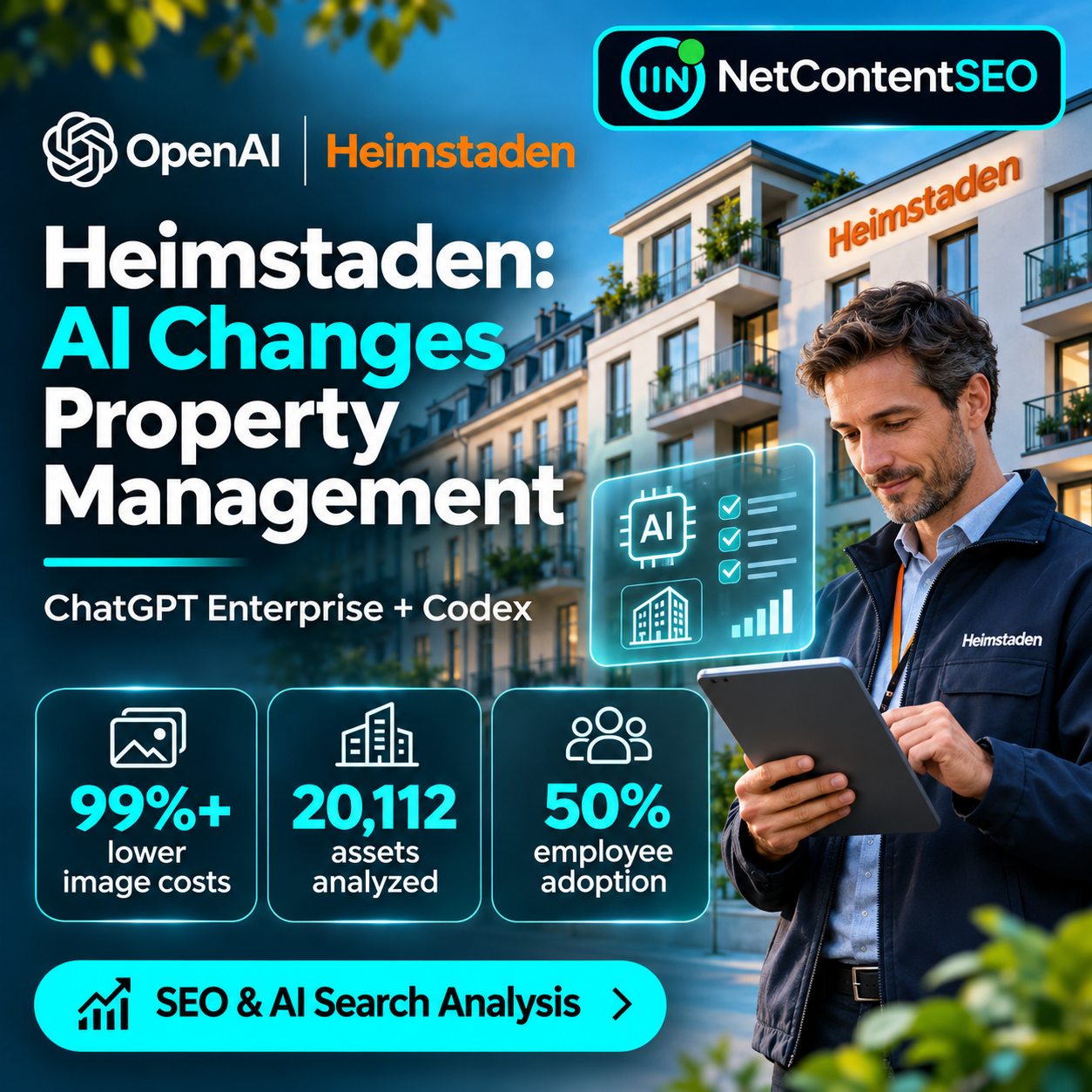

European residential operator Heimstaden is applying ChatGPT Enterprise and Codex to work that spans apartment listings, environmental-risk analysis and property operations. A November 3, 2026 OpenAI customer case study describes substantial results: property-image production costs reduced by more than 99% in one market, 20,112 assets analyzed with Codex, and 50% employee adoption within two to three months of the Enterprise rollout. These are company-reported outcomes, not an independently controlled comparison.
From isolated AI tasks to an integrated letting workflow
When an apartment becomes vacant, getting it back onto the market requires pricing, photography, advertising and ongoing feedback. Heimstaden uses AI-supported tools for pricing recommendations, virtual image styling, apartment descriptions, quality checks on live advertisements and market feedback. Employees still review and approve decisions, but the preparatory work becomes faster and more connected.
The clearest cost example comes from the Netherlands. According to the case study, producing one virtually staged property image previously cost about €50 and now costs less than €0.10. Heimstaden estimates potential annual savings of €130,000 in that market. That is a narrow but meaningful operational metric: it should not be misread as a 99% reduction in total property-management costs.
Codex helps a domain expert analyze 20,112 properties
The company's environmental sustainability analyst Julia Erlandsen used Codex to build an approach for collecting, cleaning, standardizing and checking disparate environmental data. The resulting workflows supported analysis of 20,112 property assets and generated more than six million rows of useful data. Heimstaden estimates that the work, otherwise requiring five people for a year, was delivered by two people in two months. The methodology and validation remained under human control.
This illustrates a broader change in enterprise software: subject-matter experts can use AI-assisted coding to build repeatable internal analytical capabilities without waiting for a conventional development project. It does not remove the need for source verification, quality assurance or domain expertise.
Adoption depends on governance and practical value
Heimstaden selected OpenAI after evaluating platforms in June 2025 and launched ChatGPT Enterprise in September 2025. Half of employees were using it within two to three months, the company says. Its operating model combines employee training, a central AI transformation office, local AI champions and preparation of property systems and data for AI-assisted workflows.
The deployment also reaches frontline work. A Norwegian caretaker used ChatGPT to help assess a neglected apartment and draft a prioritized refurbishment plan, which remained subject to employee review. This matters because the value of AI is not confined to engineers, analysts or marketing teams.
Next: AI agents connected to property systems
Heimstaden is rolling out a Procurement Intelligence Platform that uses OpenAI models through APIs and works across Microsoft Outlook, SharePoint and Teams to support contract analysis and procurement preparation. The company is also co-developing Amplio Estate, a property-management platform intended to support AI workflows through the Model Context Protocol (MCP). These are ongoing initiatives and future capabilities, not evidence that autonomous property management is already complete.
What this means for SEO and AI Search
Although the OpenAI announcement is an enterprise AI case study rather than a search-engine ranking update, it has clear implications for property discovery. If AI assists with listing descriptions, images, quality checks and pricing, publishers and property platforms will need reliable, consistently modeled information about each property: location, availability, amenities, costs, accessibility, conditions and restrictions.
For SEO, AI-generated descriptions should remain accurate and distinctive rather than becoming repetitive templates. Virtual staging should be transparently identified so prospective tenants do not confuse digitally furnished images with actual property conditions. Listing pages should expose material facts in crawlable content, keep availability current, and use relevant structured data only where it accurately represents the page and complies with search-engine requirements.
For AI Search, the broader lesson is about trustworthy data foundations. Assistants can summarize or act on property information only as reliably as the underlying records allow. Clear entity identification, verifiable attributes, updated inventory and traceable provenance are more useful long-term investments than indiscriminately generating more text. Heimstaden's case does not demonstrate a direct improvement in organic rankings or AI citations, and none should be inferred.
Where the transformation becomes measurable
The case shows three different categories of progress: direct unit-cost reduction in image production, analytical throughput from Codex-assisted data processing, and organizational adoption of ChatGPT Enterprise. They should be measured separately. More ambitious workflows that act across systems will also require audit trails, permissions, human approval gates and tests for accuracy and unintended effects.
Heimstaden's most important lesson may be that AI deployment is a process-design challenge. Its reported gains come from combining tools with employee knowledge and usable operational data. In real estate, that could make listings more consistent and management more responsive, but trustworthy information and human accountability remain essential.
Primary source: OpenAI, “Heimstaden is changing residential real estate management with AI,” November 3, 2026.