

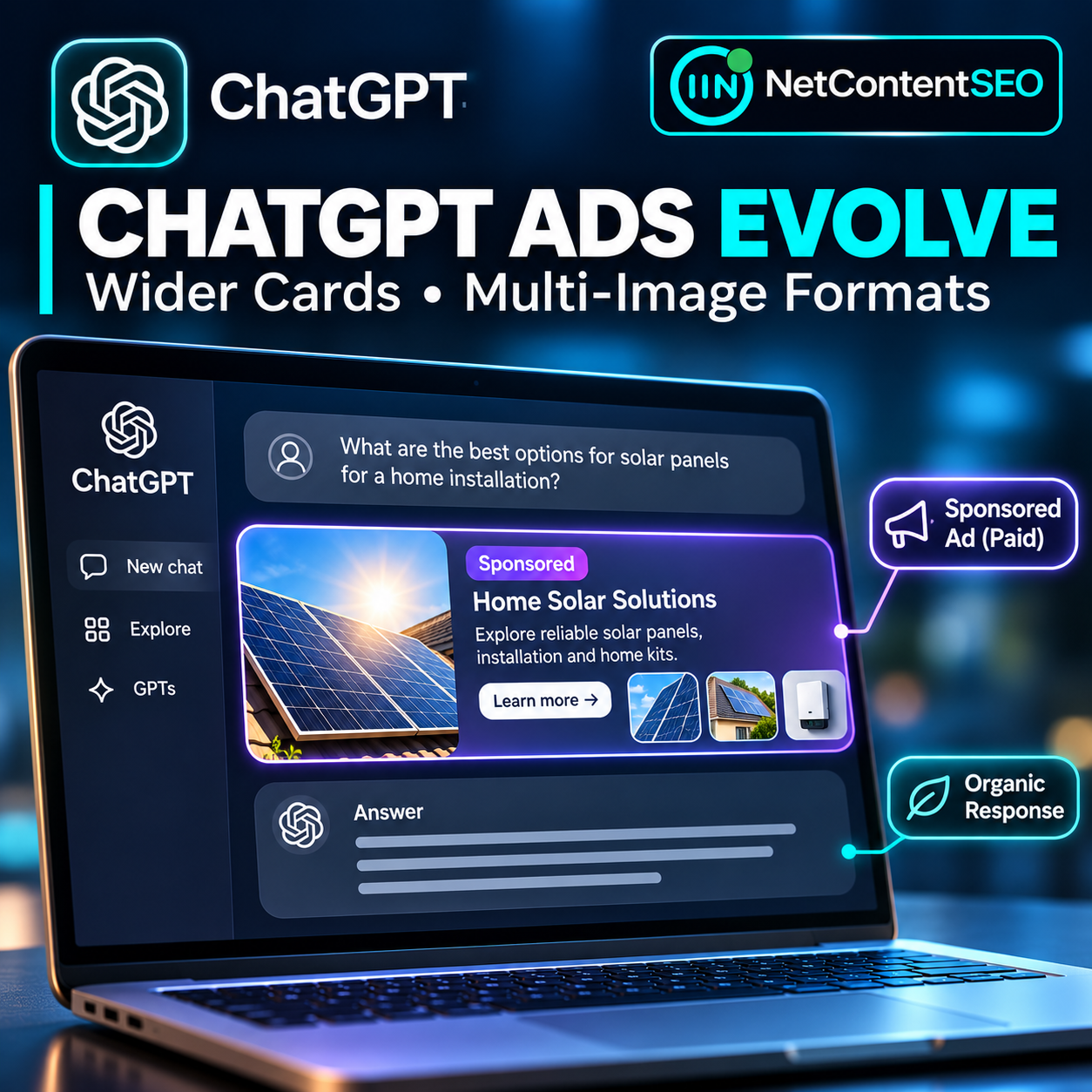

ChatGPT advertising is expanding beyond the familiar single-image sponsored card. An October 30, 2026 report from Search Engine Roundtable describes a wider standard ad unit and broader access to multi-image creative. OpenAI's own advertiser documentation confirms that multi-image ads entered open beta on October 26, while its October 5 product announcement describes a separate visual-ad test during image generation. Together, these developments show how conversational AI advertising is evolving—but they should not be confused with a change to organic answers or evidence of advertising performance gains.
What changed in ChatGPT Ads?
Search Engine Roundtable reported on October 30 that OpenAI's advertiser update introduced a wider standard advertising card on desktop, designed to use more of the conversation width. According to the report, existing campaigns and creative can be used without requiring advertisers to take action. This specific wider-card detail is based on the industry publication's account of advertiser communications; it should not be presented as a separately verified public product announcement.
A second development has clearer public documentation. OpenAI's help article on creating ChatGPT ads says the multi-image ad format entered open beta on October 26, 2026. Advertisers can select a single image or multiple images in Ads Manager for standard campaigns with Reach, Clicks or Conversions objectives. OpenAI recommends four to six square images, each with a 1:1 aspect ratio, for multi-image ads. This is a documented product capability, not merely a rumored interface experiment.
Two visual advertising experiences, not one
The multi-image option for standard ad campaigns should be distinguished from the visual format that OpenAI announced on October 5. That announcement described an initial test of visual ads shown during image generation for eligible Free and Go users, beginning in the United States with a limited advertiser group. OpenAI stated that these ads would be clearly labeled and remain separate from the generated image.
OpenAI's general advertising guidance also describes an ad unit below a ChatGPT response that may contain one or multiple images. The existence of different placements and creative formats matters: an ad displayed beneath a text answer is not the same experience as an ad presented while an image is being generated. Neither should be represented as content organically produced by the assistant.
Why larger cards and multiple images matter
Traditional search advertising has largely been organized around short queries, text listings and clearly defined results pages. Conversational interfaces offer a different environment. Users may describe a problem, compare alternatives and refine preferences over multiple turns. A larger card or several images can give an advertiser more room to explain a product or service within that context.
That potential should not be mistaken for a measured outcome. The cited announcements do not establish that wider cards improve click-through rates, that multi-image ads generate more sales, or that the formats outperform conventional search ads. Those questions require controlled testing and performance data.
For advertisers, the practical implication is creative planning. OpenAI's published guidance emphasizes distinct, useful imagery and specific benefit-focused copy. For multi-image ads, it recommends four to six square images, and notes that the images share the same destination URL. Brands should therefore avoid treating a multi-image unit as several unrelated advertisements: the visuals should work together to explain one coherent offering.
Sponsored placements and organic answers must remain distinct
The most important editorial distinction is between paid visibility and the answer produced by ChatGPT. OpenAI says advertisements are clearly labeled and displayed separately from responses. It also states that advertising selection operates separately from answer generation and does not influence the assistant's answers. The company's October 21 technical explanation describes a dedicated advertising system that retrieves, ranks and selects ads independently of the service generating the conversational answer.
This separation is fundamental for users and publishers. A sponsored card is a paid placement. A citation or source reference in an answer is a different kind of visibility. Neither an ad impression nor an ad click proves that a brand has become more prominent in organic AI responses. Conversely, a brand appearing in an AI answer does not imply it paid for placement.
As the interface becomes more visual, disclosure and presentation become even more important. A larger image may attract attention, but it should not blur the distinction between advertising and editorial or informational output. This is an issue of user comprehension and trust, not simply design.
What changes for SEO and AI visibility?
For SEO professionals, the development adds a paid distribution layer to an already changing discovery environment. Brands can now think about at least three separate questions: whether their information is discoverable and usable as a source, whether their brand is mentioned in an answer, and whether a paid placement is displayed in a relevant conversational context.
These mechanisms should not be collapsed into a single 'AI visibility' metric. Organic answer visibility depends on the system's information retrieval and generation behavior. Sponsored exposure depends on the advertising system, campaign eligibility and ad selection. Their business outcomes may overlap, but they require separate measurement.
For publishers, this raises a longer-term economic question. AI interfaces are developing their own advertising inventory even as publishers evaluate changes in referral traffic from AI-assisted discovery. The existence of more ad formats does not establish how revenue will be shared, whether publishers will receive additional traffic, or how overall search economics will change. Those remain open questions.
Measurement is expanding alongside creative formats
OpenAI's October 5 announcement did not focus only on visual advertising. It also described expanded conversion and attribution integrations, including partners that help advertisers connect campaign exposure with downstream business outcomes. Its advertiser guidance now covers Reach, Clicks and Conversions campaign objectives.
That combination is significant: new creative formats become more useful when advertisers can evaluate their results. Yet the availability of attribution tools is not evidence that the newly introduced formats already perform better. Advertisers should distinguish impressions, clicks, conversions and incremental business impact, and should avoid drawing causal conclusions from unadjusted before-and-after comparisons.
What is confirmed, and what remains uncertain?
Confirmed by OpenAI documentation: multi-image standard ads entered open beta on October 26; advertisers can select single- or multi-image formats; OpenAI announced visual-ad testing during image generation; sponsored units are labeled and separate from ChatGPT answers.
Reported by Search Engine Roundtable: a wider standard ad card is rolling out on desktop, using more of the conversation width and existing campaign assets. This detail is attributed to the publication's report of an advertiser communication.
Not established by these sources: universal availability of every format, measured increases in advertising effectiveness, changes to organic answer ranking, or guaranteed commercial benefits for publishers and advertisers.
Conclusion: AI advertising is becoming more visual, but the distinction still matters
The latest ChatGPT advertising developments point toward richer creative units, more flexible formats and a growing measurement infrastructure. Some changes are documented in OpenAI's public advertiser guidance; others, including the wider desktop card, are reported through industry coverage of advertiser updates.
The central issue for the AI Search ecosystem is not simply whether advertisements become bigger or more visual. It is whether paid exposure remains understandable as paid exposure, separate from the informational answer, and whether advertisers can measure outcomes without confusing them with organic AI visibility. That distinction will be essential as conversational interfaces develop more mature commercial models.
Sources
OpenAI Help Center: Creating Ads for ChatGPT Ads.
OpenAI: Building Advertising for the Way People Use AI (October 5, 2026).
OpenAI: How We Built ChatGPT's Novel Ad Stack for User Trust and Relevance (October 21, 2026).