

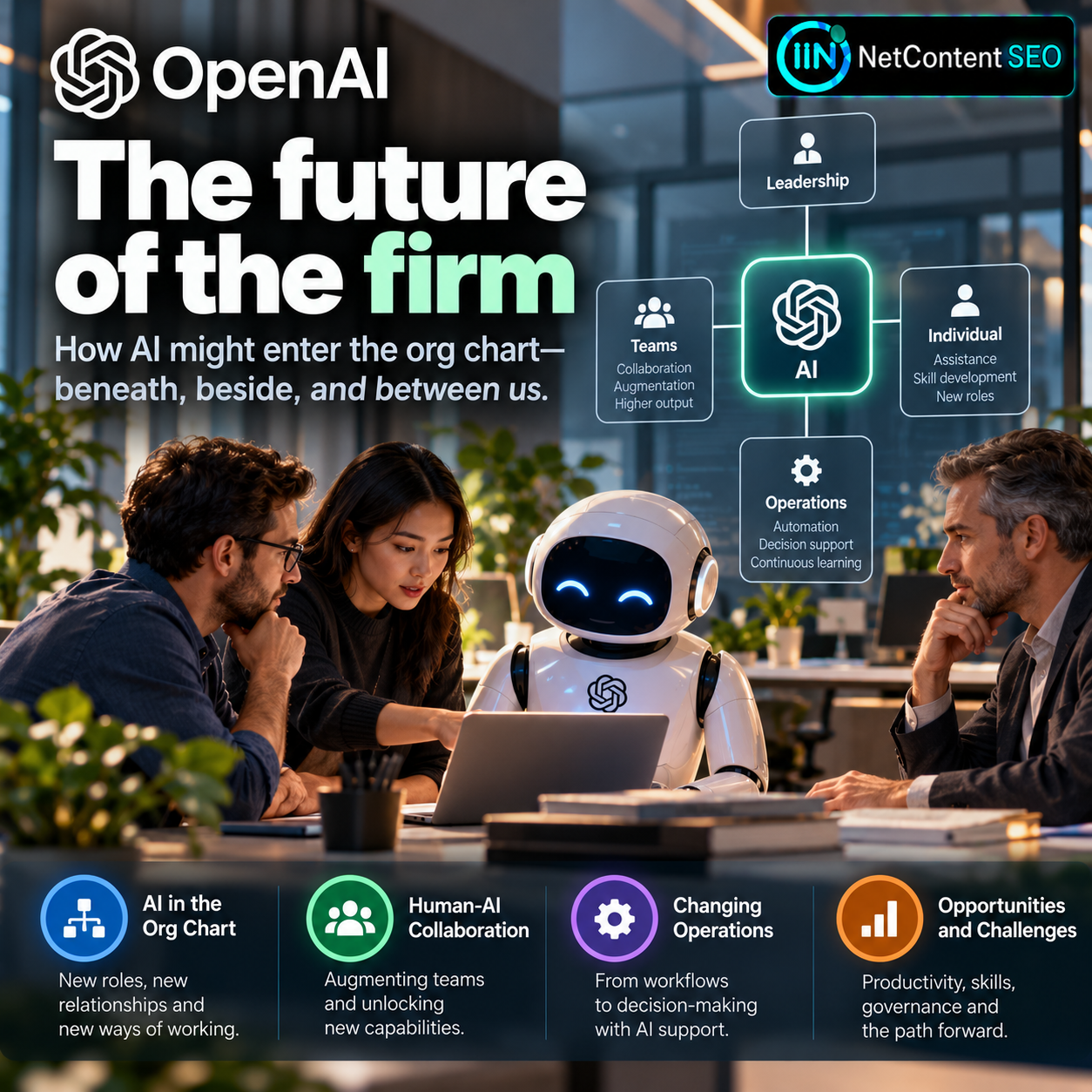

AI may change the structure of companies as much as it changes the tasks employees perform. In “The future of the firm,” an essay hosted on OpenAI's website, Hemanth Asirvatham and Elliott Mokski explore three ways increasingly capable AI could enter organizational charts: beneath employees, beside employees and between layers of human management.
The authors are explicit about the status of their argument. The essay is part of a series featuring independent perspectives on a future shaped by advanced AI, and it reflects their own views—not an official OpenAI corporate policy or forecast. Their scenarios are thought experiments about organizational change, not evidence that every company is about to adopt an AI manager.
For digital businesses, agencies and SEO teams, the analysis is useful because it shifts the question from “Which tasks can AI automate?” to “How will teams allocate authority, responsibility and expertise when AI can coordinate substantial work?”
Three models for the AI-powered company
The essay proposes three organizational patterns. In the first, employees direct AI agents that handle much of the work they once performed themselves. In the second, managers delegate whole responsibilities to AI systems operating alongside human teams. In the third, AI provides a coordinating or advisory layer between executives and the rest of the organization.
The authors do not expect any one model to appear in pure form. They suggest that elements of all three may coexist as AI capabilities improve and organizations experiment with adoption.
1. Beneath us: Employees become managers of AI agents
In the first scenario, which the authors call “The Promoting,” the visible human reporting structure stays largely intact. The change happens below individual contributors: employees gain access to AI agents that draft, analyze, organize and execute tasks under their direction.
A worker who once assembled spreadsheets manually might instead oversee agents performing the preparation and reconciliation, concentrating on interpretation, coordination and judgment. As agents become more capable, an employee could direct multiple specialized systems, effectively supervising a miniature operation.
The authors argue that this pathway could allow organizations to adopt AI incrementally because the employees closest to a task often know how to evaluate its output. However, they also acknowledge that automation does not guarantee employment stability. If demand for additional output does not grow, firms might reduce headcount or working hours rather than continually expanding responsibilities.
What happens to entry-level work?
One of the sharpest questions concerns apprenticeships. Junior staff have traditionally learned through routine work: research, documentation, reporting and repeated execution. If AI performs that work, companies need new ways to teach practical judgment and domain expertise.
The authors see an opportunity for newer workers to take on larger responsibilities earlier. That possibility comes with a challenge: organizations must ensure employees learn to assess work they have not personally practiced extensively.
2. Beside us: AI becomes a colleague or team
The second scenario, “The Interleaving,” places AI systems alongside human employees within existing reporting structures. Instead of giving every worker an assistant, a manager might assign a whole function or project to a coordinated AI team.
The essay illustrates this with a furniture-company executive who asks an AI marketing team to plan a campaign. Agents coordinate research, design and other tasks, escalating decisions that require executive judgment or human input.
The distinction is scope. A narrow tool needs people to adapt their workflows around it. A capable AI team might be able to understand a business objective, gather context and deliver a coordinated result with less hands-on configuration. The authors argue that systems able to perform broader functions could, paradoxically, be easier for executives to adopt than tools that automate only isolated tasks.
This remains a proposed trajectory, not proof that AI can already replace entire professional departments reliably. Complex functions involve tacit knowledge, legal obligations, physical-world constraints and collaboration that remain difficult to automate end to end.
3. Between us: AI as an advisory or management layer
The third scenario, “The Layering,” is the most organizationally provocative. AI sits between senior leaders and operational teams, interpreting information, detecting problems and suggesting actions. In a more extreme version, people might receive work coordinated by an AI system.
The authors describe a more immediate possibility: an always-available AI consultancy that can read organizational documents and communications, identify inconsistencies and surface work that leadership might otherwise miss.
For example, an AI system could flag that a launch promise conflicts with engineering plans, then propose a response. A human executive would still decide whether to act. This arrangement could shorten information pathways between leadership and teams, but it could also concentrate authority at the top.
Productivity insights or workplace surveillance?
An AI system with broad access to company communications could recognize contributions that conventional productivity dashboards miss. Yet the same access raises substantial privacy, security and labor-governance questions.
Organizations would need clear rules about what information an AI may access, how workers are informed, how errors are challenged, and who is accountable when an automated assessment influences employment or performance decisions. Better analytical capability does not eliminate the need for due process or proportional data use.
Why AI adoption may depend on organizational design
The central insight of the essay is that AI adoption is not simply a software-purchasing decision. Companies must decide which tasks can be delegated, which outputs require review and which responsibilities should remain with accountable people.
That is especially important as agents move from generating text to taking actions in business systems. An agent that drafts a proposed change creates a different risk profile from one that publishes content, changes a production website, allocates a budget or modifies customer records.
As AI becomes more capable, companies may need to rethink approval paths, escalation rules, access controls and evaluation practices. The most productive structure may combine automation with explicit human oversight rather than simply inserting AI into every existing workflow.
What this could mean for SEO agencies
SEO teams offer a practical example because their work combines repeatable operations with strategic interpretation. Keyword clustering, internal-link audits, structured-data checks, content briefs and reporting can often be partially automated. Yet deciding which findings matter requires understanding business goals, search intent, technical constraints and the reliability of underlying data.
Under the beneath-us model, an SEO specialist could direct agents that crawl websites, compile issues and draft recommendations, while retaining responsibility for prioritization and quality control.
Under the beside-us model, a marketing director might delegate a defined research or monitoring workstream to an AI team operating alongside human SEO, content and development specialists.
Under the between-us model, an AI coordination layer could review SEO dashboards, content production schedules and development tickets to flag discrepancies or missed dependencies to leadership.
These are applications of the essay's framework to SEO operations, not examples reported as existing deployments in the source article.
And what about AI Search?
The essay is about firms and labor organization, not a new search algorithm, AI citation mechanism or Google ranking factor. Its relevance to AI Search is indirect but meaningful: as search workflows incorporate AI-generated answers, research agents and automated publishing tools, teams need stronger processes for checking sources, evaluating claims and measuring outcomes.
AI can accelerate the creation of search content and analysis. It can also scale mistakes if poorly sourced claims, fabricated citations or incorrect technical recommendations move automatically from one system to another. Clear ownership of editorial judgment and publication approval becomes more important, not less.
Businesses should distinguish between automation of SEO operations and visibility within AI-powered search experiences. The first concerns how a team works; the second concerns how users discover and evaluate information. Improving one does not automatically guarantee the other.
Five governance questions before expanding AI agents
Before granting agents broader operational authority, companies should establish which systems and data they can access; which actions they can take without approval; how results and failures will be logged; how humans can override or correct decisions; and how employee skills will develop as routine tasks are automated.
These safeguards are particularly important when systems touch personal data, customer relationships, production websites or financially significant decisions. A useful organizational model must make accountability understandable even when several agents contribute to a single outcome.
The employment question remains open
The essay deliberately considers a transitional economy in which humans and AI remain complementary. It does not prove that AI adoption will preserve jobs, raise wages or eliminate middle management. Actual outcomes will depend on technology capabilities, demand, competition, business choices and labor institutions.
Companies may use AI to expand output, reduce costs, change hiring patterns or create new services. Those possibilities can coexist, and the balance may differ across industries and organizations.
NetContentSEO assessment
The most useful takeaway is that AI agents could change who coordinates work—not merely how quickly individual tasks get done. The distinction between AI beneath, beside and between people gives leaders a practical vocabulary for evaluating automation plans.
For SEO agencies and digital publishers, a sensible starting point is to delegate bounded, auditable work while keeping editorial standards, technical approvals and strategic accountability clearly assigned. As agent capabilities increase, organizations can revisit the structure rather than assume the traditional org chart will remain untouched.
Above all, readers should treat “The future of the firm” as a thoughtful set of scenarios from its named authors, not as an official OpenAI prediction about employment or an announcement of new enterprise features.
Primary source: Hemanth Asirvatham and Elliott Mokski, “The future of the firm,” hosted by OpenAI.