

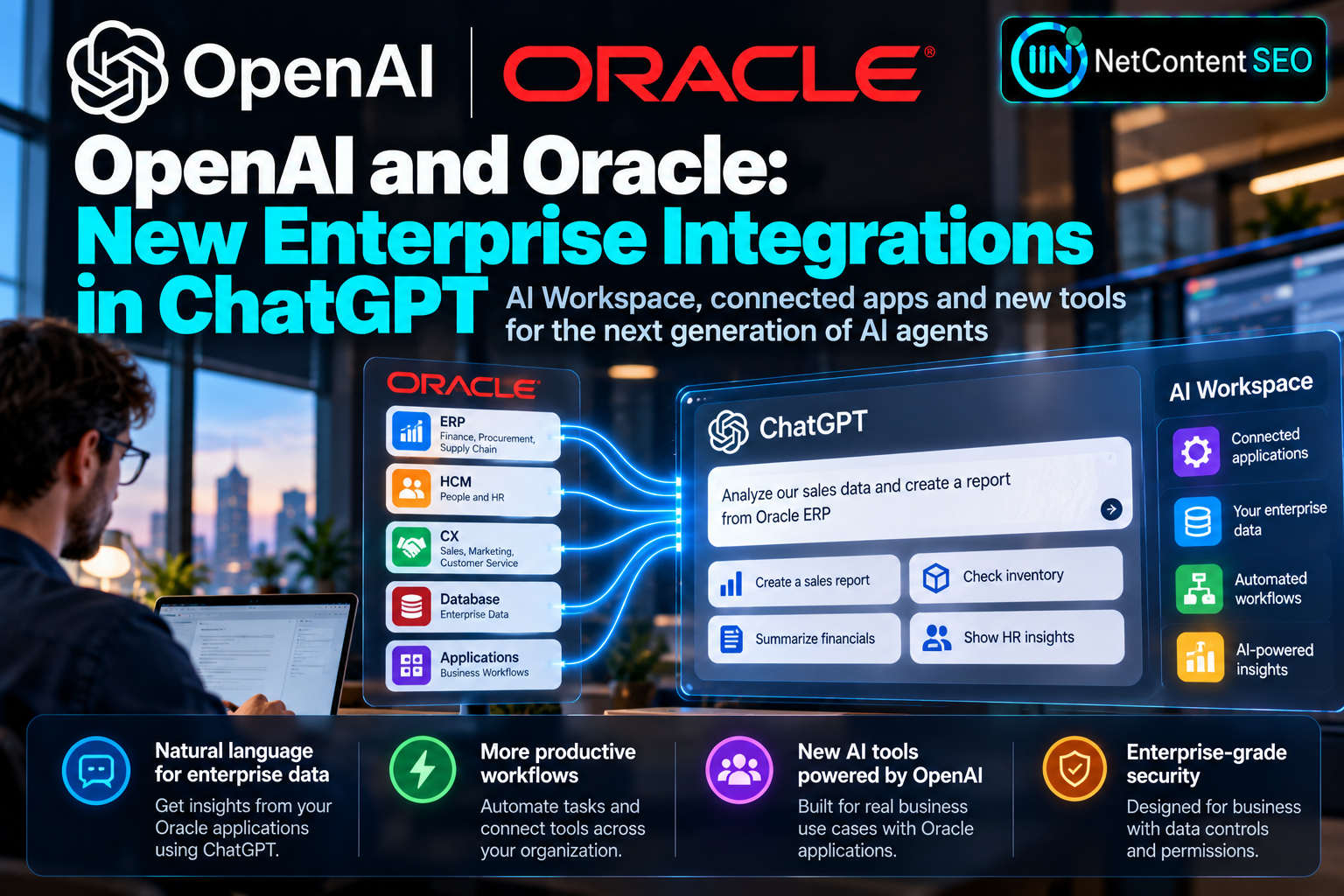

OpenAI and Oracle announced an expanded partnership on October 27, 2026, focused on bringing Oracle business applications, enterprise data and approved workflows into ChatGPT. The announcement marks another step toward AI agents that can work with real business systems rather than simply generate text. Oracle is developing AI Workspace, while the companies are also collaborating on security, application development and tools for smaller businesses.
For the AI industry, the implications are substantial: connecting conversational interfaces to enterprise software could make it easier for employees to access information and complete routine tasks. For SEO and AI Search professionals, however, one distinction is essential. This is not a ChatGPT Search ranking update or a change to its web citation system.
Oracle AI Workspace: connecting ChatGPT to business systems
According to the official OpenAI announcement, Oracle is developing Oracle AI Workspace to connect business applications, information and workflows to ChatGPT. The intended experience allows employees to use natural language to find relevant company data and work across authorized systems.
Consider a finance employee preparing for a monthly close. Information may be distributed across procurement, finance and planning applications. Instead of switching repeatedly between different interfaces, an AI workspace could help bring together relevant records and support the next approved steps. That is the direction described in the announcement, not a claim that every Oracle workflow is already generally available.
Enterprise permissions and approval requirements are central to this model. An assistant that can act on business data must respect who is authorized to see records and which actions require human oversight.
Why the partnership matters for AI agents
Traditional chatbots primarily answer questions. Connected AI agents aim to go further: retrieve information from authorized applications, interpret it in context and help users perform work. The distinction becomes important when an employee needs to investigate an invoice, prepare a report, build an internal tool or coordinate a process spanning multiple departments.
That transition creates new responsibilities. Organizations need reliable identity management, controlled access, audit trails, human approvals and clear handling of errors. A natural-language interface can simplify the experience, but it does not eliminate the need for strong governance.
New Oracle offerings built with OpenAI models
The partnership also includes several announced Oracle products and initiatives. Oracle AI Security Mesh is intended to help organizations identify and address vulnerabilities in applications and infrastructure using OpenAI cybersecurity models. Security teams will still need to validate findings and define the authorized scope of testing.
Oracle AI SMB Bundle brings together ChatGPT Business, Codex, Oracle applications and recurring Oracle Cloud Infrastructure credits. The bundle is positioned for smaller organizations seeking to combine AI-assisted development and everyday business operations.
Oracle App Composer is designed to help teams build applications with Codex and other AI tools, connect those applications to approved Oracle data and workflows, and deploy them using Oracle Cloud Infrastructure. The value proposition is faster development of internal tools, although real-world results will depend on product maturity, security controls and organizational needs.
OpenAI products through Oracle Marketplace
OpenAI also said that eligible United States customers will be able to purchase access to the OpenAI API, Codex and ChatGPT Work through Oracle Marketplace using established procurement arrangements and qualifying Oracle Universal Credits.
This matters because software purchasing and vendor approval can slow enterprise adoption. A familiar marketplace may simplify the commercial process for qualifying Oracle customers. The announcement should not be interpreted as confirming identical availability, pricing or terms in every country.
Oracle's existing adoption of ChatGPT and Codex
The companies pointed to Oracle's own use of OpenAI tools. OpenAI reported approximately 130,000 active ChatGPT users and more than 95,000 active Codex users at Oracle. These are reported internal usage figures, not counts of companies already using Oracle AI Workspace.
An earlier OpenAI case study about Oracle described practical applications, including research workflows and AI-assisted development. Such examples help explain why Oracle is investing in deeper integration, but they are company-reported experiences rather than independent benchmarks of the newly announced products.
What changes for SEO and AI Search?
The immediate impact is on enterprise AI infrastructure, not public search rankings. OpenAI and Oracle are working toward a future in which conversational interfaces serve as access points to company applications and structured data. That direction reinforces the importance of accurate underlying records, clear data ownership, permissions and verifiable sources.
There is a conceptual connection with AI Search: both enterprise assistants and search experiences need relevant information and trustworthy answers. But the mechanisms are different. A connected Oracle business application does not imply that Google will rank websites differently, that ChatGPT Search has changed how it discovers public pages or that OpenAI has revised its external citation rules.
The October 27 announcement contains no confirmed changes to ChatGPT Search citations, indexing or public-web visibility. Describing it as an SEO algorithm update would misrepresent the news.
Questions businesses should ask before adopting connected AI
Before deploying an enterprise AI workspace, businesses should identify which data sources the assistant can access, how existing user permissions are enforced, which actions require approval and how activity is logged. They should also establish procedures for verifying important answers and correcting errors.
Those questions are especially important when agents can act on records rather than merely summarize them. A system that generates an inaccurate answer is problematic; a system that executes an unauthorized action can have much greater consequences.
NetContentSEO assessment
The OpenAI–Oracle partnership illustrates the shift from conversational AI toward operational AI agents. Oracle AI Workspace is being developed to connect enterprise applications and workflows to ChatGPT, supported by additional offerings for security, application creation and business adoption.
The announcement is strategically important, but its planned capabilities should not be confused with proven general availability. Organizations will need to assess each released product's actual permissions, reliability and workflow behavior.
For SEO and AI Search professionals, the takeaway is the growing role of AI as an interface to information and action—not a newly announced change to search rankings or citations.
Primary source: OpenAI, October 27, 2026 announcement on Oracle applications in ChatGPT. Additional context: OpenAI's Oracle customer story.