

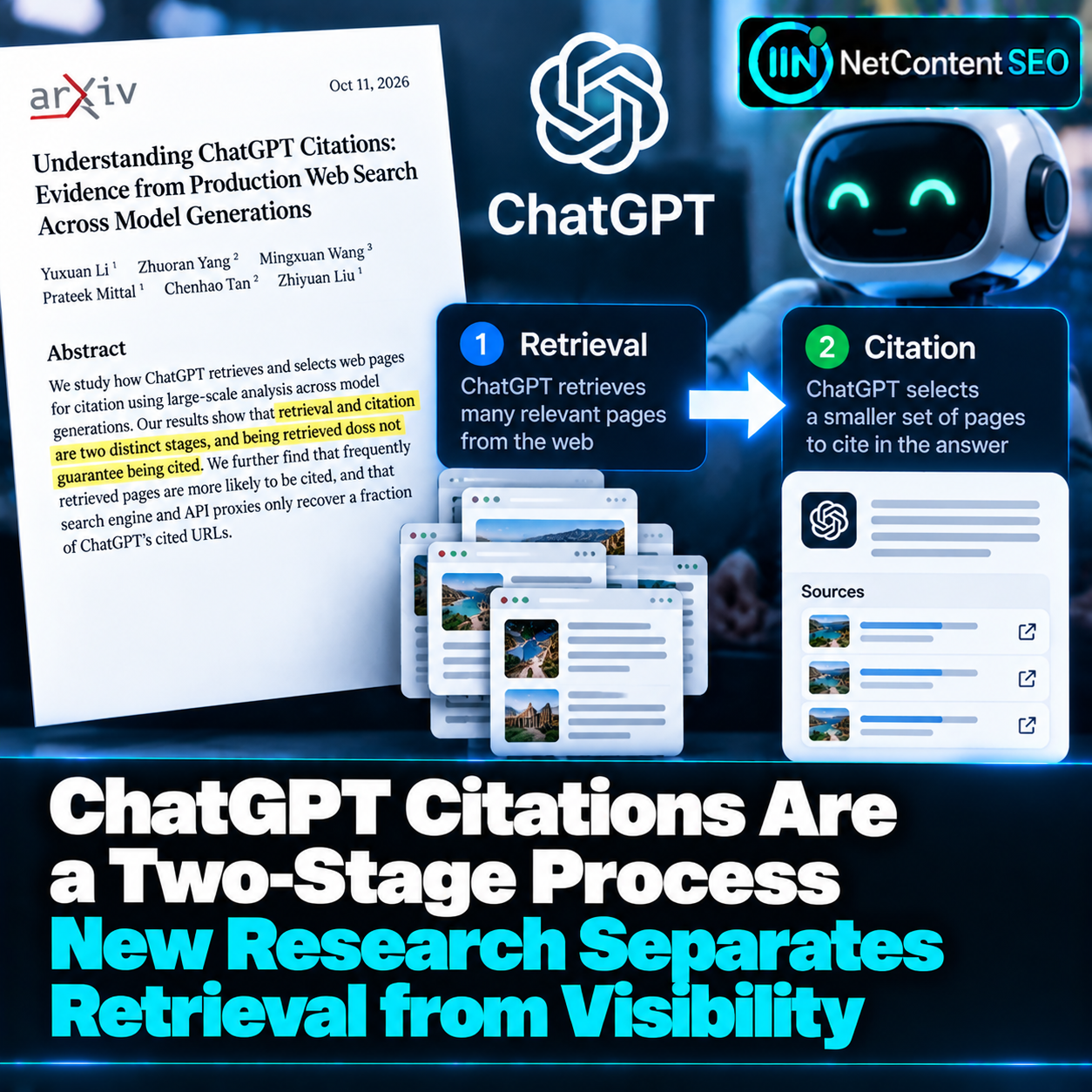

A new arXiv study published on October 11, 2026 examines how ChatGPT retrieves web pages and selects sources to cite in its answers. Its central finding is important for AI visibility measurement: retrieval and citation are two distinct stages. A page can be retrieved during search without ultimately appearing as a citation in the generated answer.
The paper, available on arXiv, analyzes evidence from production web search across ChatGPT model generations. The findings are observational and should be treated as preliminary rather than as a universally applicable description of every AI search system.
Retrieval does not guarantee a citation
When ChatGPT searches the web, it may retrieve a set of potentially relevant pages. The answer-generation process then determines which sources are cited in the final response. The study emphasizes that these are separate steps, so appearing in the retrieval set is not equivalent to being visible to the user as a cited source.
This distinction matters for publishers and SEO teams. A page may be discoverable by the retrieval system but not selected for attribution in the answer. Conversely, measuring only final citations provides no complete picture of all the pages considered along the way.
Repeated retrieval is associated with citation
The study reports that pages retrieved more frequently are more likely to be cited. This suggests that retrieval frequency and final citation visibility are related, but not interchangeable. The finding does not establish that increasing retrieval frequency alone will guarantee a citation, nor does it provide a universal optimization formula for publishers.
For practical AI visibility work, the implication is to distinguish signals that measure whether a source can be retrieved from those that measure whether it appears in the answer. Combining these into one score can obscure where a page is succeeding or failing.
Search proxies capture only part of ChatGPT Web citations
One reported result is that Google Search and OpenAI's Responses API, even when used together as proxies, recover only around one quarter of the URLs cited by ChatGPT Web in the study. This is a warning against treating conventional search results or a separate API as a complete substitute for observing ChatGPT's own web-search behavior.
The result is tied to the study's methods, sample and tested configurations. It should not be generalized to every query, current product configuration or other AI assistant without further evidence.
What this means for GEO and AI visibility measurement
Generative Engine Optimization (GEO) reporting often focuses on whether a brand or URL appears in an AI answer. The study points to a more granular measurement model: retrieval, selection for citation and final presentation should be tracked as separate outcomes wherever the data makes that possible.
For example, a monitoring system might record whether a page is retrieved in a test, whether it is cited in the response, how the citation is presented and whether the answer links to the intended destination. These measures describe different stages and should not be treated as interchangeable indicators of visibility.
There are important limits. Access to internal retrieval candidates may not be available in ordinary product interfaces, and results from one set of model versions or queries may not represent another. Where retrieval data is unavailable, teams should state that limitation instead of inferring retrieval from a citation or from rankings in another search engine.
Research limitations
The paper is a preprint on arXiv and has not necessarily undergone peer review. Its reported observations relate to specific ChatGPT 5.2–5.5 configurations and the study's own data and methodology. Model behavior, web-search integrations and citation policies can change over time.
These findings therefore support a useful distinction between retrieval and citation, but they do not establish a universal ranking system for AI answers or prove that the same rates apply to all models.
NetContentSEO assessment
The study reinforces a core principle for AI Search analysis: being available to a retrieval system and being cited in its answer are different achievements. Publishers should avoid using search rankings or third-party API results as complete proxies for ChatGPT citations. A stronger measurement framework separates discoverability, citation frequency and downstream referral outcomes—and makes clear which stages can actually be observed.
Primary source: arXiv — research on ChatGPT retrieval and citation behavior.