

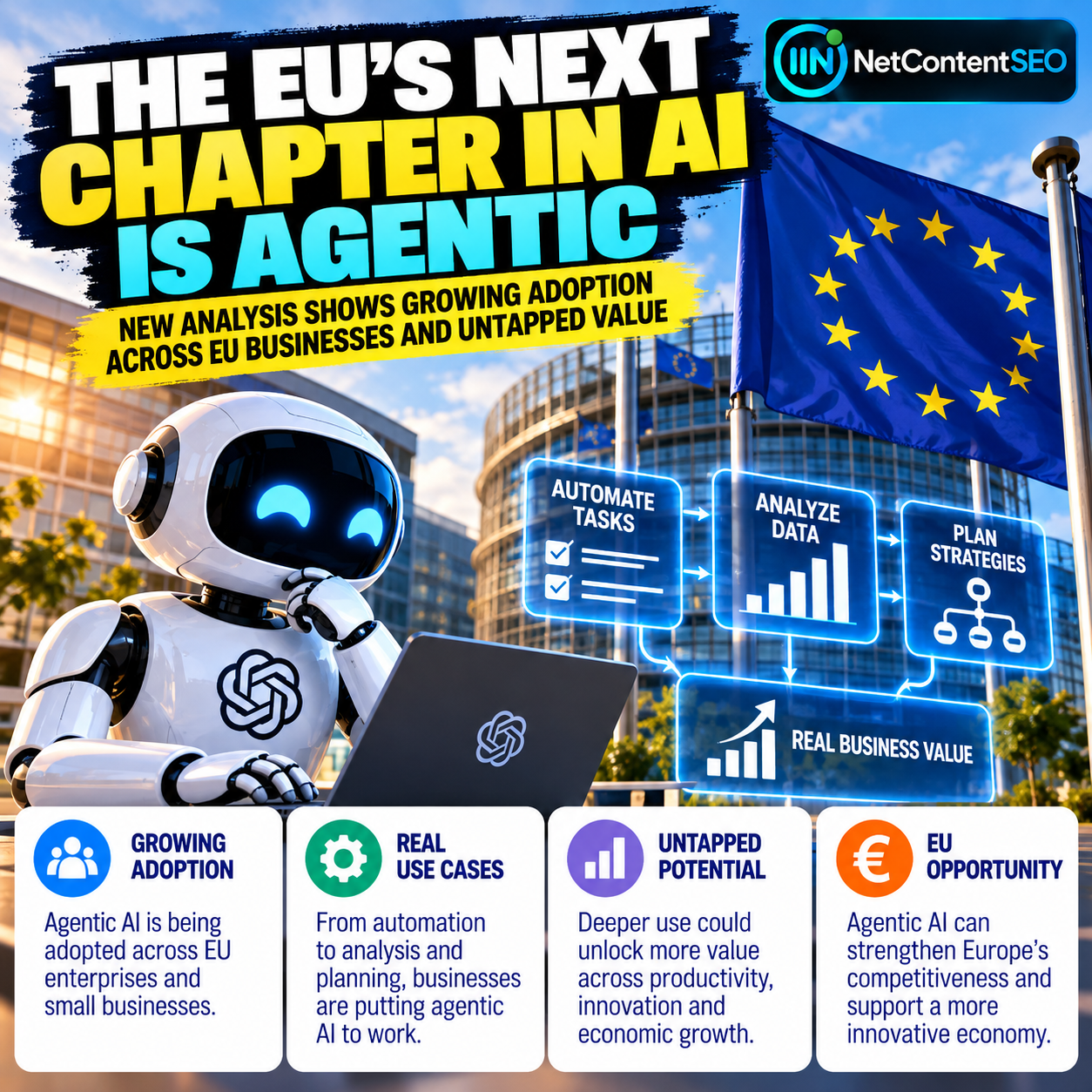

Agentic AI is gaining ground across European businesses, but the next opportunity may lie in moving beyond experimentation toward deeper, more systematic use. In a new analysis, OpenAI examines adoption across enterprises and small businesses in the European Union and considers where broader use of AI agents could unlock additional value.
The central distinction is between using AI to assist with individual tasks and putting agentic systems to work across more connected workflows. As adoption grows, the question for organisations is how to translate early use into practical improvements in productivity, operations and the way teams deliver work.
What agentic AI means for businesses
Agentic AI refers to AI systems that can help carry out multi-step tasks toward a goal, rather than responding only to a single prompt. Depending on the system and the permissions provided, an agentic workflow may plan steps, use available tools, work with information and support a process through to a result, with human oversight where needed.
For businesses, the potential value is not simply generating an answer more quickly. It is connecting assistance across parts of a workflow so that teams can reduce repetitive work, coordinate tasks and focus more time on decisions that require human judgement.
Adoption is growing across EU enterprises and small businesses
OpenAI's analysis looks at agentic AI adoption across both larger enterprises and small businesses in the European Union. This matters because AI adoption is not limited to organisations with extensive technical teams: smaller companies may also find useful applications when tools can be introduced into existing work without building every component from scratch.
The opportunity and the implementation challenges can differ by organisation size, industry, available skills and the processes being automated. A large enterprise may focus on integrating AI into established systems and governance, while a small business may start with a narrower workflow where time savings are easy to evaluate.
Where deeper use could unlock more value
The analysis points to an important next step: moving from initial adoption toward deeper use. Simply making an AI tool available does not guarantee that it will change how work gets done. Value depends on whether teams identify suitable tasks, integrate tools into real workflows and assess the results.
- Workflow integration: connect AI assistance to recurring processes rather than treating every task as an isolated interaction.
- Clear business goals: define the outcome a workflow should improve, such as time to completion, service quality or the amount of manual coordination required.
- Human oversight: establish when an agent can proceed independently and when a person must review, approve or intervene.
- Skills and adoption: help employees understand how to use the systems, check their work and identify tasks where AI is appropriate.
- Measurement: evaluate results against a baseline instead of assuming that more AI usage automatically creates more value.
What EU organisations should consider before scaling
Organisations considering wider agentic AI use should start with workflows that have clear objectives and manageable risks. They should also consider data access, privacy, security, permissions, reliability and accountability before allowing systems to take actions across business tools.
A practical rollout can begin with a limited pilot, documented success criteria and a review process. Teams can then expand to more complex tasks when the system performs reliably and the organisation understands the operational implications. The appropriate level of autonomy will depend on the consequences of an error and the sensitivity of the information involved.
Why small businesses matter in the next phase
Small businesses can benefit when agentic tools reduce the overhead involved in research, administration, customer communication and other repeatable work. However, the best use cases will vary, and a business should not automate a process simply because automation is possible. The workflow still needs to be well understood, and the results need to be checked.
For smaller teams with limited time and technical resources, the most useful starting point may be one contained process where improvements can be measured. Lessons from that pilot can help determine whether the workflow should be expanded or redesigned.
What the analysis does—and does not—tell us
OpenAI's publication provides analysis of agentic AI adoption across EU enterprises and small businesses and discusses where deeper use could unlock more value. The headline alone does not establish that every sector or company has adopted agents at the same rate, nor does it mean that all organisations are ready to deploy autonomous systems across their operations.
Adoption figures and broader conclusions should be interpreted within the methodology and definitions described in the original analysis. Businesses should avoid treating overall trends as a guarantee of specific productivity gains for their own teams.
The takeaway
The next chapter of AI in Europe is not only about adoption; it is about turning agentic AI into useful, measurable workflows. OpenAI's analysis examines how use is growing across EU enterprises and small businesses and where deeper integration may create more value. For organisations, the practical path is to choose clear use cases, set appropriate safeguards, support employees and measure real outcomes before expanding the role of AI agents.