

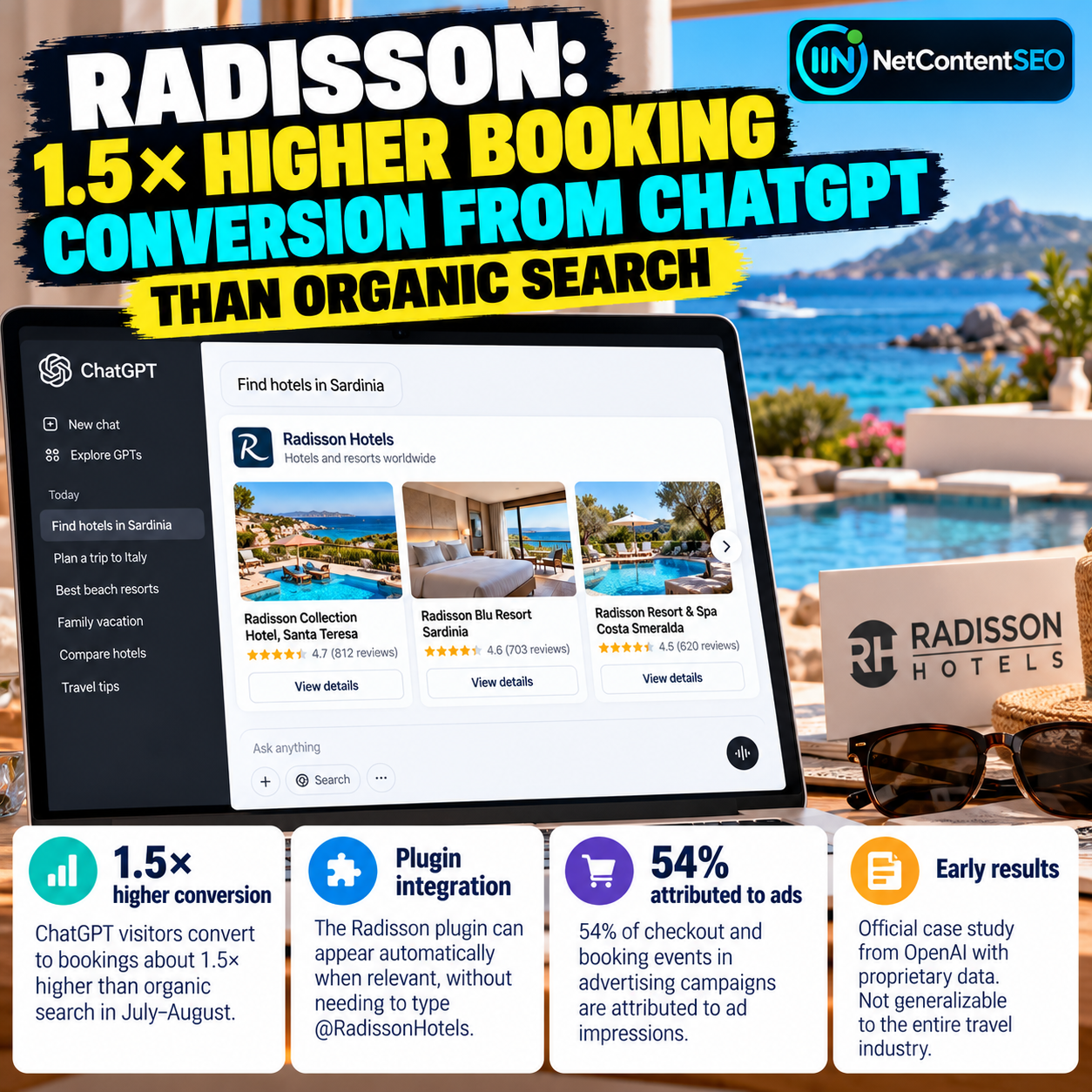

Radisson Hotel Group says visitors arriving through ChatGPT converted into bookings at around 1.5 times the rate of visitors from organic search during July and August 2026. The early result comes from OpenAI's published Radisson case study and is based on the company's own data. It offers a useful signal about hotel discovery through conversational AI, but it should not be treated as a benchmark for the wider travel industry.
OpenAI also reports that the Radisson Hotels app or plugin can surface automatically when relevant, without users explicitly typing @RadissonHotels. Separately, 54% of checkout and booking events recorded in Radisson's advertising campaigns were attributed to ad views. That figure concerns advertising attribution and should not be confused with the 1.5× visit-to-booking conversion comparison.
What Radisson reported
- 1.5× booking conversion: visitors from ChatGPT converted to bookings at approximately one and a half times the rate of visitors from organic search during July–August 2026.
- Automatic surfacing: the Radisson experience can appear when relevant, without requiring the user to type
@RadissonHotels. - 54% attributed to ad views: OpenAI says 54% of checkout and booking events recorded in Radisson's advertising campaigns were attributed to ad views.
These are results from an official case study using proprietary campaign and product data. They are not an independently audited industry-wide comparison.
Why the 1.5× conversion figure matters
Travel planning often involves comparing destinations, accommodation options, facilities, prices and dates. A conversational interface can help users narrow those choices before they visit a hotel website or booking flow. If visitors arriving through ChatGPT have already developed stronger intent, that could help explain a higher conversion rate in a particular case.
However, the published comparison alone does not establish why the difference occurred. Audience composition, campaign exposure, user intent, attribution windows and the definition of a qualifying visit can all influence conversion metrics. The reported ratio should therefore be read as a result from this Radisson period, not proof that ChatGPT traffic always converts better than organic search.
The plugin can appear without an explicit mention
OpenAI says the Radisson Hotels experience may surface automatically when relevant, rather than requiring users to type @RadissonHotels. This matters because discovery can happen through the assistant's interpretation of a user's request, rather than only through a deliberate search for a named app.
For hotel brands, the case raises practical questions about how their inventory, services and booking paths are represented inside AI experiences. It does not mean every hotel will be surfaced automatically, nor does it establish that the same behaviour is available for every brand or market.
How to interpret the 54% advertising-attribution figure
The case study says 54% of checkout and booking events recorded in Radisson's advertising campaigns were attributed to ad views. This is an advertising-attribution statistic, not a claim that 54% of all Radisson bookings came from ChatGPT or that 54% of ChatGPT visitors booked a room.
View-through attribution can assign credit to an ad impression even when a user does not click the ad. To interpret the number correctly, analysts need to understand the attribution model, measurement window, campaign scope and the events included. The public case-study summary does not provide enough information to independently reconstruct the calculation.
What travel marketers and SEO teams should do
- Measure AI-referred sessions separately. Track visits and bookings from ChatGPT and other AI sources where analytics and consent settings permit.
- Compare like with like. Document the conversion definition, dates, markets, devices and attribution windows before comparing AI referrals with organic search.
- Make booking information clear. Keep room types, amenities, policies, location details and booking paths accurate and easy to understand on owned properties.
- Monitor app and plugin discovery. Check how brand experiences appear in supported AI interfaces and whether users can complete the intended journey.
- Avoid universal claims. Treat Radisson's figures as a case study to investigate, not as a forecast for every hotel or travel business.
What remains unknown
The case study provides an initial result, but the figures alone do not show whether the difference persists across seasons, destinations, hotel brands or larger samples. They also do not establish causation between ChatGPT exposure and the higher conversion rate. Further comparable data would be needed to assess repeatability and to distinguish the effect of AI discovery from differences in user intent or campaign design.
The takeaway
Radisson's early case study reports a 1.5× visit-to-booking conversion rate from ChatGPT compared with organic search during July–August 2026. OpenAI also describes automatic surfacing of the Radisson experience and reports that 54% of checkout and booking events in Radisson's advertising campaigns were attributed to ad views. These are notable proprietary results, but they should remain separate metrics and should not be generalized to the entire travel sector without more evidence.
Source
OpenAI — Radisson Hotel Group brings hotel discovery into ChatGPT