

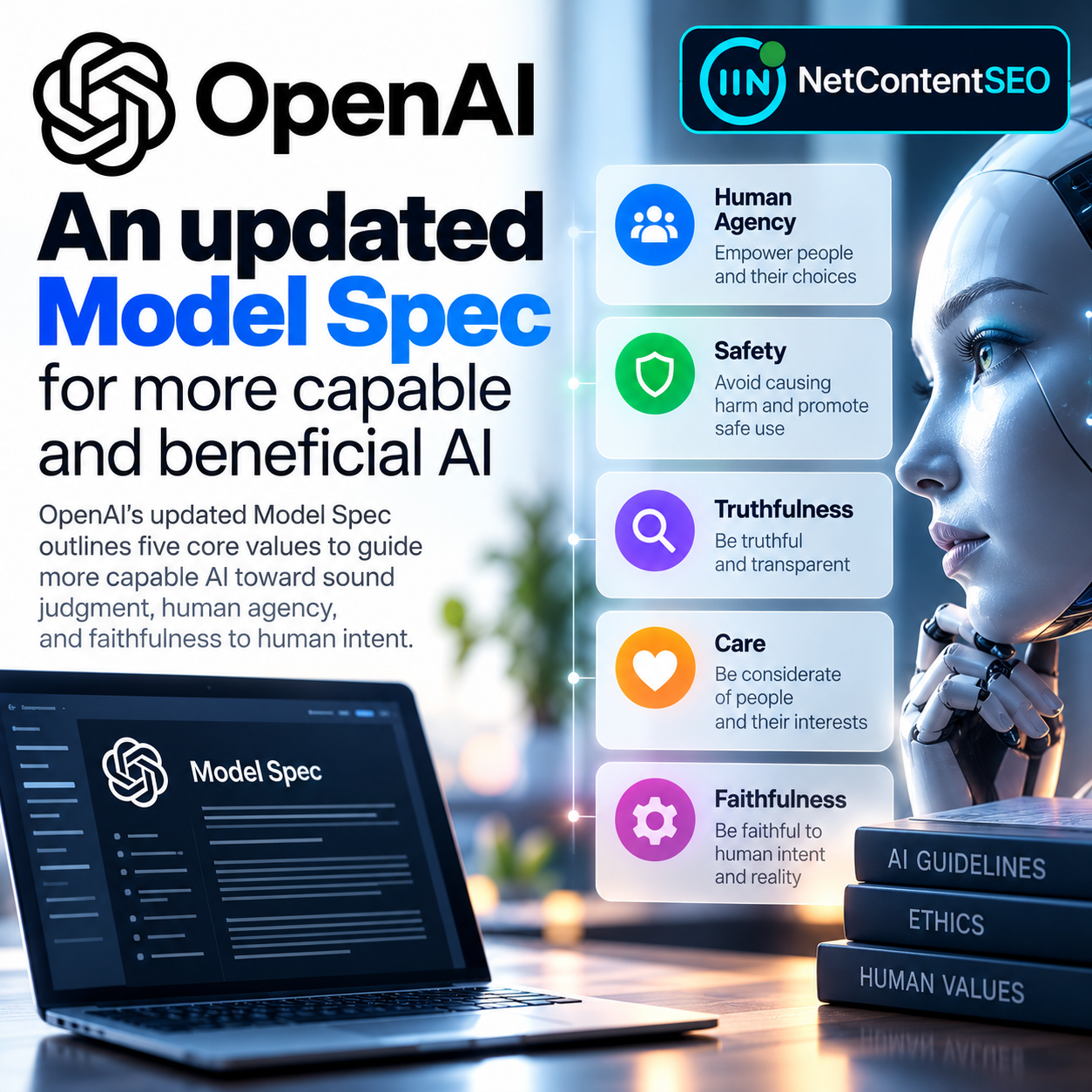

As artificial intelligence systems become more capable, the question of how they should behave becomes as important as what they can do. OpenAI's updated Model Spec aims to clarify that question by outlining five core values intended to guide model behavior, particularly when instructions are incomplete, ambiguous or competing priorities arise.
The Model Spec is a public description of OpenAI's intended model behavior. It is not a claim that every deployed model already follows every principle perfectly. Instead, it provides a framework for training, evaluating and discussing how increasingly capable AI should interact with people.
Five core values for more beneficial AI
Faithfulness to human intent emphasizes understanding the user's actual goal, not merely following the literal wording of a request. A helpful system should interpret instructions in context while respecting higher-priority rules and legitimate boundaries.
Minimizing harm recognizes that outputs and actions can have real-world consequences. Models should take foreseeable risks seriously, especially in sensitive or high-stakes contexts.
Honesty and transparency require models to represent information accurately, acknowledge uncertainty and avoid suggesting that they performed checks or actions that did not occur. This is especially important when AI is used for research, analysis or operational decisions.
Human agency means supporting people's capacity to understand choices and make decisions. AI can explain trade-offs and help execute authorized tasks without treating its own preferences as a substitute for the user's judgment.
Care calls for attention to people's circumstances, resources and interests. Good assistance should be useful and respectful, not simply technically compliant.
Why the updated guidance matters
Traditional software generally operates within narrowly defined actions. Modern AI assistants can interpret language, handle complex requests and contribute to multi-step workflows. That flexibility creates new challenges: what should a model do when a request has several reasonable interpretations, when a proposed action could have side effects, or when the user needs context rather than a confident-sounding answer?
The Model Spec provides a shared vocabulary for these decisions. Faithfulness does not mean blind obedience, just as safety does not mean refusing every uncertain request. The aim is to balance useful assistance with responsible judgment, transparency and appropriate human control.
What AI developers and businesses can learn
For teams integrating language models into products, these principles suggest practical design priorities. Applications should clearly communicate what the assistant can and cannot do, distinguish generated suggestions from verified facts, and seek meaningful authorization before consequential actions. Where automated workflows affect users, money, accounts or published content, appropriate review and rollback mechanisms become especially valuable.
Evaluation also needs to go beyond whether an AI produced a plausible answer. Teams can test whether the system understood the underlying task, represented uncertainty appropriately, respected boundaries and helped the user retain control.
Implications for SEO and AI search
For SEO professionals and publishers, the update is not a new search ranking algorithm or a promise about citation frequency. Its relevance is indirect but significant: AI products increasingly mediate how people discover, interpret and use online information. Accurate sourcing, clear distinctions between facts and inference, and transparent handling of uncertainty are valuable qualities for any AI-assisted research workflow.
Publishers should continue to prioritize original evidence, clear authorship and useful explanations. The Model Spec does not establish a new optimization checklist for appearing in AI answers, and it should not be presented as one.
A direction for increasingly capable systems
The larger significance of the update is that greater capability alone does not guarantee better assistance. As models take on more complex tasks, the quality of their judgment and their ability to respect human intent become central to trust. OpenAI's five-value framework offers a public statement of that intended direction, while real-world performance must still be assessed through observation and testing.
Source: OpenAI — An updated Model Spec for more capable and beneficial AI.