

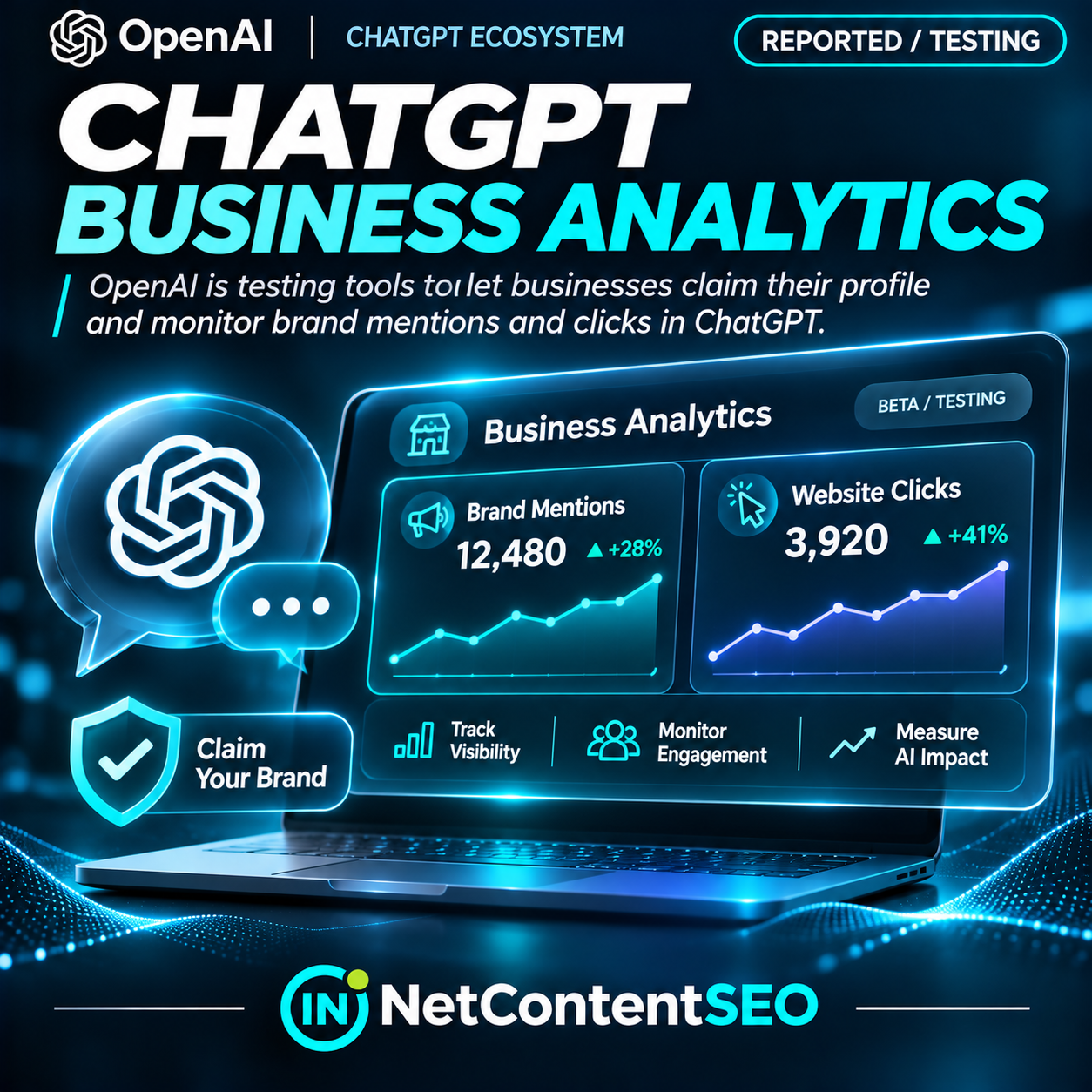

November 7, 2026. OpenAI appears to be testing a business analytics interface that could show companies how often their brands appear in ChatGPT responses and how many people click links to their websites. The feature was reported on November 6 by Barry Schwartz at Search Engine Roundtable and examined in depth by PPC Land, following a LinkedIn disclosure from Marketplace Pulse founder Juozas Kaziukėnas.
The reported system, described as part of a larger Business Hub, would let businesses claim a profile, update product and company information, and track daily appearances and website clicks. However, OpenAI has not officially announced this product, confirmed a launch date, or described universal access. This is a REPORTED / TESTING development, not a generally available ChatGPT Search Console.
What has actually been observed?
According to Kaziukėnas, he had seen early versions of the feature since August 2026 and observed a banner on November 6 inviting businesses to claim their presence in ChatGPT. The reported interface includes a daily chart for two metrics: the number of times a business appears in ChatGPT answers and the number of clicks on links to its website.
The banner described three functions: tracking how a business appears, keeping product and business information current, and letting a business agent answer customer questions using business-controlled context. Kaziukėnas said ownership verification could involve connecting a Shopify store. That is one reported example, not confirmation that every publisher, service business or website owner can currently verify.
The evidence comes from a researcher's account of a developing interface, subsequently reported by two publications. There is no public OpenAI product documentation establishing the final metric definitions, eligibility, pricing, launch markets, data retention or export capabilities.
Why first-party ChatGPT data would matter for GEO
Today, many AI visibility programs use controlled prompts, repeated testing and third-party tracking tools to estimate whether an AI system recommends or cites a brand. Those methods can reveal useful patterns but cannot directly count every real user exposure inside the platform. A first-party measurement product could provide an additional layer: observed appearances and outbound clicks, as counted by ChatGPT itself.
That would not automatically make the numbers comprehensive or comparable with Google Search Console. Their meaning depends on definitions that have not been published. A brand mention in prose, a product card, a source citation and a link to a publisher are not the same event. The tool might count some or all of them; at present, the distinction is unresolved.
Similarly, a click recorded inside ChatGPT is not necessarily identical to a session in a website analytics platform. Browser behavior, redirects, attribution rules, repeat clicks, consent settings and cross-device activity can affect reconciliation. A useful analytics launch would need clear definitions for each metric.
The reported feature set—and what is missing
| Capability | Current evidence | Practical implication |
|---|---|---|
| Claim business ownership | Reported banner and Shopify verification example | Potential way to associate an organization with its ChatGPT presence |
| Brand appearances | Reported daily counts | Could establish first-party mention trends |
| Website clicks | Reported daily counts | Could measure direct outbound interest |
| Update products and business details | Reported banner | Potential business-profile management |
| Business agent | Reported banner | Potential customer question-answering experience |
| User prompts and search questions | Explicitly described as absent | No direct explanation of which queries caused exposure |
| Competitor rankings | Explicitly described as absent | No full share-of-voice benchmark |
| API, exports, pricing, regions | Not established | Automation and access cannot yet be planned |
Absence from early reporting should not be interpreted as proof that an eventual product will never offer a feature. The specific absence of prompts and competitor comparisons, however, was explicitly described by Kaziukėnas.
Mentions, citations, impressions and clicks are different
GEO measurement often mixes four events. A mention occurs when an AI answer names a brand. A citation points to a source used or offered as evidence. An impression requires a platform-specific rule defining what exposure counts. A click is an action on a link or interface element. These can overlap without being interchangeable.
For example, ChatGPT could recommend a software company by name without linking to its website. A research article could be cited as evidence while the answer recommends a different brand. A user could see the brand, then search for it later on Google. Only the final case involves a possible AI-influenced visit that might not register as a direct ChatGPT referral.
The proposed dashboard would be most valuable if OpenAI published counting rules, including how it treats repeated appearances in one conversation, multiple links, follow-up turns and different answer formats. Without those details, calculating a reliable click-through rate from mentions and clicks could be misleading.
How this compares with Google and Bing's AI reporting
Other search platforms have begun exposing different parts of AI discovery measurement. Bing introduced an AI Performance experience in Webmaster Tools in February 2026, including citation-related metrics and sampled grounding queries. Google has offered generative AI visibility reporting, although its reporting dimensions and click attribution differ. These tools do not provide identical definitions or complete coverage.
As PPC Land notes, a ChatGPT dashboard with brand mentions and clicks but no prompts would address a different measurement gap. Bing's grounding-query information can help identify themes behind source usage; ChatGPT's reported first-party clicks could offer a direct traffic signal. Neither would independently explain every ranking, retrieval or selection decision.
Glenn Gabe had called for an AI Search Console in 2025, arguing that site owners need visibility into the queries, citations and traffic associated with AI search. The emerging tools are partial responses to that need, not yet a unified measurement standard across AI platforms.
Business Hub is not ChatGPT Business or Ads Manager
The reported Business Hub should not be confused with ChatGPT Business, OpenAI's workplace subscription, or with the existing reporting tools for paid ChatGPT advertisements. Barry Schwartz's report suggests the new feature is aimed at organic appearances, separate from ads. The exact relationship between the reported business agent and existing sponsored-agent advertising formats is not established.
This distinction is important for agencies. A paid impression, an unpaid brand mention, a cited source and a business-agent interaction have different meanings and may require separate reporting. Combining them into one visibility figure would conceal whether a brand is earning recommendations or purchasing placement.
What businesses can do now, before a public launch
- Audit brand identity. Make sure the official business name, website, product names and contact details are consistent across authoritative owned channels.
- Track direct ChatGPT referrals. Review existing analytics for identifiable ChatGPT visits, while documenting referrer loss and attribution limitations.
- Create a reproducible prompt set. Use representative informational, comparison and transactional questions, with documented date, language, region and login conditions.
- Separate measurement layers. Report brand mentions, source citations, outbound referrals and conversions as distinct KPIs.
- Preserve baselines. Store current weekly metrics so that any future first-party ChatGPT data can be compared against a documented starting point.
- Review business information. Maintain accurate product catalogs, service descriptions, policies and structured information where relevant; do not assume these guarantee AI selection.
- Check verification eligibility only through official interfaces. Avoid unofficial claim links or third-party services promising early access to an unannounced product.
- Document unresolved questions. When a dashboard becomes available, verify definitions, ownership requirements, historical coverage, privacy controls and export options before using its numbers in client reports.
A practical measurement model for SEO and GEO teams
A robust reporting system should distinguish visibility (brand appearances), attribution (source citations), engagement (clicks and qualified sessions) and business impact (leads, transactions or revenue). The proposed ChatGPT analytics could help with the first and third categories, but it would not automatically provide the causal explanation behind a change.
Consider a brand whose reported mentions increase while clicks remain flat. Possible explanations include more informational mentions, different link placement, changes in user intent or counting rules. The dashboard alone would not identify which explanation is correct. A controlled prompt panel, website analytics, qualitative reviews and commercial data would still be needed.
Conversely, an increase in website sessions attributed to ChatGPT would not prove that the model cited the brand more often. A new link treatment or attribution method could alter recorded traffic without changing underlying recommendation frequency. Cross-validation is essential.
What remains unknown
OpenAI has not publicly confirmed the final product name, launch schedule, geographic availability or access criteria. There is no verified definition of a counted appearance, the click attribution window, handling of repeated turns, whether data is historical or prospective, or whether an API will exist. The reported Shopify verification path does not establish an equivalent path for news publishers, local businesses or independent consultants.
The existence of an experimental interface also does not mean OpenAI is exposing individual user conversations. The reporting described by Kaziukėnas explicitly excludes user and prompt data. Any eventual implementation will need to reconcile business analytics with privacy expectations.
Frequently asked questions
Has OpenAI officially launched ChatGPT Business Analytics?
No. As of November 7, 2026, the feature has been reported from an experimental interface but not officially announced for general availability.
What metrics could it show?
According to the reporting, daily counts of business appearances in ChatGPT responses and clicks on links to the business website.
Can companies already claim their business in ChatGPT?
A claim-business banner was observed, and Shopify-based verification was cited as an example. General eligibility and a public claim process have not been confirmed.
Will it show the prompts users typed?
Not according to the current report. Prompt data and individual user data were described as unavailable.
Will it rank competitors?
No competitive benchmark or ranking was reported. The feature should not be presented as a complete share-of-voice platform.
Is it the same as ChatGPT Ads Manager?
No. The reported feature appears focused on organic business visibility, while Ads Manager measures paid campaigns.
Does a mention equal a citation?
No. A brand can be mentioned without a linked source, and a source can be cited without its brand being recommended.
Can it replace third-party GEO trackers?
Not on the reported feature set. First-party counts would complement controlled prompt tests and external monitoring, particularly because the reported dashboard lacks query context.
Does this mean ChatGPT will reveal its ranking algorithm?
No. Neither ranking criteria nor retrieval and selection mechanisms have been disclosed through this report.
Conclusion: a potential first-party scoreboard, not yet a complete AI Search Console
If OpenAI releases the feature described by Kaziukėnas, verified businesses could gain something that GEO practitioners have long lacked: direct platform-reported trends for brand appearances and outbound clicks. That would make it easier to distinguish a visibility change from a referral change and to evaluate the value of appearing in AI answers.
But measurement without context remains incomplete. Until prompt-level insights, definitions and source-attribution details are available, businesses will still need a combination of first-party analytics, independent testing and conversion data. The key development is not a new ranking factor; it is the possibility of a more transparent measurement layer for ChatGPT discovery.
Sources
- Search Engine Roundtable — OpenAI Working On ChatGPT Tools For Business For Analytics & Citations, November 6, 2026.
- PPC Land — ChatGPT builds mention and click charts for verified businesses, November 6, 2026.
- Search Engine Roundtable — OpenAI Drops UTM Parameters From ChatGPT Results, October 14, 2026.