

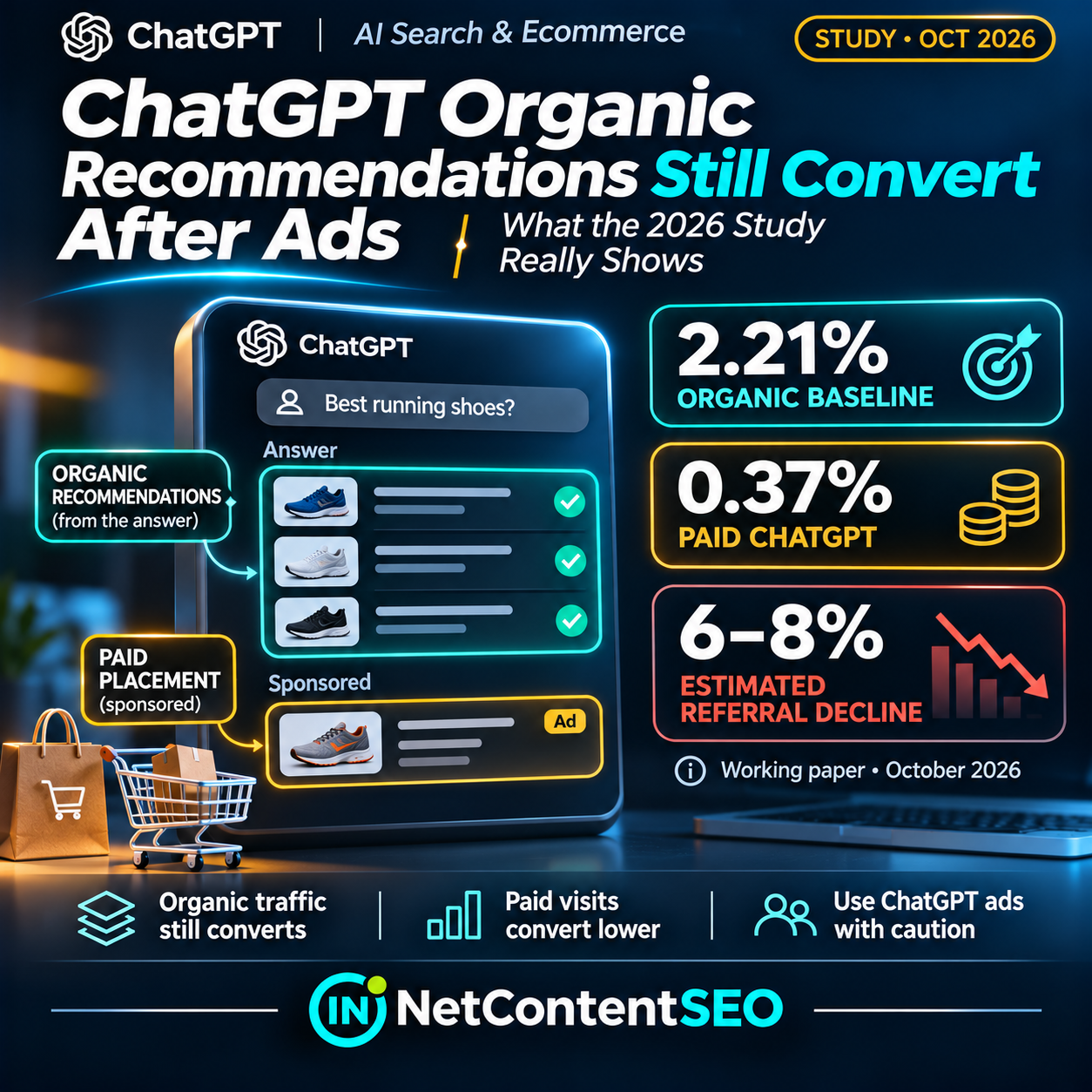

November 6, 2026. A new working paper examining nearly ten billion online shopping sessions suggests that advertising inside ChatGPT is associated with fewer unpaid referrals to ecommerce websites, while visitors arriving from unpaid ChatGPT recommendations continue to convert at approximately their previous rate. The finding complicates a simple narrative that adding advertisements automatically creates more commercial value for brands.
The research, Can Advertising Fund Free AI? Evidence from ChatGPT's International Advertising Rollout, was written by Maximilian Kaiser of WU Vienna and Christian Schulze of Frankfurt School of Finance & Management. It examines 1,898 ecommerce websites over 60 weeks, from June 2025 through August 2026. The authors use the staggered international rollout of ChatGPT advertising, with the European Union untreated during the observation period, to estimate changes in unpaid referrals. The paper is an October 2026 working paper under review, not a finalized peer-reviewed causal verdict.
The finding that matters most for organic AI visibility
Before advertising began, unpaid ChatGPT referrals converted at a baseline rate of 2.21% in the researchers' organic sample. Following the rollout, the estimated change in conversion was just −0.02 percentage points, with p = .648. The study therefore does not find a meaningful deterioration in conversion quality among users who still arrived from unpaid recommendations.
Referral volume tells a more nuanced story. The estimated reduction over the first 13 post-launch weeks was 5.9%, but the reported 95% confidence interval runs from −12.6% to +1.2%, crossing zero. After adjustments accounting for faster ChatGPT usage growth in North America than Europe, the authors estimate a reduction of approximately 7.2% to 8.4%. That is why the researchers summarize the impact as roughly six to eight percent fewer organic referrals, while the uncertainty around the unadjusted estimate must remain visible.
The implication is not that every site lost eight percent of its ChatGPT traffic, or that advertising alone has been proven to cause a uniform decline. It is that the rollout coincided with a measurable change in referral volume under the study's identification assumptions, while the visitors who continued arriving showed broadly stable conversion behavior.
What the paid channel comparison actually measures
The same paper reports that, in US traffic, a paid ChatGPT referral generated an average $0.89 in revenue per session, compared with $2.45 from a paid Google Search session. That is approximately 64% less revenue per visit. Conversion rates were 0.37% for paid ChatGPT and 1.17% for Google paid search.
These are observed ecommerce outcomes in different advertiser samples, not an apples-to-apples experiment in which every advertiser bought the same traffic at the same price. The paid comparison is also distinct from the organic 2.21% baseline, which comes from another group of sites. A headline implying that organic ChatGPT converts exactly six times better than paid ChatGPT for the same merchants would overstate what the data establishes.
Frankfurt School's November 3 research release reports a further commercial comparison: approximately $0.52 of revenue for every advertising dollar spent on ChatGPT, versus $3.40 for Google Search advertising in the analyzed data. Revenue divided by ad spend is not profit, and those returns are sample-specific rather than a universal forecast for all future campaigns.
Why organic referrals may behave differently from sponsored clicks
There is a plausible behavioral explanation. A user who asks an AI assistant for help comparing products may arrive at a retailer after receiving an answer that has already organized the options and clarified what to buy. A sponsored placement may attract attention at a different stage of consideration. But the study does not directly measure consumer trust or prove that people converted because they perceived an unpaid recommendation as more credible.
For marketers, it is important to separate the observed result from the hypothesis. Observed: conversion among remaining organic referrals stayed approximately stable, while paid ChatGPT traffic generated less revenue per session than Google paid search in the sample. Interpretation: unpaid recommendations may carry useful pre-visit context and intent. Not established: a causal psychological mechanism in which consumers universally trust organic AI answers more than advertisements.
The advertising and organic discovery trade-off
Advertising may create revenue for an AI platform while changing how users interact with its interface. A sponsored element can occupy attention and potentially alter the route to external sites. The study's staggered rollout design makes it possible to compare changes across markets, but it cannot by itself reveal every interface-level mechanism behind referral losses.
This distinction matters for GEO. The appearance of a brand in an answer, a citation link, a sponsored impression, an outbound visit and a completed purchase are different outcomes. An advertiser could gain sponsored visibility without gaining profitable sales. A publisher could retain strong brand recommendations but see fewer clicks. A merchant could receive fewer referrals while maintaining or improving the conversion rate of those referrals.
Reporting all of these under a single “AI visibility” score would conceal the trade-offs. A better measurement framework tracks presence, source attribution, outbound referrals, conversion and revenue separately.
How to measure organic ChatGPT traffic without mixing it with ads
- Define channel rules. Separate ChatGPT organic referrals from identifiable paid campaigns using consistent UTM parameters and referrer information where available. Document sessions that cannot be confidently classified.
- Build a pre/post baseline. Track weekly sessions, transactions, conversion rate and revenue per session before and after relevant ad exposure or campaign changes.
- Segment by country. The rollout was staggered, so country and eligibility differences matter. Avoid comparing regions with different shopping behavior as though they were identical.
- Segment by product type. High-consideration products and simple commodity purchases may have different referral behavior. The researchers' earlier Marketing Science study identified product-complexity differences in organic LLM commerce.
- Check attribution gaps. AI-assisted discovery can lead to a later direct visit or branded search. A last-click report will not necessarily capture every influenced sale.
- Monitor source quality. Record whether relevant brands and pages appear in answer citations when that information is observable, but do not infer clicks from mentions.
- Annotate product changes. Log interface rollouts, new ad campaigns, checkout integrations, attribution changes and major site updates so that unrelated events are not mistaken for ad effects.
- Compare commercial outcomes. Evaluate revenue per session, acquisition cost, contribution margin and incremental conversions rather than click volume alone.
What a small paid ChatGPT experiment should look like
Businesses interested in advertising should run a bounded test rather than redirecting an established organic or search budget based on platform adoption figures. Choose a product group with a clear conversion event, define an acceptable customer acquisition cost, apply campaign tracking and set a spending limit. Compare results with matched search campaigns and, where feasible, a holdout group.
Measure incremental purchases, not only attributed clicks. The paper's suggested parity click value of approximately $0.26 reflects its comparison assumptions and observed returns; it is not an official market price, recommended bid or guarantee that buying at that price would be profitable for a particular business.
Also evaluate the possibility that ads capture customers who would otherwise have clicked an unpaid recommendation. Cannibalization cannot be quantified reliably from a single advertiser dashboard without appropriate controls.
What changes for B2B and software companies?
The working paper focuses on ecommerce websites with measurable sessions and purchases. B2B software journeys are often longer, involving demos, procurement reviews and multiple decision-makers. Therefore, it is not methodologically sound to transplant the study's retail conversion percentages directly into SaaS pipeline forecasts.
However, the measurement principle transfers well. Ask new leads which tools appeared on their AI-generated shortlist, whether the brand was recommended in the answer or seen in a sponsored placement, and whether the AI interaction influenced their research. Record source information in CRM fields, then evaluate qualified opportunities, pipeline value and closed revenue over a meaningful period.
A brand mention that helps a buyer shortlist a vendor may matter commercially even if the first measurable website visit comes later through direct traffic. That is a hypothesis worth testing with customer interviews and attribution data, not a reason to assign invented revenue to every AI mention.
Does this prove organic GEO is always better than paid AI advertising?
No. The study describes an early phase of ChatGPT advertising, observed through August 2026. Advertising products, targeting, formats and pricing may evolve. The authors' estimates also depend on the underlying panel and staggered rollout design. Future campaigns may perform differently, and some product categories may be better suited to paid conversational placements than others.
It does suggest that businesses should not treat an advertising channel's rapid revenue growth as proof of advertiser return on investment. Nor should they assume organic AI discovery has become irrelevant because sponsored placements exist. The evidence supports careful experimentation and separate measurement of both channels.
Frequently asked questions
What study is this?
It is the October 2026 working paper Can Advertising Fund Free AI? by Maximilian Kaiser and Christian Schulze, using data from 1,898 online shops and nearly ten billion visits across 60 weeks.
Did ChatGPT organic conversion fall after ads launched?
The authors report a change of −0.02 percentage points from a 2.21% baseline, which was not statistically significant in their analysis.
Did organic ChatGPT referrals decline by 6–8%?
The paper estimates a decline in that range under its adjusted assumptions. Its unadjusted −5.9% estimate has a confidence interval that includes zero, so the result should be reported with its uncertainty.
Do organic ChatGPT visits convert six times better than paid visits?
The reported rates are 2.21% organic before rollout and 0.37% paid in the analyzed samples, but they come from different groups of shops. They should not be treated as a controlled within-advertiser comparison.
How did paid ChatGPT traffic compare with Google Search ads?
In the study's US traffic, ChatGPT ads generated $0.89 per session versus $2.45 for Google Search ads, with conversion rates of 0.37% and 1.17% respectively.
Should businesses stop testing ChatGPT ads?
Not automatically. A controlled, capped experiment can be useful if performance is measured against incremental revenue and acquisition costs. Broad budget shifts are not justified by these averages alone.
Is the paper peer reviewed?
As of November 6, 2026, the authors describe it as a working paper under review.
What should SEO teams do next?
Separate unpaid AI referrals from paid traffic, monitor conversions and revenue by channel, audit source mentions and links where observable, and document uncertainty before claiming causality.
The bigger lesson: being recommended is not the same as buying an impression
The strongest conclusion from the current evidence is not that paid AI advertising has no future. It is that the value of an unpaid AI referral cannot be inferred from the number of sponsored placements sold beside an answer. For publishers, brands and SEO teams, the priority is to understand when information is selected, when users click and when that interaction produces a real business outcome.
Visibility, traffic and conversion are separate stages. Measure all three before declaring an AI channel a success or failure.
Sources
- Kaiser and Schulze, October 2026 — Can Advertising Fund Free AI? Working paper and supporting materials.
- Frankfurt School, November 3, 2026 — Research announcement.
- Kaiser and Schulze — ChatGPT Referrals to E-Commerce Websites, Marketing Science.
- AI Native / Pepper — ChatGPT’s free answer is beating its paid one, editorial commentary on the study.