

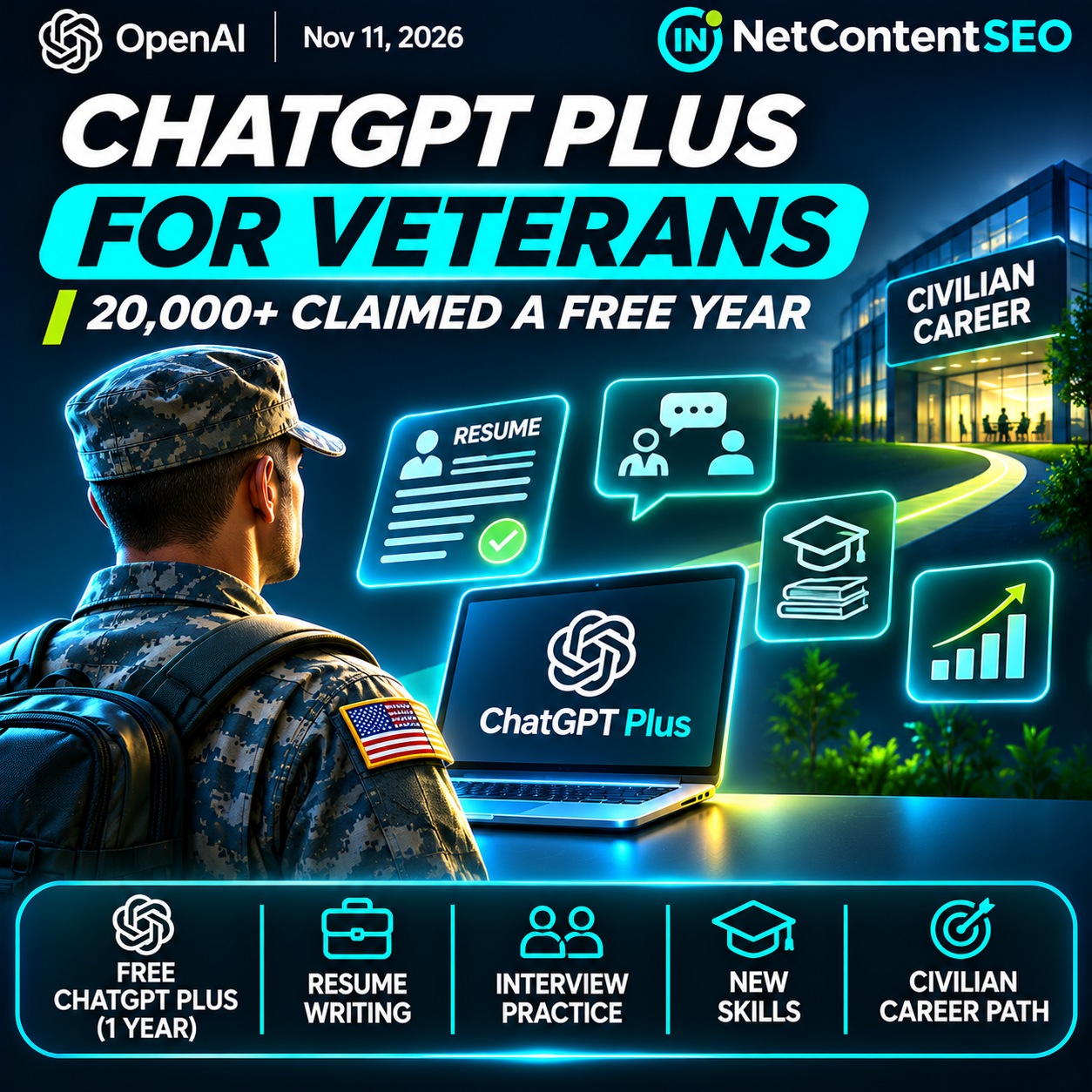

More than 20,000 U.S. veterans and transitioning servicemembers have claimed a free year of ChatGPT Plus, according to an OpenAI update published on November 11, 2026. The milestone comes one year after the company introduced a targeted offer to help people leaving military service navigate civilian employment, education and everyday decisions.
The number measures offer claims, not independently verified job placements or career outcomes. OpenAI also reports more than a dozen training events reaching nearly 1,000 members of the military community, with seven additional events planned before the end of 2026. For AI adoption, the story is less about a subscription giveaway than about how conversational assistants are being used to translate experience, practice interviews and organize complex personal transitions.
What OpenAI announced on Veterans Day 2026
OpenAI says over 20,000 eligible people claimed a year of ChatGPT Plus at no cost through its U.S. veterans and servicemembers initiative. The program originated with veterans working at OpenAI and was first announced in November 2025.
Alongside the subscription, OpenAI Academy and partners have organized hands-on training. Its November 11 update cites a completed six-event Academy series with Veterans Forge, as well as workshops with AI Collective Hampton Roads and NPower. OpenAI says further sessions are scheduled during November.
These figures show participation and distribution. The company has not published a controlled study showing that ChatGPT users secure jobs faster, earn more or achieve better long-term employment outcomes than comparable nonusers.
Who qualifies for the free year of ChatGPT Plus?
According to OpenAI's official promotion terms, the offer is for verified U.S. military servicemembers who expect to transition out of active service within the next 12 months, and veterans or retirees who left active duty within the past 12 months. It is not a universal free subscription for every veteran regardless of separation date.
Eligible applicants must use a personal ChatGPT account, complete military-status verification through ID.me, and meet the promotion's account and subscription requirements. Each eligible subscriber may claim the offer once. It cannot be sold, transferred or combined with other promotions.
OpenAI's 2025 launch announcement mentioned verification through SheerID, while the current promotion instructions specify ID.me. Applicants should follow the current claim process rather than relying on older coverage of the original launch.
How to claim free ChatGPT Plus: step by step
- Open chatgpt.com/veterans-claim and sign in to the personal ChatGPT account that should receive the offer.
- Select Verify with ID.me and sign in to or create an ID.me account.
- Complete the military verification process and authorize ID.me to share the verification result with OpenAI.
- If prompted, provide the relevant military service end date.
- After ChatGPT confirms eligibility, select Claim offer.
- Check that the one-year promotion is applied before completing any checkout step.
OpenAI warns that users with active app-store-billed Plus subscriptions cannot redeem the offer while that subscription remains active. Existing eligible web-billed Plus subscribers generally should not cancel before applying the promotion. Enterprise workspace accounts are not eligible for this personal offer. If the process fails, contact OpenAI Support rather than repeatedly linking the same military identity to different accounts.
Important billing detail: after the free year ends, the subscription automatically renews at the standard ChatGPT Plus monthly rate unless canceled. OpenAI says canceling the promotional subscription may end access immediately, so users should review the cancellation terms before acting.
How veterans are using ChatGPT to prepare for civilian work
OpenAI's November update features individual accounts of people using ChatGPT for practical transition tasks. These stories illustrate possible uses but are testimonials, not representative research on the entire group of 20,000 claimants.
Air Force veteran Tilak Bhatnagar describes using the assistant to prepare for around a dozen interviews, translate military experience into language civilian employers would recognize and compare job offers. He later joined a technology company. The story highlights the value of revisiting an ongoing conversation with the same context rather than starting every planning task from scratch.
Another Air Force veteran, Sadarian Bell, used ChatGPT to plan his transition and convert military healthcare experience into a civilian résumé. He practiced interview responses aloud through voice mode. The example suggests that conversational rehearsal can help applicants work through unfamiliar questions, although it does not establish that AI feedback is equivalent to guidance from a qualified career counselor.
Navy veteran Kelli Ramirez used ChatGPT to organize ideas, research publishing questions and navigate Amazon Kindle Direct Publishing. She subsequently published two books. Her experience shows that the transition need not lead only to conventional employment; it may also involve entrepreneurship, creative work and self-directed learning.
Why translating military experience is difficult
Military roles often involve skills that transfer to civilian work—leadership, logistics, operations, technical maintenance, healthcare, cybersecurity and project management—but military job titles and acronyms may be unfamiliar to civilian recruiters.
An AI assistant can help a veteran describe responsibilities in terms of outcomes and competencies. For example, a service member who coordinated equipment maintenance might ask for help expressing the work as operational planning, inventory management, safety compliance and team leadership. The result should be checked against the person's actual duties and achievements; an assistant should never invent qualifications, certifications or performance metrics.
The most useful workflow is iterative: describe the real experience, identify target roles, draft a résumé, compare it with actual job requirements and revise the wording while preserving accuracy.
Five practical prompts veterans can try
These are illustrative prompts written for this article, not quotations from OpenAI's published prompt collection:
- Translate experience: “I served in [role] and handled [responsibilities]. Identify transferable civilian skills without inventing achievements, then suggest three relevant job families.”
- Improve a résumé: “Rewrite these verified duties as clear résumé bullet points for [target role]. Flag missing metrics instead of making them up.”
- Practice interviews: “Act as an interviewer for [position]. Ask one question at a time, wait for my response and give constructive feedback on clarity and evidence.”
- Compare opportunities: “Create a decision matrix for these job offers based on location, compensation, schedule, growth and my stated priorities. Mark unknown information clearly.”
- Plan next steps: “Build a four-week job-search plan that includes networking, applications, skills assessment and time for reviewing official benefits information.”
OpenAI also provides a collection of 100 example chats for veterans and training resources through OpenAI Academy. Users should avoid entering classified material, sensitive operational information, unnecessary personal identifiers or private records belonging to other people.
What the OpenAI Academy program adds
Access to a tool does not automatically mean users know how to apply it effectively. OpenAI's workshops address that gap by demonstrating concrete tasks such as résumé writing, interview practice and custom GPT creation.
The November 11 announcement reports a workshop in Reston, Virginia, with nearly 100 veterans and active-duty servicemembers, and three sessions at the American Legion national convention in Louisville attended by more than 80 Legionnaires. The company says it has held over a dozen training events for nearly 1,000 participants overall.
Its published schedule lists a November 12 NPower event in St. Louis, a November 14 event in Nashville with Veterans Forge and Wounded Warrior Project, a virtual session on November 17, and NPower events in Dallas and San Antonio on November 19 and 21. Availability, registration and participation requirements should be confirmed through the linked official event pages.
Where AI assistance should stop
ChatGPT can help organize information, explain unfamiliar terminology and generate questions for a professional. It should not be treated as an authoritative source for veterans' benefits eligibility, legal rights, medical decisions or financial obligations. Policies and deadlines change, and individual circumstances matter.
For benefits, use official U.S. Department of Veterans Affairs resources and accredited advisers. For career decisions, verify job postings, qualifications, salary terms and employer identities directly. AI-generated résumés and interview answers should reflect real experience rather than optimized but misleading claims.
These safeguards are especially important when users are navigating a major life transition and may be making consequential decisions based on incomplete information.
What this means for AI Search and digital discovery
The initiative offers a useful example of conversational discovery: a user may begin with an open-ended question about future employment and continue through career exploration, résumé development, interview preparation and comparing offers within one assistant interface.
That changes the information journey. Instead of making a separate search for every step, a person may rely on an assistant to structure the process and identify relevant resources. Employers, training providers, credentialing organizations and public agencies may increasingly need to ensure their official information is accurate, accessible and easy to verify when users consult AI systems.
However, the OpenAI announcement does not measure which websites were cited, how often employers were recommended, how much referral traffic was generated or whether ChatGPT changed any particular site's rankings. It is an adoption and education story, not evidence of a new SEO ranking factor.
Implications for employers, training providers and publishers
Organizations serving career-changing professionals can take practical steps without assuming they can control ChatGPT's recommendations. Employers should publish clear job requirements, distinguish required qualifications from preferred experience and explain transferable skills where possible. Training providers should keep program dates, costs, eligibility and credential outcomes current. Public-service publishers should maintain authoritative, accessible guidance and clearly identify the agency responsible for it.
For SEO teams, the sensible priorities are stable URLs, useful page structure, accurate organization and program details, accessible content and consistent entity descriptions. These are good foundations for both conventional search and retrieval-based systems, but none guarantees inclusion in a ChatGPT answer.
Measurement should also distinguish AI-assisted decision making from AI-referred website sessions. A person may discover an opportunity through a conversation and later apply by typing the employer's URL directly. That journey may not be visible in ordinary referral analytics. Surveys and first-party application questions can provide additional context, but attribution should be interpreted cautiously.
Frequently asked questions
How many veterans have claimed the offer?
OpenAI reported more than 20,000 veterans and transitioning servicemembers had claimed a free year of ChatGPT Plus as of November 11, 2026.
Is ChatGPT Plus free for all U.S. veterans?
No. The current promotion applies to verified eligible U.S. servicemembers within 12 months before transition and veterans or retirees within 12 months after leaving active service, subject to additional terms.
Where can eligible veterans apply?
At chatgpt.com/veterans-claim, using a personal ChatGPT account and ID.me verification.
Can an existing Plus subscriber claim the free year?
Eligible subscribers billed directly through the web may be able to apply the offer without canceling. Active app-store-billed subscriptions have different restrictions. Follow the official Help Center instructions for the account's billing arrangement.
Does the subscription renew after 12 months?
Yes. According to OpenAI's terms, it renews at the standard monthly price unless canceled.
Does the program guarantee employment?
No. OpenAI has published participation figures and personal stories, not a controlled employment-outcome study.
Can ChatGPT help with VA benefits?
It can help formulate questions and explain general information, but eligibility, deadlines and benefits decisions must be verified with official VA sources or qualified advisers.
What does the announcement mean for SEO?
It illustrates how people may use AI assistants throughout a complex decision journey. It does not establish a new ranking factor, citation system or measured search traffic impact.
The bottom line
OpenAI's 20,000-claim milestone suggests meaningful uptake of an AI subscription program aimed at people navigating the transition from military to civilian life. The company's examples show how conversational tools can support résumé writing, interview practice, career exploration and creative projects. But claims and testimonials are not proof of improved employment outcomes.
For AI Search, the broader lesson is that assistants are becoming tools for extended decisions, not just one-off answers. Organizations that want to remain useful in those journeys should focus on clear, verified information and reliable services rather than treating AI adoption figures as evidence of guaranteed visibility.
Sources
- OpenAI — ChatGPT Plus for veterans and servicemembers (November 11, 2026).
- OpenAI — Free ChatGPT for transitioning U.S. servicemembers and veterans (November 10, 2025).
- OpenAI Help Center — ChatGPT Plus for Service Members, Veterans & Retirees: Terms of Service.
- Official ChatGPT veterans offer claim page.