

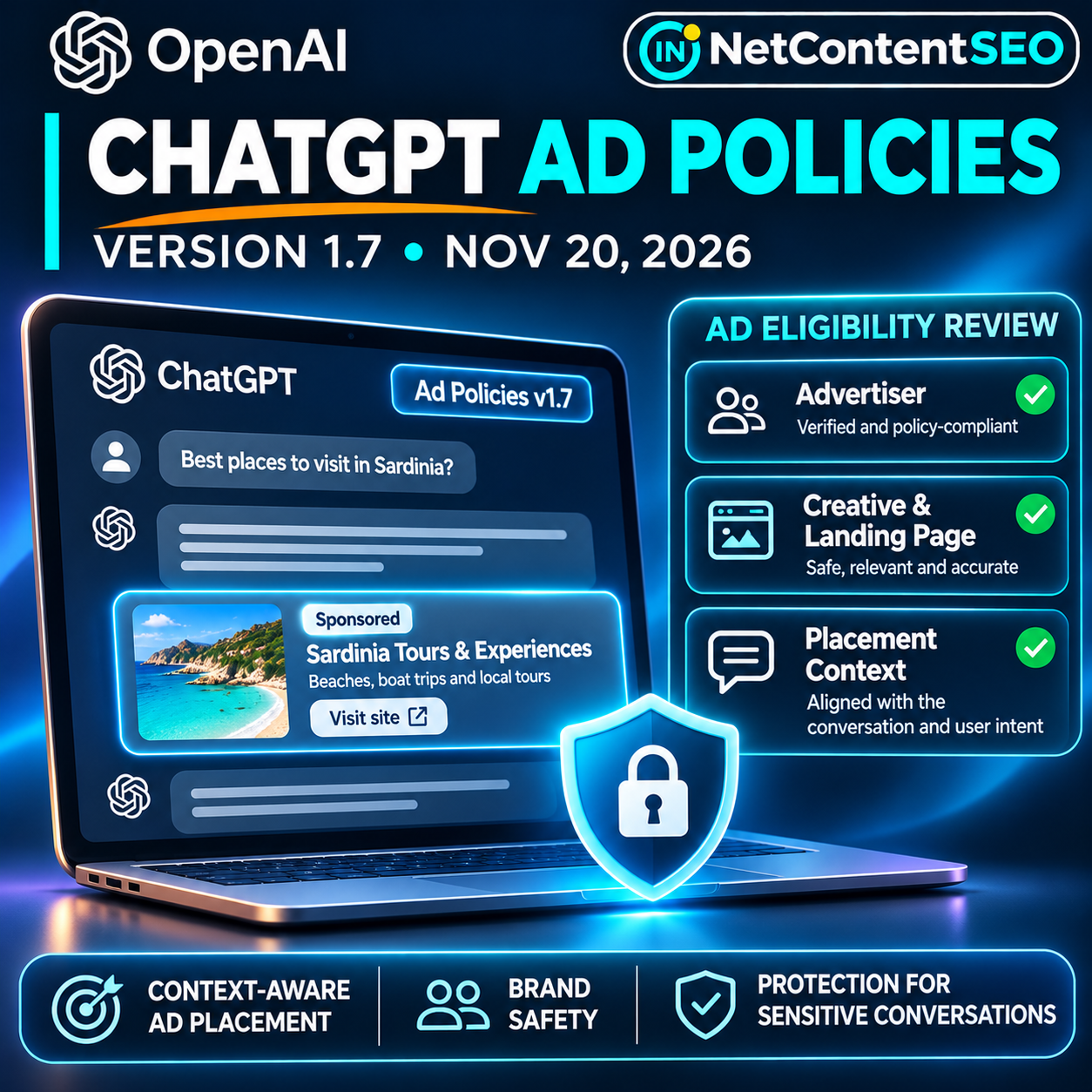

OpenAI updated its ChatGPT advertising policies on November 20, 2026, clarifying how the company evaluates which conversations are suitable for advertising and what standards advertisers must meet. Version 1.7 is particularly relevant to marketers exploring conversational advertising because it makes clear that placement eligibility depends on context, not merely the presence of certain words. The update does not introduce a new SEO ranking factor or change how organic AI citations are selected.
What changed in version 1.7?
The official OpenAI Ad Policies changelog states that version 1.7, dated November 2026, clarifies and provides more detail about existing placement and advertiser policies. It is a clarification of the rules, not evidence that OpenAI launched an entirely new advertising product on November 20.
The policy now explains that safeguards consider the subject of a conversation, how central a topic is to the discussion, and whether a person has disclosed a sensitive personal situation. A passing reference to a sensitive subject does not automatically make the entire conversation ineligible. Conversely, labeling a conversation educational or fictional does not automatically make advertising appropriate.
This distinction matters because conversational interfaces are different from conventional search result pages. A single conversation may contain several topics, changing intentions and personal disclosures. A placement decision therefore cannot be understood solely as a keyword-to-ad match.
Brand-unsafe contexts and sensitive personal conversations
OpenAI distinguishes between two broad reasons for withholding ads. Brand-unsafe contexts involve material that is inappropriate for advertising, including categories such as harmful conduct, fraud, cyber abuse, explicit sexual content, serious violence, political advocacy and other prohibited or unsuitable material. Sensitive user contexts involve personal vulnerability, such as acute emotional distress, serious health situations, grief, coercion or significant financial hardship.
The policy also describes unhealthy emotional dependence on an AI assistant as a sensitive interaction. That is important because a conversation can be inappropriate for commercial messaging even when the user is not discussing an illegal or otherwise prohibited topic. The focus is on protecting user trust and avoiding intrusive placements during vulnerable moments.
These examples are not exhaustive. OpenAI explicitly states that eligibility depends on the overall content and context of a conversation. Advertisers should not assume that any specific word automatically triggers or avoids ad placement.
Three levels of advertising review
The current policy describes three distinct layers of evaluation. First, OpenAI reviews advertisers, including identity, legitimacy, eligibility and relevant risk signals. Second, it reviews advertising creatives and landing pages to check whether the full offer complies with the rules. Third, it evaluates whether an approved ad can appear in an appropriate conversational context.
This means approval of an advertiser or creative does not guarantee that the ad will appear in every otherwise relevant conversation. The placement itself must pass the applicable safeguards. Likewise, a seemingly acceptable ad cannot lead to a deceptive or prohibited landing page.
OpenAI says most reviews use automated systems with human oversight, including language models and classifiers. Some cases may be escalated for manual review, particularly where risk or uncertainty is higher. Monitoring continues after approval, with the possibility of limited delivery, removal or stronger action against noncompliant advertisers.
Which advertising categories are supported?
During the initial rollout, OpenAI says ChatGPT advertising is primarily focused on consumer categories such as lifestyle and household goods, local services, travel and experiences, and digital products or education. Financial, legal and healthcare services may be allowed in limited cases with pre-approval and additional safeguards. Other sensitive or regulated categories remain restricted or disallowed.
These eligibility rules can evolve. They should not be interpreted as a promise that every business within a broadly permitted category will be approved, or that the same advertising options are available in every country.
Why landing pages and advertiser identity matter
The policy requires advertisers to represent their identities, affiliations and offers accurately. Advertising destinations must be reviewable and consistent with the creative. Businesses may not impersonate another company, misuse trademarks, hide prohibited content behind redirects or create a misleading impression of endorsement by OpenAI.
Lead-generation and referral businesses must make their intermediary role clear before collecting personal information. Advertisers offering regulated services must maintain any required qualifications and comply with the applicable geographic rules. These requirements make the landing page part of the advertising trust assessment rather than simply the final step after a click.
For marketers, the practical implication is straightforward: transparent business information, accurate claims and a clear explanation of the offer are essential. However, the policy does not establish that a better landing page automatically receives more ad impressions or lower costs.
How conversational advertising differs from keyword advertising
Traditional search advertising often starts with a query and a matching auction or targeting process. A conversational interface may instead consider a longer interaction in which the user's goal becomes clearer over several turns. The November policy provides insight into the safety and eligibility layer, but it does not publish a complete targeting algorithm, auction formula or attribution model.
For example, a conversation about planning a holiday could be commercially relevant to travel advertisers. But a discussion that shifts into a sensitive personal crisis may no longer be appropriate for advertising, even if travel-related words still appear. This is an illustrative interpretation of the policy, not a disclosure of OpenAI's exact placement algorithm.
Ads in ChatGPT are separate from the assistant's responses and do not determine the substance of its answers. Marketers should therefore distinguish paid placement from being organically mentioned or cited in an AI-generated response.
What this means for SEO and GEO
The version 1.7 update is not an organic ranking change. It does not announce a new method for influencing Google rankings, Bing rankings or the selection of citations in ChatGPT answers. Its relevance to SEO and generative engine optimization is strategic: as conversational interfaces develop advertising products, brands may have to measure paid visibility and unpaid AI visibility separately.
Organic AI visibility involves whether a brand, product or publisher appears in an assistant's answer and whether sources are attributed. Advertising visibility involves eligibility, campaign configuration and the platform's placement rules. Neither should be treated as proof of the other. A brand can be cited without advertising, and a paid placement does not guarantee inclusion in an organic answer.
For publishers and agencies, this reinforces the need for separate reporting on AI referrals, brand mentions, citations, ad impressions, clicks and conversions wherever reliable metrics exist. Without clear attribution data, claims about incremental revenue from conversational advertising should remain cautious.
Practical recommendations for advertisers
- Review category eligibility: confirm that the product or service is permitted and that any required pre-approval or professional licensing is in place.
- Audit business identity: ensure the advertiser's name, affiliation, contact information and offer are presented accurately.
- Check the full destination: review landing pages, redirects, claims, media and lead-generation disclosures—not just the ad text.
- Respect sensitive contexts: avoid strategies that seek to exploit emotional vulnerability, distress or other protected conversational situations.
- Separate measurement: report paid advertising outcomes independently from organic AI mentions and citations.
- Monitor policy revisions: eligibility rules and supported categories may change as the advertising program expands.
- Validate campaign performance: evaluate qualified leads, conversions and customer value rather than assuming conversational relevance guarantees commercial results.
What the update does not disclose
OpenAI's policy does not provide a complete explanation of ad ranking, pricing, auction dynamics or the precise weight assigned to individual conversational signals. It does not show that version 1.7 caused measurable changes in ad performance or organic referral traffic. Nor does it imply that advertisers receive access to private user conversations; the document describes placement safeguards, not an unrestricted data-sharing arrangement.
Those limits are important. The policy tells marketers where advertising may be considered appropriate and what conduct is required. It does not reveal every technical mechanism used to select or deliver ads.
The bigger picture: commercial relevance with contextual safeguards
OpenAI's November 20 clarification shows why advertising in AI conversations requires a different approach from simply inserting ads beside search results. The same dialogue can contain shopping intent, research questions and personal vulnerability. A responsible advertising system must assess not only whether an offer is relevant, but whether displaying it is appropriate at that moment.
For SEO and AI Search professionals, the main lesson is to keep organic discovery, paid placement and user trust conceptually separate. Conversational advertising may become an important acquisition channel, but its long-term value will depend on transparent advertiser practices, appropriate placement and reliable measurement—not on an imagined new ranking shortcut.
Primary source: OpenAI Ad Policies, version 1.7, updated November 20, 2026.