
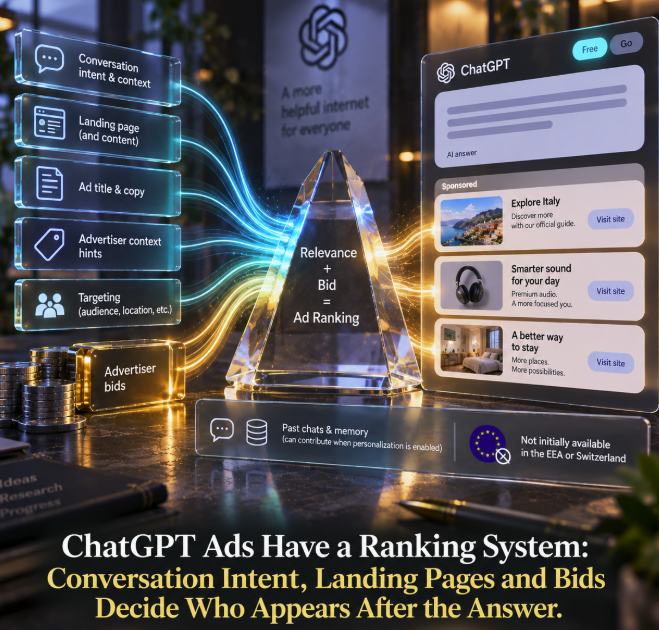
ChatGPT Ads now has a documented ranking system. OpenAI has published new detail on how advertisements are selected and ordered beneath ChatGPT responses, showing that the paid layer is not simply a matter of buying an impression against a keyword.
According to OpenAI's updated Ads in ChatGPT documentation, advertisements can appear below the end of a response for eligible users on the Free and Go plans. The system evaluates the intent and context of the current conversation together with the ad's landing page, title, copy, advertiser-provided context hints and targeting selections. When more than one eligible advertisement can be shown, OpenAI says ranking considers a combination of factors including relevance and advertiser bids.
For advertisers, this is the clearest indication yet that ChatGPT Ads introduces its own optimization problem. The bid matters, but so does the system's understanding of what the user is trying to accomplish and how well the advertiser's message and destination fit that conversation.
Ads appear after the answer, not inside it
OpenAI continues to draw a firm product boundary between advertising and the assistant's response. Ads can appear below a ChatGPT answer, are labeled as sponsored and are visually separated from the generated response.
The company says advertisers cannot influence, rank or alter ChatGPT's answers. Seeing an advertiser below a response therefore does not mean the model recommended that business, nor does purchasing advertising provide a mechanism for entering the organic answer.
This distinction is essential when measuring AI visibility. ChatGPT now has an organic answer layer and a paid placement layer, but they operate through separate systems and should not be reported as though they were interchangeable.
Conversation intent is one of the core ad-selection signals
Traditional search advertising begins with a query. ChatGPT advertising can evaluate a much larger unit of context: the conversation itself.
OpenAI says its ads system considers both the context and intent of the current conversation. A user may have already described a problem, compared options, added constraints, rejected an earlier suggestion and clarified what they actually need. That sequence can provide substantially more information about commercial intent than a short search phrase.
This does not mean advertisers receive the conversation. OpenAI says chats are not shared with advertisers. The relevance assessment happens within ChatGPT, while advertisers receive aggregated, non-identifying performance information such as views and clicks.
The landing page is part of the matching system
One of the most important details for search marketers is that OpenAI explicitly lists the ad's landing page among the signals used for selection and delivery.
That means the destination is not merely where the user goes after clicking. Its content can contribute to the system's understanding of whether the advertisement is relevant to the conversation in the first place.
This creates a familiar but distinct optimization problem. A campaign may have strong creative and a competitive bid, but the landing page still needs to make the product, service or offer understandable enough for OpenAI's advertising system to connect it with the appropriate conversational context.
OpenAI has not published a weighting formula for these signals, so advertisers should not infer that the landing page carries a specific percentage of an ad's score. The confirmed point is narrower: landing-page information is one of the documented inputs.
Ad title and copy are also ranking inputs
The title and description do more than persuade the user after an ad is displayed. OpenAI lists both among the signals considered when selecting and delivering ads.
For advertisers, this increases the value of semantic clarity. Creative needs to communicate what is being offered, not simply attract attention. If the matching system is trying to understand whether an ad belongs beneath a particular conversation, vague language can make that relationship harder to establish.
This does not imply that marketers should mechanically stuff conversational keywords into ad copy. OpenAI's system is explicitly described in terms of context and intent, and its advertiser guidance treats context hints as broader relevance guidance rather than exact-match keyword targeting.
Context hints are not conventional keywords
OpenAI's advertiser documentation adds another useful layer. At the ad-group level, advertisers can provide context hints describing conversations, topics or keywords where their products or services may be relevant.
OpenAI says those hints help guide ad matching but are not exact-match keywords and do not guarantee delivery in a particular conversation. That makes them closer to semantic guidance than a traditional instruction to bid on a specific query string.
For campaign strategy, the distinction matters. An advertiser is not simply compiling a list of phrases to intercept. It is helping the system understand the kinds of conversations in which the offer makes sense.
Targeting and bids complete the advertiser-controlled side
OpenAI also considers advertiser targeting selections. Together with the landing page, creative and context hints, those settings determine whether an ad is eligible and relevant to a particular opportunity.
When multiple eligible ads compete for placement, advertiser bids enter the ranking decision. OpenAI's advertiser documentation describes the mechanism more specifically as a relevance-weighted, second-price auction designed to balance advertiser and user value.
Advertisers set maximum bids at the ad-group level. Reach campaigns can use maximum CPM bids, while click-focused campaigns use maximum CPC bids. OpenAI currently recommends a starting maximum CPC bid of roughly $3–$5 for CPC campaigns and may provide bid-strength guidance in Ads Manager.
The practical takeaway is straightforward: the highest bid is not documented as an automatic winner. Relevance is part of the auction.
ChatGPT Ads creates a paid relevance problem, not just a bidding problem
That structure makes ChatGPT Ads interesting from an SEO and GEO perspective without turning advertising into SEO. Organic and paid systems remain separate, but both depend in different ways on machines understanding entities, content and intent.
In the paid system, advertisers now know that OpenAI evaluates several semantic surfaces: what the conversation is about, what the landing page contains, what the title and copy communicate and how the advertiser describes the contexts in which the offer is relevant.
The advertiser then adds economic competition through the bid. A useful mental model is therefore not “bid for a keyword,” but “be eligible and relevant to a conversational need, then compete in the auction.”
Personalization can add signals beyond the current conversation
OpenAI's documentation also explains how the ranking system can expand when ad personalization is enabled. Select signals from the user's broader ChatGPT experience may contribute to assessing which ads are relevant.
If memory is enabled, OpenAI says ChatGPT may save and use memories and reference recent chats when selecting an advertisement. Its current ad-controls documentation also says past chats, memory and ad interactions can contribute when personalized ads are active.
Again, those signals remain inside ChatGPT rather than being handed to advertisers. OpenAI says advertisers do not receive chats, chat history, memories, names, email addresses, precise location, IP addresses or sensitive information.
The EEA starts without personalized ads
There is an important regional qualification for European advertisers and users. OpenAI says personalized ads are not initially available in the European Economic Area or Switzerland.
That means the newly opened European advertising markets should not be analyzed as though the full personalization stack described for other regions is already active there. Current-chat context can still matter, but the broader use of past chats and memory for ad personalization is initially unavailable in the EEA and Switzerland.
For Italian advertisers in particular, this distinction follows immediately after OpenAI's September 18 expansion of self-service Ads Manager availability. As NetContentSEO reported in our coverage of the Italian rollout, eligible businesses can now directly create campaigns, but the regional personalization environment is not identical to markets where personalized ads are enabled.
Turning personalization off does not turn ads off
OpenAI also separates personalization from advertising itself. If a user disables ad personalization, ads can still be selected using the context of the current chat thread. What changes is the use of broader signals such as other chat threads, ads history or topics.
This creates two relevance modes rather than a simple ads-on versus ads-off distinction. Contextual matching can operate against the current conversation, while personalized matching can add selected signals from the user's broader ChatGPT experience where the feature is available and enabled.
Free users who want to avoid ads entirely may also have access to an ads-free Free configuration with reduced usage limits and reduced feature access, depending on regional availability. Plus, Pro, Business, Enterprise and Edu accounts do not receive ChatGPT ads under OpenAI's current policy.
One response can support more than one ad
OpenAI says users may see one or more ad units below a response when there is a relevant match. An ad unit itself may contain one or more items from a single advertiser or multiple advertisers.
For longer conversations, OpenAI says it also considers overall context and user experience. That language suggests the ad system is not evaluating each assistant response as an isolated page impression. The conversation's accumulated context can influence whether and how advertising is presented.
OpenAI has not disclosed a fixed ad load, ranking score or formula for how those user-experience considerations interact with the auction.
Some conversations are excluded from advertising entirely
Not every relevant commercial opportunity is eligible for an ad. OpenAI says advertisements do not appear near sensitive or regulated user topics, including personal health, mental health and politics. Temporary Chats also do not show ads, and accounts identified as belonging to users under 18 are excluded.
Those restrictions create an eligibility layer before ranking. An advertiser can have a relevant product and a competitive bid while the surrounding conversation remains ineligible for advertising.
That is another reason not to interpret the auction as a simple highest-bid marketplace. Policy, context, eligibility, relevance and price all participate at different stages.
Landing-page optimization now has a ChatGPT Ads dimension
The documented role of the landing page is likely to be the most immediately actionable part of the update for performance marketers. Landing pages have traditionally been optimized for human conversion and, in search advertising, for alignment with campaign intent and platform quality systems.
ChatGPT Ads introduces another machine reader. OpenAI's advertising system needs to understand the destination well enough to use it as a relevance signal against conversational intent.
That does not justify inventing a new checklist of unconfirmed ranking factors. OpenAI has not said that schema markup, page length, keyword density or any particular SEO technique increases ChatGPT ad rank. The responsible conclusion is limited to what the documentation confirms: landing-page information participates in ad selection.
The paid AI visibility stack is becoming measurable
OpenAI's advertiser documentation currently exposes reporting for impressions, clicks, spend, click-through rate, average CPC, average CPM and conversions. Advertisers can also add static tracking parameters such as UTM parameters to landing-page URLs.
This creates a more conventional measurement layer alongside the still-emerging field of organic AI visibility. Paid ChatGPT exposure can be tied to campaign metrics, while organic citations and mentions require different measurement methods.
The two can now be studied together without confusing them. A brand can ask whether it appears organically in relevant AI answers and separately whether paid placements reach useful conversational contexts at an acceptable cost.
ChatGPT Ads now has its own form of relevance engineering
OpenAI's September 20 documentation update gives marketers a clearer model of what happens after an advertiser launches a campaign. The system does not merely wait for a matching keyword and choose the largest bid. It evaluates conversational intent, creative, destination content, advertiser guidance and targeting, then combines relevance with economic competition when eligible ads need to be ranked.
That creates a new optimization discipline adjacent to search advertising but not identical to it. Advertisers need to make their offer understandable across the surfaces the system actually reads: the landing page, title, copy, context hints and targeting configuration. The bid then competes within that relevance framework.
For NetContentSEO, the larger significance is that AI visibility now has a documented paid-ranking layer. Organic answer inclusion remains independent, but the sponsored space below the answer has its own selection logic — and OpenAI has now begun telling advertisers exactly which signals feed it.