
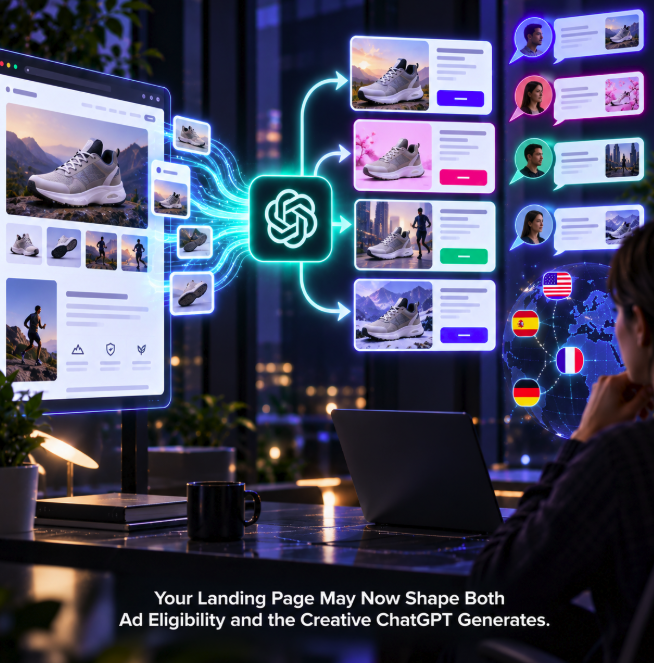
OpenAI is giving the advertiser’s landing page a larger role inside ChatGPT Ads. The page is already one of the signals the advertising system considers when deciding whether an ad is relevant, and OpenAI now says Ads Manager can also use the landing page as source material when suggesting ad copy and imagery. At the same time, advertisers can opt into AI-powered text customization that adapts existing headlines and descriptions to the context of a user’s conversation and automatically translates the copy into the user’s preferred language.
The creative changes were announced in OpenAI’s official September 16 advertising update. OpenAI says advertisers drafting an ad can receive suggested copy and imagery based on the campaign’s landing page and objective. The advertiser remains in control and can review and edit the suggestions before deciding whether to add them to a campaign.
That creates a feedback loop that is unusual compared with conventional ad platforms. The landing page is not merely the destination after the click. It can help ChatGPT’s advertising system understand the offer, participate in relevance and policy decisions, and now provide input for the creative the advertiser may ultimately show.
The landing page already helps determine which ads are relevant
OpenAI’s official ChatGPT Ads documentation says its ad system selects and delivers advertisements based on expected relevance and outcomes. Among the signals it considers are the context and intent of the current conversation, the ad’s landing page, title, copy, advertiser-provided context hints and, when ad personalization is enabled, selected signals from the user’s broader ChatGPT experience.
This means the landing page is already part of the matching system rather than a passive URL attached to the ad. A page that clearly describes a product or service gives the advertising system another source of information when evaluating whether the offer fits the commercial context of a conversation.
NetContentSEO previously documented this architecture in its analysis of how conversation intent, landing pages and bids influence ChatGPT Ads delivery. The September creative tools make the same landing-page content useful at another stage of the campaign lifecycle.
Ads Manager can now use the page to suggest creative
OpenAI says AI assistance is rolling out directly inside Ads Manager. When an advertiser drafts an ad, the system can suggest copy and imagery based on the landing page and campaign objective.
The campaign objective matters because the same product can be framed differently depending on whether the advertiser is trying to generate awareness, clicks or conversions. The landing page supplies information about the offer; the objective supplies information about what the campaign is trying to accomplish.
OpenAI does not describe the feature as autonomous publishing. Advertisers can review and edit the suggested creative before choosing whether to add it to the campaign. That review step is important because a landing page can contain language that is technically accurate in context but unsuitable or misleading when compressed into an advertisement.
The advertiser therefore remains responsible for the claims that reach users even when AI helps draft them.
Text customization can adapt the ad to the conversation
The second major feature is AI-powered text customization. OpenAI says advertisers can opt into a system that adapts their existing headlines and descriptions to better fit the context of a conversation.
This is different from conventional static creative rotation. Instead of choosing only among fixed advertiser-written variants, the system can modify the wording to make an existing message more relevant to what the user is discussing.
OpenAI also says the feature can automatically translate ad copy into the user’s preferred language. That potentially allows one advertiser-provided message to be adapted across conversational and linguistic contexts without requiring the advertiser to manually write every possible variation.
The opt-in requirement is an important qualification. OpenAI is not saying that every ChatGPT ad is automatically rewritten for every user. Advertisers choose whether to enable the AI-powered customization feature.
Conversation context and ad personalization are not the same thing
OpenAI’s advertising documentation distinguishes between the context of the current conversation and broader ad personalization. That distinction matters when describing how creative can change.
Even when broader ad personalization is disabled, ads can still be selected using the context of the conversation currently taking place. Broader personalization, where available and enabled, can use selected signals from a user’s wider ChatGPT experience.
The September announcement specifically says AI-powered text customization can adapt advertiser headlines and descriptions to the context of a conversation. That should not automatically be interpreted as permission to use every piece of a user’s historical ChatGPT activity in the generated wording.
OpenAI’s consumer advertising documentation says users can turn off ad personalization and still see ads based on the current conversation. The platform therefore treats conversational relevance and cross-conversation personalization as separate concepts.
The landing page is also part of the policy and accessibility layer
A landing page has to do more than provide useful semantic input. OpenAI’s creative guidance for ChatGPT Ads says the ad creative, image and landing page must comply with OpenAI’s advertising policies. Ads can be rejected when they are misleading, inconsistent or contain disallowed content.
The same guidance says landing pages must use valid links and must not block OpenAI’s advertising and search user agents, OAI-AdsBot and OAI-SearchBot. That makes technical accessibility part of advertising readiness.
NetContentSEO previously examined the crawler side of this system, noting that OpenAI’s dedicated ads crawler makes landing-page accessibility relevant to campaign validation and delivery. A page can contain excellent product information and still create advertising problems if OpenAI’s systems cannot retrieve it.
The landing page therefore has at least three jobs: satisfy policy and technical requirements, provide information used in relevance decisions and increasingly supply material for AI-assisted creative generation.
The same page can influence the ad before and after the click
Digital marketers traditionally optimize landing pages for what happens after the user arrives: conversion rate, checkout completion, lead generation or another business action. ChatGPT Ads gives the page upstream influence as well.
Before the click, the system can examine the landing page when deciding whether an advertisement is relevant to a conversation. During creative production, Ads Manager can use the page to suggest copy and imagery. After the click, the user finally experiences the page directly.
This makes landing-page optimization a full-funnel advertising task. An unclear page can create friction before a visitor ever sees it, while a precise page can provide better inputs to both the matching and creative systems.
That does not mean advertisers should rewrite landing pages solely for machines. The page still has to persuade and inform people. The emerging challenge is to make the offer explicit enough that both users and automated systems can understand it correctly.
Clear claims become more important when AI can reuse them
AI-assisted creative creates a new reason to audit the language on product and service pages. If Ads Manager can use landing-page content as input, vague, exaggerated or context-dependent claims can become poor source material for advertising suggestions.
A statement buried in a technical qualification may not survive compression into a headline. A promotional phrase that assumes the reader has already seen pricing details may become misleading when separated from those details.
Advertisers should therefore think about whether the page expresses benefits, limitations, pricing and eligibility in ways that remain accurate when summarized. This is similar to optimizing content for AI retrieval more broadly: the clearer the underlying source, the less ambiguity an automated system has to resolve.
Human review remains the safeguard. OpenAI says advertisers can edit AI suggestions before adding them, so the system is providing draft material rather than transferring responsibility for claims to the platform.
AI-generated creative and website-metadata drafts are separate features
OpenAI’s current Help Center documentation also describes a “Suggested ad drafts” feature that can prefill an ad with an image, title and description using existing website metadata. That documentation explicitly says the suggested-draft feature does not generate new copy or imagery with AI.
This should not be confused with the AI assistance announced on September 16. The launch announcement separately says Ads Manager can suggest copy and imagery based on the landing page and campaign objective.
The distinction illustrates how quickly OpenAI’s advertising tooling is evolving. One workflow can import or prefill existing website material, while another uses AI assistance to propose creative. Advertisers and analysts should avoid collapsing every automated creative feature into a single mechanism.
For reporting purposes, it is useful to identify whether a particular asset was imported from site metadata, generated as an AI suggestion or adapted through the opt-in text-customization system.
Creative variation can become much more granular
OpenAI already advises advertisers to build for coverage rather than rely on one message. Its creative guidance recommends multiple distinct headline and copy variants so the system has more opportunities to match relevant messages to users.
AI-assisted creation and contextual customization can dramatically increase that variation. A landing page can seed new creative suggestions, while existing advertiser copy can be adapted to different conversations and languages.
This changes the bottleneck. Producing another text variation becomes cheaper, so the harder problem becomes controlling quality across a larger creative surface. Advertisers need to ensure that variations remain meaningfully different, factually accurate and aligned with the underlying offer.
OpenAI’s own guidance emphasizes usefulness and specificity over generic marketing language. In a conversational environment, an ad that directly addresses what the user is trying to accomplish may be more valuable than a broad slogan designed for mass reach.
Localization can move from campaign production to delivery
Automatic translation is another potentially significant operational change. International advertisers traditionally maintain localized creative libraries, with separate copy written or reviewed for each market.
OpenAI says opt-in text customization can automatically translate ad copy into a user’s preferred language. That can reduce the number of manually produced variants needed to reach multilingual audiences.
But automatic translation does not eliminate localization risk. Product availability, pricing, regulatory claims and cultural expectations can differ between markets even when the words translate correctly. Advertisers still need campaign targeting and landing pages that match what the translated advertisement promises.
The technology can solve the language transformation; it cannot automatically guarantee that the underlying commercial offer is valid in every country where that language is spoken.
Landing-page optimization is becoming AI advertising optimization
The September 16 rollout makes the advertiser’s website more central to ChatGPT Ads than a conventional destination URL. OpenAI’s system can use the landing page as a relevance signal, Ads Manager can use it as input for creative suggestions, and policy systems need to be able to crawl and validate it.
That means paid AI discovery increasingly rewards the same qualities that matter in other machine-mediated channels: structured information, explicit product benefits, accurate claims, accessible pages and strong consistency between source content and promotional messaging.
The difference is that the advertising system can now actively transform those inputs. It can help generate copy and imagery, adapt existing text to a conversation and translate the message for the user.
For advertisers, the landing page is becoming both destination and dataset. The content that once waited at the end of the ad journey can now help determine whether the ad is relevant and what the ad itself says before the click ever happens.