

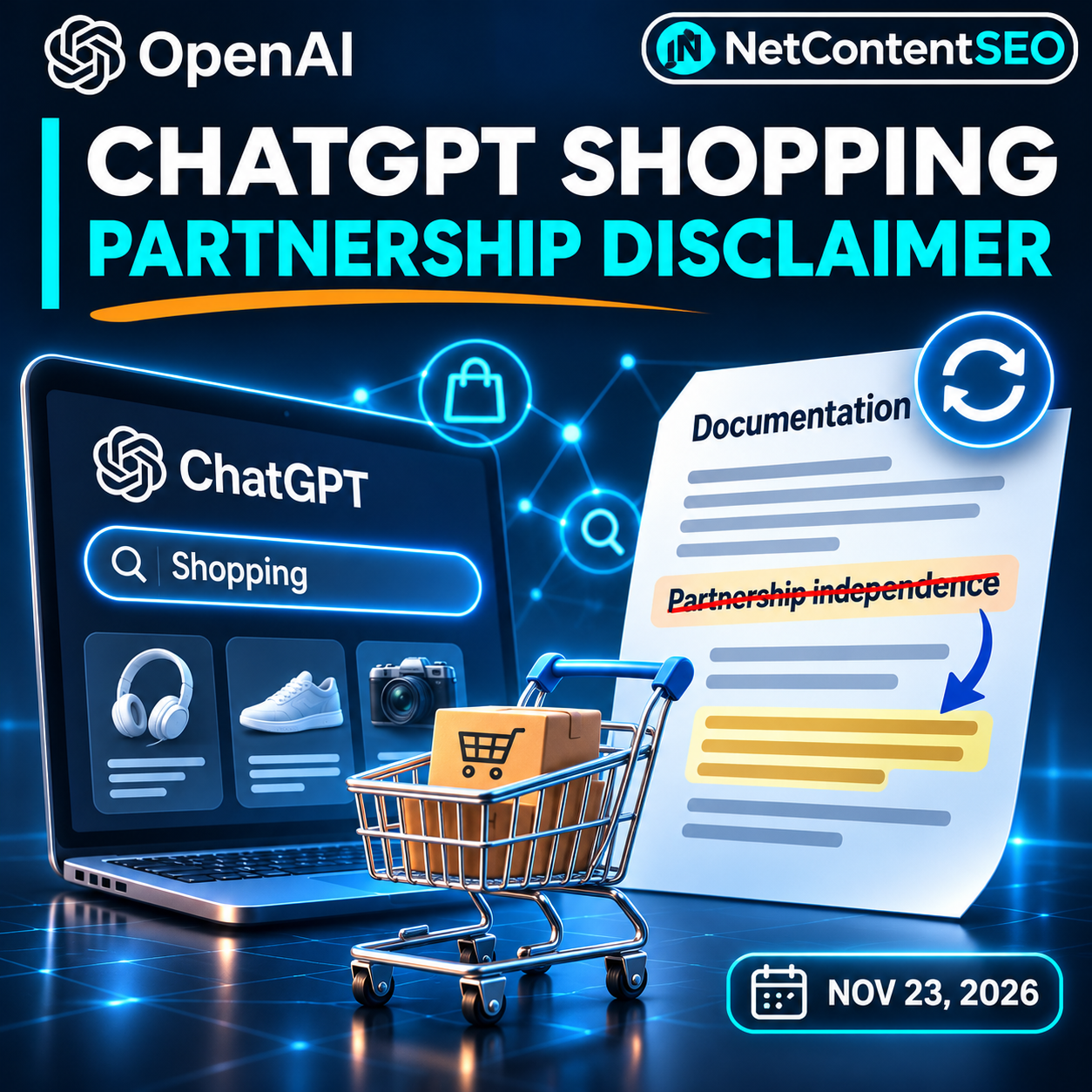
OpenAI has removed an explicit assurance about commercial partnership independence from its ChatGPT shopping documentation. The change, reported on November 23, 2026, by Barry Schwartz at Search Engine Roundtable, raises important questions for ecommerce merchants and AI Search professionals. The updated documentation still distinguishes product recommendations from advertising. Crucially, the removal of a statement does not establish that commercial partnerships now determine product rankings.
What changed in OpenAI's documentation?
According to Search Engine Roundtable's November 23 report, the previous wording explicitly denied influence from OpenAI partnerships and described product selection as independent. The current Shopping with ChatGPT Search help page instead states: “Product results are not ads; how products and merchants are selected is described below.”
The present wording is directly verifiable in the official documentation. The historical comparison comes from Schwartz's reporting, which credits Juozas Kaziukėnas for spotting the change. November 23 is the reporting date, not necessarily the precise date when OpenAI edited the page.
Does this mean partnerships now influence shopping rankings?
No such conclusion can be established from the edit alone. The removal changes the scope of the public assurance, but it does not reveal the implementation of the shopping selection system, the terms of individual commercial agreements or whether any ranking weights have changed. A documentation revision is evidence of revised communication, not conclusive evidence of a revised algorithm.
That distinction should remain central to coverage of this story. Merchants have a legitimate interest in understanding whether commercial relationships affect discoverability, but a claim of preferential placement requires evidence beyond a deleted sentence.
Product results and advertising remain separate
OpenAI continues to describe shopping results as distinct from paid advertisements. Its separate advertising documentation explains that advertising does not influence the assistant's answers and that ads are labeled separately. The shopping documentation update should not be interpreted as an announcement that advertisers can buy organic product recommendations.
How ChatGPT selects products and merchants
The current shopping documentation describes multiple inputs, including the customer's request and relevant context, structured product information from providers, existing model-generated responses and applicable safety requirements. Product inclusion is therefore not equivalent to ranking a conventional web page for a keyword.
Merchant selection is another stage. After identifying a product, the system can display suppliers using information from participating data providers and merchants. Commercially relevant attributes such as stock, cost, merchant quality and whether the seller is the original manufacturer can affect this comparison. These are examples of documented considerations, not a complete formula or a guarantee of inclusion.
Why product feeds matter for ecommerce GEO
The official help page identifies Shopify Catalog as a source of integrated merchant product information and describes an application process for direct product feeds. These routes are worth evaluating because an AI shopping interface needs reliable product facts, not just persuasive landing pages.
Better catalog coverage may make it easier for a system to discover an item and present accurate details. That potential operational benefit must be distinguished from preferential treatment based on a commercial contract. The documentation does not establish that paying for a partnership improves organic product placement or that submitting a feed guarantees a recommendation.
Independent retailers should keep identifiers, variants, inventory, prices, shipping conditions and return policies aligned across their websites and approved catalog integrations. They should also check whether third-party listings contain outdated or inconsistent information. Accurate product descriptions and accessible landing pages remain useful regardless of how shopping interfaces evolve.
Three different kinds of commercial visibility
Ecommerce reporting increasingly needs to distinguish product discovery, merchant selection and paid promotion. A brand might appear in a generated product comparison while a competing retailer receives the purchase link. A merchant might have an accurate catalog feed but rarely be selected for a particular shopping intent. An advertiser might receive sponsored impressions without appearing in unpaid recommendations.
These outcomes have different business implications. Measuring them together can hide whether a visibility change comes from catalog coverage, product relevance, merchant availability or advertising delivery.
How to monitor ChatGPT shopping visibility
Merchants and SEO teams can establish a repeatable benchmark using representative shopping requests, including category searches, product comparisons and specific budget or delivery requirements. Record the date, market, relevant user context, products displayed, merchant links and whether any placements are explicitly sponsored. Repeat comparable requests because generative results can vary.
Compare catalog availability with the products actually displayed, and distinguish a product-level omission from a merchant-level omission. Where possible, reconcile referral sessions and conversions with first-party analytics. Repeated observations may reveal patterns worth investigating, but they cannot on their own prove a causal relationship between a partnership and ranking. Such research would require controls for competing explanations and reliable information about the relevant agreements.
What ecommerce businesses should do now
- Audit catalog completeness and product identification across sales channels.
- Review eligibility for supported catalog integrations and direct feeds.
- Keep pricing, inventory and fulfillment information synchronized.
- Maintain useful, accessible product pages with accurate specifications and policies.
- Track product recommendations, merchant links and paid placements separately.
- Document repeated visibility patterns instead of drawing conclusions from a single generated response.
- Monitor official documentation for clarification about commercial relationships and selection criteria.
What this means for SEO and GEO
This is not an announced Google or Bing organic ranking update. It is a transparency issue within an increasingly important shopping discovery channel. As consumers use assistants to narrow product choices, the ability to surface a relevant product and identify a suitable seller can influence the path to purchase.
For generative engine optimization, the practical challenge extends beyond brand mentions. Businesses must understand whether their product information is available to the system, whether their products are recommended when relevant and whether their stores appear among viable purchase destinations. None of these outcomes is guaranteed by conventional SEO or by a commercial integration.
What remains unknown
OpenAI has not explained in the cited shopping documentation why the explicit partnership assurance was removed. The available evidence does not establish a change in ranking weights, a paid inclusion mechanism, preferential merchant treatment or a measurable effect on ecommerce traffic. The historical wording comparison is reported by Search Engine Roundtable; the revised wording is confirmed directly in OpenAI's current help page.
The bottom line
A public assurance about partnership independence has disappeared, making the question of commercial influence worth investigating. But the appropriate response is scrutiny rather than an unsupported accusation. Ecommerce professionals should prioritize reliable product data, distinguish advertising from unpaid visibility and monitor how products and merchants are selected as AI shopping evolves.
Sources: OpenAI Shopping with ChatGPT Search; Barry Schwartz, Search Engine Roundtable, November 23, 2026; OpenAI Ads in ChatGPT.