

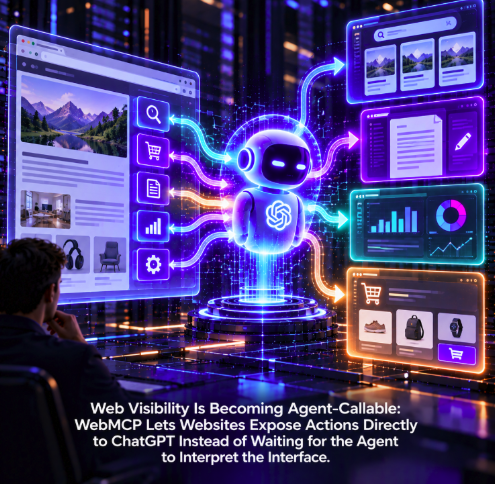

Web visibility is starting to acquire a new technical layer. A website no longer has to wait for an AI agent to inspect its interface, infer what buttons and fields mean and simulate a human user. With site tools in ChatGPT’s desktop browser, supported websites can expose structured capabilities directly to the agent through WebMCP.
OpenAI documents the feature in its official guide to site tools in the ChatGPT desktop app. The company says site tools use WebMCP, a proposed web standard that lets websites make tools available directly to AI agents. Availability currently depends on the user’s account and selected model, the website must provide compatible tools, and the feature works in the ChatGPT desktop app’s built-in browser rather than ordinary Chrome. citeturn0search0
The architectural change is significant. Search visibility asks whether a machine can discover and retrieve information. Browser-agent accessibility asks whether a machine can operate a human interface. WebMCP introduces another question: has the website published a machine-callable capability for the task itself?
A website can tell ChatGPT what it knows how to do
OpenAI says ChatGPT automatically discovers site tools provided by the webpage currently open in its built-in browser. When tools are available, an indicator appears in the address bar; users can inspect the available tools and see whether they read information or make changes. If a tool matches the user’s request, ChatGPT can discover and use it automatically. citeturn0search0
That is different from conventional browser automation. In a purely visual workflow, an agent has to understand the rendered page and decide which control corresponds to the desired action. A site tool gives the agent an explicit capability supplied by the website.
The site effectively publishes an action surface alongside its human interface.
WebMCP moves machine usability from inference toward declaration
Modern websites already expose meaning to machines in several ways. HTML gives documents structure. Structured data can identify entities and properties. APIs expose data and operations to software clients. WebMCP brings a related concept into the agent-facing web experience: a page can declare tools that an AI agent can invoke while working with the live site.
This matters because interfaces are often ambiguous to automation. A button labelled “Continue” may have different meanings depending on state. A dashboard can contain dozens of interactive controls. A rich editor may require complex event handling. A structured tool can describe the intended capability more directly than visual interpretation alone.
WebMCP therefore does not simply make a page easier to read. It can make the site’s functionality more legible to an agent.
The first documented use cases span search, editing, dashboards and commerce
OpenAI’s examples show how broad the tool surface can be. ChatGPT can use site tools to search documentation or compare information, edit a document, whiteboard or notebook, explore a dashboard or interactive page, build a travel itinerary, compare available options and update a shopping cart. citeturn0search0
These examples cross the boundary between retrieval and action. Searching documentation is primarily informational. Editing a document changes state. Updating a cart changes a commercial workflow. Exploring a dashboard can combine retrieval with interactive analysis.
That range makes WebMCP relevant beyond developer tooling. Any website whose value depends on structured actions could eventually have an agent-facing interface distinct from the visual interface humans use.
Site tools operate on the live page and signed-in session
Site tools use the webpage that is open, its current state and the user’s signed-in session. The user and ChatGPT can work on the same live page and review changes as they happen. If authentication is required, OpenAI instructs the user to sign in directly on the website. citeturn0search0
This is important because WebMCP is not merely a remote public API detached from browser state. The tool is associated with the webpage providing it and can participate in the context of the user’s current session.
OpenAI notes that the built-in browser maintains its own browser state, so being signed into a site in Chrome does not necessarily sign the user into the same service inside ChatGPT’s browser. citeturn0search0
Tools are page-scoped rather than universally installed
A site tool is available only on the webpage that provides it. OpenAI says a tool does not carry across to another page or website, and closing the relevant page removes access until the user opens it again. Tools supplied only by embedded content are not currently supported. citeturn0search0
That creates a different discovery model from a globally connected app or plugin. The agent discovers capabilities in the context of browsing a particular page.
For publishers, this suggests that agent capability can become page-aware. Different parts of a site can expose different operations depending on what is appropriate to the current context.
Tool calls become part of the conversation’s source trail
OpenAI says site-tool activity appears in the conversation in the order it occurs. In Sources, activity is organized by website and includes the tools ChatGPT used. Users can also inspect recently used tools from the browser interface. citeturn0search0
This creates an interesting new meaning for provenance. A source trail can document not only which webpage supplied information, but which structured capability the agent invoked while completing the task.
For businesses, that could eventually make agent visibility measurable at an action level. Being cited is one form of visibility; being selected as the tool that completes the user’s task is another.
Agent-callable visibility is not the same as search visibility
A website can be highly visible in search and expose no WebMCP tools. Conversely, a site tool cannot help an agent on a page it never reaches. The two layers complement rather than replace one another.
NetContentSEO has repeatedly found that AI discovery contains multiple gates. In an analysis of ChatGPT query fan-out, one visible user prompt generated many hidden searches before sources were selected. WebMCP sits farther downstream: after navigation reaches a supported page, the website can expose an explicit operation instead of forcing the agent to infer every interaction from the interface.
This expands the visibility funnel from discovery, retrieval and citation into capability discovery and execution.
WebMCP can reduce the fragility of visual browser automation
Browser agents can already click buttons and fill forms, but visual automation is inherently exposed to interface change. A redesigned menu, modal, unusual widget or ambiguous label can alter the path the agent must follow.
A structured site tool can offer a more direct route because the website itself defines the operation. That does not guarantee perfect execution, and OpenAI does not claim that site tools eliminate all browser failures. But the architecture can reduce dependence on the agent correctly reverse-engineering the UI for every task.
For developers, this is similar to the difference between screen-scraping an application and integrating with a documented operation. The human interface remains valuable, while the machine gets a more explicit contract.
Cloud Browser and desktop site tools solve different problems
It is important not to confuse WebMCP site tools with ChatGPT Work’s Cloud Browser. NetContentSEO recently covered Cloud Browser’s ability to operate supported websites remotely. That environment runs on a separate cloud computer and can continue delegated work after the user leaves. citeturn0search5
Site tools, by contrast, are currently documented for the built-in browser in the ChatGPT desktop app. The user and ChatGPT share the live browsing context, and tools are discovered from the webpage currently open there. citeturn0search0
Both systems move AI discovery toward action, but they do so through different execution environments. One emphasizes remote delegated browsing; the other adds structured agent-callable capabilities to a user-supervised desktop browsing session.
Security becomes part of the tool contract
Giving websites structured capabilities also creates risks that ordinary content retrieval does not. OpenAI explicitly warns that site tools can expose functionality not otherwise visible on the webpage and introduces risks including data exfiltration and prompt injection. citeturn0search0
The company says ChatGPT applies its normal browser safeguards plus an additional review before each site-tool call, checking the tool and the information it would receive. ChatGPT asks permission before interacting with a website and requires confirmation for sensitive activities such as sharing personal information, making purchases, deleting data, changing permissions or sending messages. citeturn0search0
A website or tool cannot authorize sensitive disclosure on the user’s behalf. If a tool asks for information from outside the current page, OpenAI says ChatGPT asks the user to verify the request before proceeding. citeturn0search0
Agent optimization now includes designing good tools
If agent-callable websites become common, a new optimization discipline follows naturally. The quality of a tool’s name, purpose, input requirements, permissions and output can affect whether an agent understands when to use it.
This is not conventional SEO, because the object being optimized is not simply a document for ranking. Nor is it ordinary UX, because the consumer is partly an automated agent. It resembles API design, information architecture and conversion design converging around a machine user.
A retailer might expose an operation that searches current inventory and another that updates a cart. A SaaS product might expose a dashboard query or document-edit operation. A travel service might expose availability comparison. The strategic question becomes whether the site gives the agent a reliable action primitive for the user’s intent.
The website can become an agent capability provider
OpenAI’s documentation says each website decides which tools to provide, and those tools can vary between websites and pages. citeturn0search0
That makes the publisher or service operator an active participant in agent orchestration. Instead of merely publishing content and hoping an AI system interprets it correctly, the site can expose a supported way to perform a task.
The conceptual shift resembles what APIs did for software integrations, but it is occurring inside the browsing experience. A user can arrive with a natural-language objective, while ChatGPT discovers the website’s declared capability and invokes it on the user’s behalf.
Visibility can now culminate in a tool call instead of a click
Traditional search visibility is usually monetized when a user clicks through. Generative search complicates that model because an AI answer can cite a publisher without producing a visit. Agentic browsing changes it again because the assistant may interact with the service to complete the task.
WebMCP introduces a further possibility: the valuable event can be the selection of a site-provided tool. The agent does not merely read the page or imitate a visitor. It calls an operation the site intentionally exposed.
This does not make clicks, pages or conventional interfaces obsolete. OpenAI’s current implementation explicitly depends on the relevant webpage being open. But it changes what a successful machine interaction can look like.
The agentic web is acquiring its own interface layer
OpenAI describes WebMCP as a proposed web standard, so its eventual reach beyond the current ChatGPT implementation should not be assumed. Site tools are also limited today by account, model, desktop-app and website support. citeturn0search0
Even with those limitations, the product direction is clear. Websites have historically published interfaces primarily for people and documents primarily for crawlers. They can now begin publishing structured actions for agents.
That gives web visibility a new endpoint. First the agent has to discover the business or page. Then it has to retrieve or navigate to the relevant context. But once it arrives, the site no longer has to depend entirely on the agent interpreting pixels, DOM controls and interaction patterns correctly.
With WebMCP, the website can tell ChatGPT what it can do—and provide a structured way to do it. In an agentic web, that may become as strategically important as telling a search engine what a page is about.