

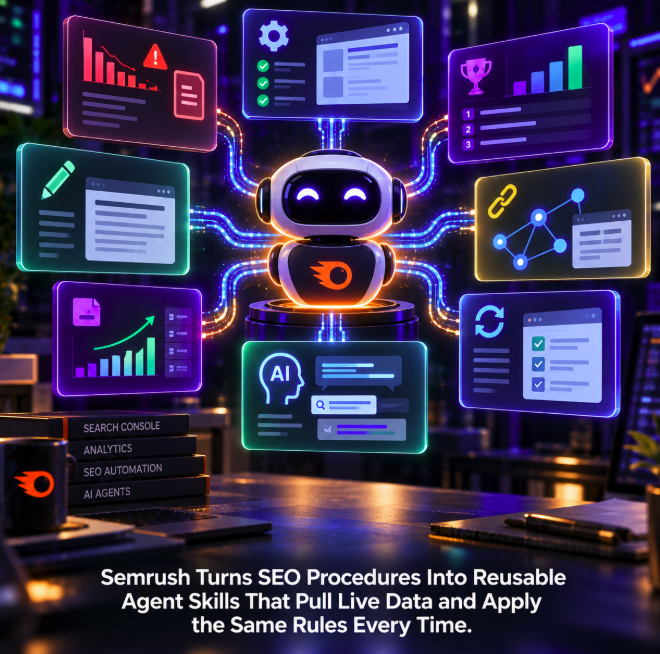
Semrush has published a practical blueprint for turning recurring SEO procedures into reusable AI-agent skills rather than rebuilding the same instructions in a prompt every time. The company tested eight workflows against a live website, connecting an AI environment to current SEO data and giving the agent documented methods for tasks ranging from content decay and technical triage to internal linking, AI citation gaps and post-migration checks.
The official Semrush guide, published September 18 by Carlos Silva with contributions from Faizan Ali, defines agentic SEO as handing a repeatable workflow to an AI system that can retrieve its own data, follow a documented methodology and return the same kind of analysis each time it runs. The emphasis is not simply on making an LLM perform more SEO tasks. It is on separating business context, methodology, data access and the current request so the process can be reused and debugged.
That distinction matters because much of what is marketed as AI SEO is still prompt-driven assistance: export a spreadsheet, paste it into a chatbot, describe the task and hope the next run follows the same logic. Semrush’s model treats the procedure itself as infrastructure. The agent receives live data through Model Context Protocol connections, reads a reusable skill that defines the checks and rules, and uses a short prompt only to specify what should be done now.
Semrush splits agentic SEO into four layers
The framework starts with a project containing persistent information about the site, business, audience and constraints. This can include strategy documents, content guidelines, brand rules and ideal-customer profiles. Instead of repeatedly explaining those details inside every prompt, the project supplies the background across runs.
The second layer is the skill: a documented method containing the steps, definitions, checks and conditions the agent should apply. Semrush describes this as the part that makes the workflow repeatable. If a technical audit should always verify a particular set of conditions, those conditions live in the skill rather than depending on whether the operator remembers to mention them during the next conversation.
The third layer is live data. Semrush uses MCP connections to give the AI access to systems such as Semrush, Google Search Console and Google Analytics. Its setup also references SerpAPI for AI Overview data and Firecrawl for web extraction, with additional destinations such as content-management systems, GitHub, Slack or project-management tools available depending on the workflow.
Only the fourth layer is the prompt. Once the other pieces exist, the prompt can remain short because it no longer needs to carry the entire methodology, company background and dataset. Semrush argues that this architecture reduces drift and makes failures easier to diagnose: when something goes wrong, the operator can determine whether the problem sits in context, procedure, data or the immediate task.
Eight workflows turn familiar SEO work into reusable skills
The eight examples cover a surprisingly broad slice of recurring SEO operations. One workflow looks for content decay by combining performance history with page context, helping identify URLs that have lost visibility and need investigation. Another performs technical triage, prioritizing Site Audit issues instead of merely dumping every warning into a report.
A competitor-investigation skill pulls current competitive data and applies a defined analysis method, while a search-opportunity workflow turns keyword and SERP evidence into a structured content brief. Internal linking becomes another agentic procedure: the system can inspect site content and identify contextual opportunities according to predefined rules rather than generating arbitrary link suggestions from a one-off prompt.
Semrush also demonstrates a portfolio-level workflow for evaluating multiple pages or opportunities together, an AI citation-mapping workflow for finding gaps in generative-search visibility, and a post-migration workflow designed to check whether important SEO elements survived a site move. The common feature is not the task category but repeatability: each process has a method that can be invoked again when the underlying data changes.
Live data is what separates the model from a sophisticated prompt
Semrush’s strongest argument is that an agentic workflow should retrieve current evidence rather than depend on whatever export happens to be pasted into a conversation. Its Semrush MCP connection exposes ranking, keyword, competitor, backlink and Site Audit information, while Search Console and Analytics connections can provide clicks, impressions, index information, engagement and conversion data.
This changes the role of the AI. A conventional chatbot can reason over a CSV, but the human remains responsible for producing the CSV, choosing the date range, updating it later and remembering which other datasets are needed. An agent with tool access can request the information defined by the workflow when the task runs.
That is particularly useful for recurring analysis. A content-decay review performed this week should use this week’s traffic and search data, not the spreadsheet an analyst downloaded last month. A post-migration check should query the current site and current index state. A competitor workflow should not assume that the competitive landscape remained frozen after the first analysis.
Consistency is the real automation target
The word Semrush repeatedly emphasizes is “same.” A workflow has not truly been automated if an AI produces a detailed competitor analysis in one run and a fundamentally different methodology the next time. The purpose of a reusable skill is to preserve the decision process while allowing the evidence and conclusions to change.
This is a useful correction to the idea that longer prompts automatically create better automation. Very large prompts mix instructions, background, examples, data and current requests into one fragile block. Semrush’s approach externalizes the stable parts. The skill can be improved over time without rewriting the entire operating prompt, and the business context can change independently of the technical procedure.
The architecture also creates a clearer review surface for human experts. An SEO lead can inspect the skill and ask whether its rules are sensible before allowing it to run repeatedly. That is more auditable than asking why an opaque conversation produced a particular recommendation after dozens of turns.
Agentic does not mean every SEO task should become an agent
Semrush explicitly draws a boundary around the concept. If a task is fixed and mechanical—checking 50,000 URLs for a status code, for example—a conventional script may be faster, cheaper and more deterministic. Agentic workflows are better suited to recurring tasks that require judgment but still follow a definable method.
The framework also does not eliminate human responsibility. An agent can apply rules consistently while the rules themselves remain flawed. It can retrieve live data while misinterpreting what that data means. It can generate a technically coherent content brief that conflicts with business priorities the project context failed to capture.
This is the same accountability problem that appears across AI SEO tooling. NetContentSEO recently examined how AI SEO systems can win on speed, price and output volume while leaving responsibility for a bad recommendation unresolved. Reusable skills improve consistency, but consistency only helps when the underlying method deserves to be repeated.
AI citation gaps become an operational workflow
One of the most strategically interesting skills addresses AI citations. Instead of treating generative visibility as a periodic research project, an agent can retrieve current evidence about where a brand or competitors are being cited, apply the same gap-analysis procedure and return prioritized opportunities.
This fits an emerging shift from domain-level SEO metrics toward source-level AI visibility. NetContentSEO recently covered another Semrush methodology arguing that teams should target the exact third-party pages AI systems already cite for commercially important prompts, rather than treating an entire publication as a single outreach target.
Turning that kind of analysis into a reusable skill is significant because AI-source ecosystems can change quickly. The useful output is not a static list of citations collected once, but a repeatable process that can be rerun to see which sources appeared, disappeared or began mentioning competitors.
Internal linking and content decay are natural candidates for agent skills
Some of the eight workflows are less novel conceptually but especially suitable for the agentic model. Content decay requires repeated comparison over time, contextual judgment about why a page is declining and a decision about whether to update, consolidate or leave it alone. Internal linking requires understanding page meaning, site structure and contextual relevance rather than merely matching keywords.
Both tasks contain enough judgment to make a rigid script limiting, yet enough repetition to make manual analysis expensive. A documented skill can define what evidence should be collected, which conditions trigger a recommendation and when uncertainty should be escalated rather than guessed.
The same logic applies to technical triage. Site crawlers already generate large inventories of issues. The valuable step is often deciding which problems matter for this site now. An agent that combines technical findings with search performance and business context can potentially prioritize more intelligently than a generic severity label, provided the prioritization rules are transparent and reviewed.
Post-migration checking shows where agentic SEO can become operational infrastructure
Site migrations are a strong test case because the same classes of errors must be checked repeatedly under time pressure: redirects, canonicalization, indexing, internal links, metadata, status codes and traffic changes. A documented procedure is valuable precisely because teams do not want the checklist to change depending on who happens to be online after launch.
An agent can run the established method against current crawl and search data, flag deviations and produce a structured report. It can also repeat the check after fixes are deployed, turning what is often a spreadsheet-heavy sequence of manual comparisons into an ongoing monitoring loop.
That does not make migrations autonomous. High-impact changes still require expert judgment, and automated systems should not be given unrestricted publishing or infrastructure permissions simply because they can diagnose problems. The practical value is in reducing repetitive collection and analysis while preserving human approval for consequential actions.
Open procedures may matter more than proprietary prompts
Semrush’s decision to publish the workflows is notable because the durable asset in agentic SEO may not be a secret prompt at all. A well-designed skill resembles a standard operating procedure that software can execute: it defines inputs, checks, decisions, expected outputs and escalation conditions.
That makes methodologies portable. The Semrush examples use Claude because its projects and skills map neatly to the architecture, but Semrush itself says capable chatbots can implement versions of the model. MCP is also an open standard, meaning the broader pattern is not inherently locked to one AI interface.
What remains proprietary is often the data, tooling and organizational context connected to those skills. Two companies can use the same content-decay procedure and reach different conclusions because their Search Console performance, competitors, conversion priorities and editorial standards differ.
The next SEO automation layer is methodology, not just generation
The most important idea in Semrush’s eight-workflow experiment is not that AI can audit a site or write a brief. Chatbots have been able to assist with those tasks for years. The change is packaging the procedure so the agent can retrieve fresh evidence and apply the same decision rules again next week without the operator reconstructing the process from memory.
That turns an AI assistant from a conversational tool into something closer to an operational layer for SEO. The project stores business context, the skill stores methodology, MCP connections supply live evidence and the prompt triggers the current job. Each component can be inspected and improved independently.
For SEO teams, that may be the more durable form of automation. The competitive advantage is not asking an AI to “do SEO” with a clever prompt. It is translating the organization’s best repeatable procedures into explicit skills, connecting those skills to trustworthy live data and keeping humans responsible for the methods and decisions that matter.