

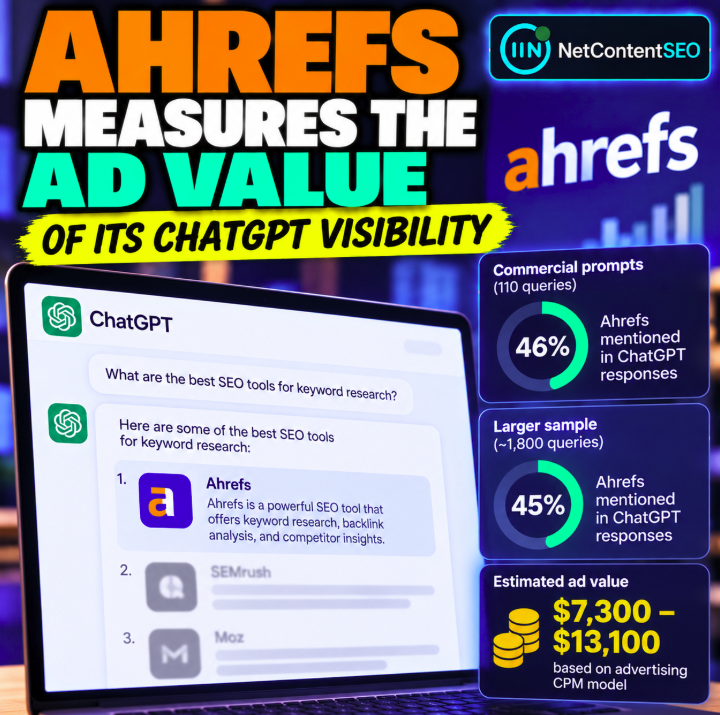

Ahrefs has published an experiment estimating the advertising-equivalent value of its visibility in ChatGPT, using Brand Radar data and Letaido. In the company's analysis, its brand appeared in 46% of responses across a sample of roughly 110 commercial prompts. When the analysis expanded to approximately 1,800 prompts, Ahrefs appeared in 45% of responses. Applying an advertising-value model to the larger sample, the company estimated an equivalent value of $7,300–$13,100.
The figures come from Ahrefs' own research published on October 6, 2026. The dollar amount is a modeled advertising equivalent based on CPM assumptions—not revenue, measured traffic, conversions or money earned from ChatGPT.
What Ahrefs measured
The experiment combines Ahrefs Brand Radar with Letaido to examine how often the Ahrefs brand appears in ChatGPT answers to commercial prompts. The reported visibility rate was 46% in a sample of around 110 prompts, and 45% after expanding the analysis to around 1,800 prompts.
The similarity between the two percentages suggests that the observed mention rate was broadly similar across these two samples. It should not be treated as a universal estimate for all ChatGPT prompts, markets, users or time periods: the results depend on the prompt set and the methodology used.
How the advertising-equivalent estimate works
Ahrefs then applied an advertising-value model to the broader prompt sample and estimated $7,300–$13,100 in equivalent value. This approach attempts to express brand exposure in a familiar marketing unit by comparing it with assumed advertising costs, such as CPM-based media value.
That calculation is a simulation, not a record of actual ad spend avoided or revenue generated. An AI mention is not automatically equivalent to a paid impression: exposure, prominence, user attention, intent and downstream behaviour can differ significantly. The estimate should therefore be read as one proposed valuation method, not as a standard market price for AI visibility.
Why this matters for GEO and AI visibility measurement
Generative Engine Optimization (GEO) measurement often focuses on whether a brand appears in AI answers, how prominently it is mentioned, and whether the answer cites or links to its website. Ahrefs' experiment adds a financial framing: it asks whether observed brand visibility can be translated into an estimated advertising-equivalent value.
This is useful as an exploratory metric, but it does not replace measures such as referral visits, qualified leads, conversions, citations, sentiment or share of voice. Each answers a different question. A brand can be mentioned without receiving a click, and a citation can send traffic without being equivalent to a paid-media impression.
What the figures do—and do not—show
- 46%: Ahrefs appeared in responses to roughly 46% of around 110 commercial prompts in the smaller sample.
- 45%: the reported visibility rate across approximately 1,800 prompts.
- $7,300–$13,100: Ahrefs' estimated advertising-equivalent value for visibility in the larger sample, based on a CPM-style model.
- Not actual revenue: the estimate does not represent sales, revenue or direct earnings from ChatGPT.
- Not measured traffic: the reported figures do not by themselves quantify visits, leads or conversions generated by the AI answers.
- Not a universal benchmark: results are specific to Ahrefs' experiment, prompt sample and valuation assumptions.
How teams should measure AI visibility
For brands building an AI visibility programme, the most useful approach is to keep several metric types separate and report their limitations clearly.
- Presence: measure how often a brand appears across a documented, repeatable set of prompts.
- Prominence and context: record whether the brand is central to the answer, how it is described, and whether the mention is positive, neutral or negative.
- Citations and links: track when the answer references the brand's own pages or other sources.
- Referral and conversion data: use analytics and attribution where available to identify measurable visits and outcomes.
- Modeled value: if using an advertising-equivalent calculation, publish the CPM assumptions, sample size, time window and formula separately from actual business results.
Repeating the same prompts over time can help reveal changes, but prompt sets, model versions and answer behaviour should be documented. Without consistent sampling, apparent changes in visibility may reflect differences in the test rather than a real shift in brand presence.
Frequently asked questions
How often did Ahrefs appear in ChatGPT answers?
Ahrefs reported a 46% appearance rate across roughly 110 commercial prompts and 45% across a broader sample of approximately 1,800 prompts.
How much was the visibility estimated to be worth?
Using its advertising-equivalent model, Ahrefs estimated $7,300–$13,100 for visibility in the larger sample.
Is that $7,300–$13,100 in revenue?
No. It is a modeled advertising-equivalent estimate based on CPM assumptions, not revenue, direct earnings or verified traffic value.
Can other brands use the same number as a benchmark?
Not without reproducing the methodology and accounting for differences in prompt selection, visibility rates and advertising assumptions. The figure is specific to Ahrefs' experiment.
Does appearing in ChatGPT guarantee a click?
No. A mention may provide exposure without sending a user to a website. Citations, visits and conversions should be tracked separately where possible.
The takeaway
Ahrefs is testing a way to put an advertising-equivalent dollar value on brand visibility in ChatGPT. Its reported visibility rates were 46% across about 110 commercial prompts and 45% across around 1,800 prompts, producing a modeled value of $7,300–$13,100 for the larger sample. The estimate is an exploratory valuation—not actual revenue or measured traffic—and should be interpreted alongside citations, referrals and business outcomes.
Primary source
Ahrefs — AI Search ROI Research (October 6, 2026).