

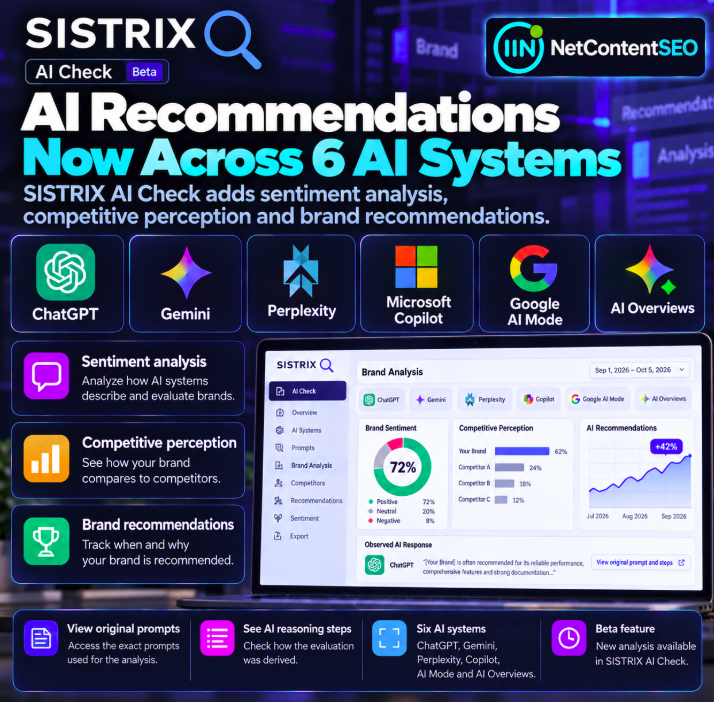

SISTRIX has expanded its AI Check beta with brand sentiment analysis, competitive perception and brand recommendation insights across six AI-powered search and answer systems. According to its October 5, 2026 update, coverage now includes ChatGPT, Gemini, Perplexity, Microsoft Copilot, Google AI Mode and Google AI Overviews. The analyses draw on observed AI responses, and users can inspect the original prompts and response passages supporting an assessment.
The development matters for SEO and Generative Engine Optimization (GEO) because it moves AI visibility monitoring beyond simple brand-mention counts. It introduces questions about how a brand is described, when it is recommended and which evidence supports a particular conclusion. The feature is in beta, and results should be interpreted as observations from the monitored prompts and systems rather than a census of all AI answers.
Primary source: SISTRIX Q3 2026 Changelog.
Which AI systems does SISTRIX AI Check cover?
The October update identifies six monitored environments:
- ChatGPT — AI assistant responses within the monitored testing setup.
- Google Gemini — responses from Google's conversational AI environment.
- Perplexity — AI answer and research responses.
- Microsoft Copilot — Microsoft's AI assistant responses.
- Google AI Mode — AI-led Google search experiences.
- Google AI Overviews — AI-generated summaries appearing within Google Search results.
Although AI Mode and AI Overviews are both Google products, they represent distinct user experiences and are listed separately in SISTRIX's coverage. Results across these environments should not be treated as interchangeable.
Brand sentiment: more than counting mentions
Brand mentions answer whether a name appears in a response. Sentiment analysis attempts to characterize how that name is discussed: positively, negatively or neutrally, depending on the tool's classification methodology. This can help teams notice when an AI system describes a brand favorably while another emphasizes limitations or alternatives.
However, sentiment is a model-derived interpretation of language. It is not a direct survey of consumers, an official reputation score or proof that the underlying assessment is accurate. Analysts should inspect the original text before taking action based on a sentiment label.
Competitive perception: comparing brands in context
The new competitive-perception capability is relevant when users ask AI systems to compare vendors, products or services. A brand may be positioned as a budget option, a premium provider or a specialist in a particular use case, depending on the prompt and the source material the system uses.
Such descriptions can reveal useful messaging questions for marketing teams, but they are sensitive to query phrasing, market, language, model version and time. A small prompt sample cannot support a universal ranking of brand preference.
Brand recommendations: when does an AI assistant suggest a company?
Recommendation analysis looks at whether a brand is actively suggested in a relevant answer rather than simply mentioned in passing. That distinction is especially important for commercial discovery: a response that names a company as one option is different from a response that recommends it for a specific requirement.
Teams should examine the original prompt and surrounding passage. A recommendation for one use case may not generalize to another, and repeated testing is necessary to assess how stable the pattern is.
Why original prompts and response passages matter
One of the strongest aspects of the announced feature is the ability to inspect the original prompts and passages used to derive the evaluations. This provides an evidence trail that can help analysts understand why a sentiment or recommendation label was assigned.
For example, a dashboard might flag a negative brand assessment. Rather than assuming an entire AI system has a negative view of the brand, an analyst can review the question that was asked, the precise passage and whether the wording is critical, comparative or merely cautious.
Importantly, access to observed prompts and answer passages is not the same as access to a model's private internal reasoning. The useful audit trail is the visible research evidence, not a claim that SISTRIX can reveal hidden chain-of-thought processes.
How to use AI Check in an AI visibility audit
- Define the brand and competitors. Use consistent entity names and relevant market alternatives.
- Group prompts by intent. Separate awareness, product comparisons, purchase decisions and troubleshooting questions.
- Review each AI system separately. Do not average all six environments into one unexplained visibility number.
- Inspect original evidence. Verify the prompt and passage behind important sentiment or recommendation assessments.
- Repeat measurements over time. Record dates and relevant model or product changes when available.
- Validate business relevance. Connect observed recommendations to meaningful topics and customer journeys rather than treating every mention as equally valuable.
What these measurements cannot prove
Observed AI responses are samples of a changing environment. They do not prove that every user sees the same answer, that a specific recommendation caused a sale or that the model will consistently recommend the same company in the future.
The announcement also does not establish that SISTRIX's sentiment classifications are independently validated as a universal measure of brand reputation. Likewise, an observed mention or recommendation does not establish a direct Google ranking factor or reveal how proprietary citation algorithms work.
Implications for SEO and GEO
Traditional SEO reporting often emphasizes rankings, impressions, clicks and conversions. AI visibility reporting adds a different set of observable outcomes: whether an AI system mentions a brand, what it says about the brand, whether it recommends the brand and whether it cites a relevant source.
These outcomes should be measured separately. A brand may be mentioned frequently without being recommended, or recommended in a narrow context without receiving a clickable citation. Comparing these signals can be informative, but combining them into a single score requires transparent definitions and appropriate caveats.
SISTRIX's evidence-oriented approach may make AI visibility reviews easier to audit, especially when stakeholders need to understand why a dashboard has flagged a brand. The quality of the underlying prompt set and sampling strategy remains essential.
Beta status and practical limitations
AI Check's new capabilities are described as beta features. That means availability, interface details, sampling methods and classifications may evolve. Before building recurring reporting around the feature, teams should confirm their account's access, coverage, methodology and export options in the current SISTRIX product documentation.
No specific number of prompts, sampling frequency, accuracy benchmark or pricing change is established in the supplied update, so none is asserted here.
FAQ
Which six AI systems are included in SISTRIX AI Check?
ChatGPT, Gemini, Perplexity, Microsoft Copilot, Google AI Mode and Google AI Overviews.
What new analyses does AI Check provide?
The October 2026 update describes brand sentiment, competitive perception and brand recommendation analyses.
Can users inspect the evidence behind an evaluation?
Yes. The update says users can view the original prompts and response passages used to derive assessments.
Does that reveal hidden model reasoning?
No. The described feature exposes observed prompts and response passages, not private internal reasoning.
Are these results representative of all AI answers?
Not necessarily. They reflect the systems, prompts and responses included in the monitoring dataset.
Is the feature generally available?
The update identifies the new functionality as beta.
NetContentSEO analysis
The meaningful advance is explainable AI visibility measurement. Coverage across six systems is useful, but the ability to connect a brand sentiment or recommendation assessment back to an observed prompt and passage is what makes the analysis more actionable. For SEO teams, the best approach is to use those observations as auditable evidence, track change over time and resist treating sampled AI outputs as a universal measure of brand reputation.
Source: SISTRIX — Q3 2026 Changelog, update dated October 5, 2026 in the supplied editorial brief.