

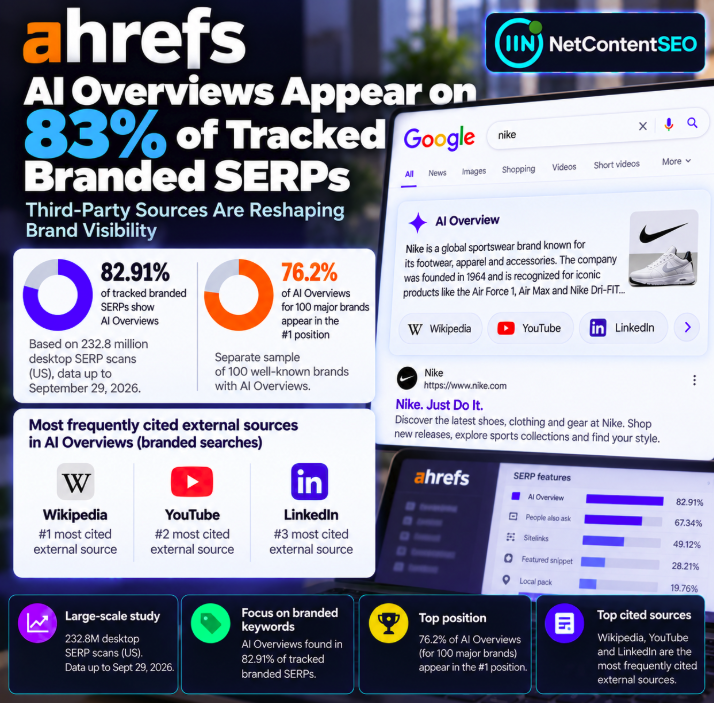

AI Overviews appeared in 82.91% of the branded search results pages tracked in a large Ahrefs analysis as of September 29, 2026. The research, published October 2, examined 232.8 million scans of US desktop Google search results. In a separate analysis involving 100 major brands, Ahrefs reported that 76.2% of the AI Overviews it observed occupied the first position.
These are striking figures for brand visibility, but their scope matters: 82.91% refers to the monitored branded SERP sample, not to all Google searches, all countries or all devices. Ahrefs also identified Wikipedia, YouTube and LinkedIn among the most frequently cited external sources in its analysis.
Primary source: Ahrefs — AI Overviews on Branded Searches, published October 2, 2026, with data through September 29.
What Ahrefs found
The study examines how frequently Google's AI Overviews appear when people search for brands, rather than focusing solely on generic informational queries. Brand searches can include company names, product brands and other queries that indicate interest in a particular organization.
Ahrefs' dataset comprises 232.8 million US desktop SERP scans. The reported 82.91% figure describes AI Overview presence within the tracked branded search results as of September 29. A separate 100-brand sample was used to investigate the position of those AI Overviews in search results.
The headline numbers at a glance
| Metric | Reported result | Scope |
|---|---|---|
| SERP scans analyzed | 232.8 million | US desktop Google search results |
| AI Overview presence | 82.91% | Tracked branded SERPs as of September 29, 2026 |
| AI Overviews in first position | 76.2% | AI Overviews observed in a separate sample of 100 major brands |
| Prominent cited external sources | Wikipedia, YouTube, LinkedIn | Sources identified in Ahrefs' branded-search analysis |
The two percentages use different study scopes and should not be combined into a single claim about every branded search. Nor does the 232.8-million scan count mean that the researchers evaluated that many unique brands or unique keywords.
Why AI Overviews on branded searches matter
When someone searches for a company by name, the company may expect its official website to play a central role in how its identity, products and services are represented. An AI Overview can introduce a synthesized answer above or near traditional results, potentially drawing on several sources to describe the brand.
This creates a distinction between owning an official website and influencing the information environment from which an AI answer is assembled. The company controls its own pages, but third-party profiles, encyclopedic entries, video platforms and independent coverage may also shape the available evidence.
What does 82.91% actually mean?
The figure indicates that AI Overviews were present on 82.91% of the branded SERPs Ahrefs tracked at the reported endpoint. It is not a probability that any arbitrary Google search will show an AI Overview. It also does not establish the same rate for mobile searches, other countries, other languages or every class of brand query.
Sampling design, keyword selection, time period and device configuration all influence how a SERP study should be interpreted. Analysts should retain these constraints whenever citing the number.
What does the 76.2% first-position finding mean?
In a separate sample involving 100 major brands, Ahrefs found that 76.2% of observed AI Overviews appeared in the first position. This suggests that AI-generated brand summaries can occupy highly prominent real estate in the sampled results.
However, the metric describes the position of the AI Overview module, not the organic ranking of a cited website. A page cited inside an AI Overview should not be described as holding the number-one organic result solely because the overview itself appears first.
Wikipedia, YouTube and LinkedIn as external sources
Ahrefs identified Wikipedia, YouTube and LinkedIn among the external domains frequently cited in branded AI Overviews. Each plays a different role in a brand's public information footprint.
Wikipedia: structured public reference material
Wikipedia pages often summarize an organization's identity, history and other established facts. Their prominence in a citation study is relevant to brand knowledge consistency, but it does not mean brands can or should treat Wikipedia as an editable marketing channel. Wikipedia has independent editorial standards and conflict-of-interest policies.
YouTube: video content and public explanations
YouTube can host product demonstrations, interviews, tutorials and other materials that describe a brand. Its presence among cited sources suggests that public video-related information can be part of the broader evidence landscape for branded queries. The study does not prove that posting more videos will automatically increase AI Overview citations.
LinkedIn: company and professional identity
LinkedIn company pages and professional profiles can provide information about organizations and the people associated with them. Their appearance among cited sources reinforces the importance of keeping public organizational details accurate and consistent across platforms.
Third-party citations are not the same as brand endorsement
A citation to an external source does not mean Google endorses every statement on that page, nor that the brand approves the description. It is a source attribution within an AI-generated response.
For companies, this makes factual consistency and correction workflows important. Incorrect founding dates, outdated product descriptions or misattributed leadership information can become problems wherever those claims appear, regardless of whether an AI Overview currently cites them.
Does an AI Overview reduce branded clicks?
The reported study statistics establish AI Overview presence and placement within the analyzed samples. They do not, by themselves, quantify how much branded organic traffic was gained or lost.
To investigate click effects, researchers would need additional evidence, such as comparable query-level impressions, clicks, CTR and other contextual factors over time. It would be misleading to infer a specific traffic decline from the 82.91% presence rate alone.
How brand SEO and GEO teams should respond
- Audit branded queries. Review how the company appears across representative name, product and entity-related searches.
- Capture AI Overview citations. Record cited URLs and domains rather than counting only whether an overview appears.
- Check entity consistency. Compare the brand's official facts across its website, company profiles and relevant independent references.
- Improve first-party clarity. Publish accurate, accessible information about products, services, leadership and key policies.
- Review legitimate third-party presence. Correct inaccuracies where appropriate without attempting to manipulate independent editorial platforms.
- Separate placement from citation. Distinguish an AI Overview's SERP position from the ranking of individual source URLs.
- Monitor by device and market. Avoid applying US desktop findings universally.
- Measure outcomes independently. Evaluate visibility, citations and referral traffic as distinct metrics.
What the research does not establish
- That AI Overviews appear in 82.91% of all Google searches.
- That the same presence rate applies to mobile or non-US search results.
- That 76.2% of all branded queries show an AI Overview in first position.
- That Wikipedia, YouTube or LinkedIn citations guarantee brand visibility.
- That Google has announced a new branded-search ranking algorithm.
- That the observed presence rate alone proves a change in clicks or conversions.
Why this matters for recognizable authorship and brand entities
As AI-generated summaries become prominent on branded queries, a company's digital identity extends beyond its own domain. Clear author and organization information, reliable source attribution and consistent public facts may help researchers understand where AI answers obtain their claims.
These are sound information-quality practices, not guaranteed methods for earning AI Overview citations. Google has not disclosed a simple optimization formula that converts profile completeness or third-party mentions into a citation.
FAQ
How often did Ahrefs find AI Overviews on branded searches?
In the tracked US desktop branded SERP sample, AI Overviews appeared on 82.91% of results as of September 29, 2026.
How large was the study?
Ahrefs analyzed 232.8 million US desktop SERP scans.
Were AI Overviews usually at the top?
In a separate 100-major-brand sample, 76.2% of observed AI Overviews appeared in the first position.
Which external sites were frequently cited?
Wikipedia, YouTube and LinkedIn were among the prominent external sources reported by Ahrefs.
Does this mean every brand needs a Wikipedia page?
No. Wikipedia inclusion is governed by independent editorial standards, and the study does not establish it as a requirement for AI visibility.
Is 82.91% a global Google Search statistic?
No. It describes a particular monitored set of branded SERPs on US desktop Google results.
NetContentSEO analysis
Ahrefs' findings suggest that branded search is increasingly an AI-mediated information experience within the dataset studied. The strategic issue is not simply whether a brand ranks first for its own name. It is how accurately that brand is described, which third-party sources are cited and how prominently AI-generated summaries appear. The right response is disciplined entity monitoring and source verification—not treating a sample-specific percentage as a universal Google Search statistic.
Primary source: Ahrefs — AI Overviews on Branded Searches, October 2, 2026.