
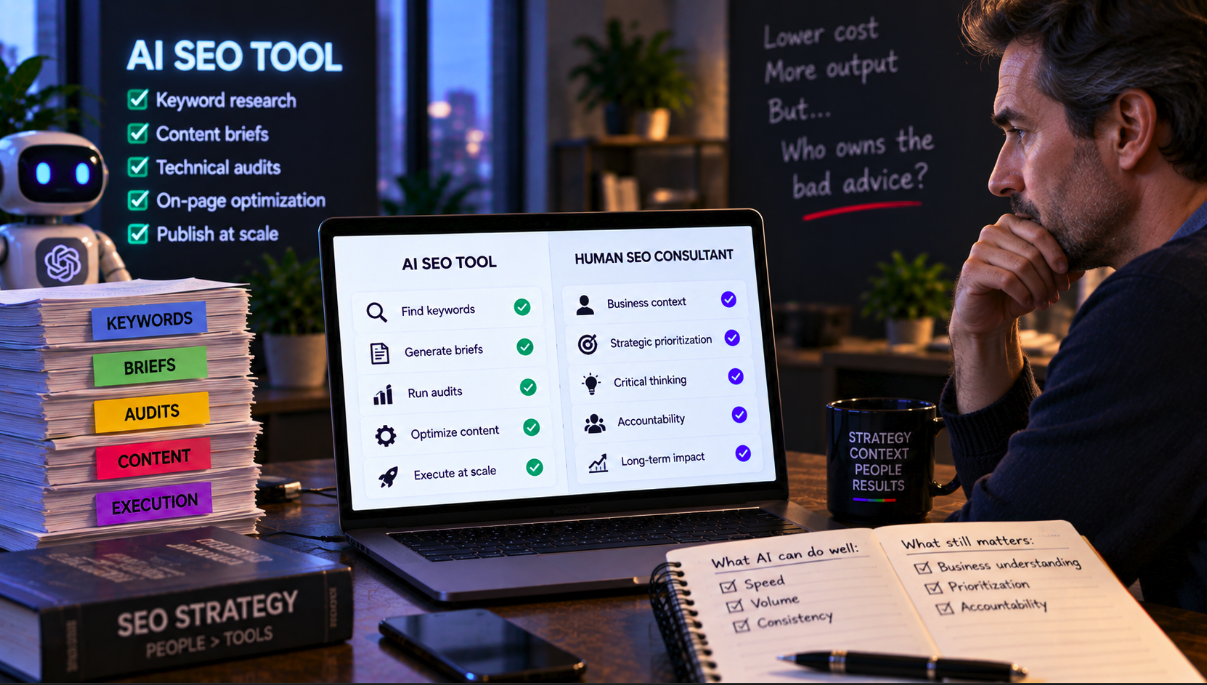
AI software has reached a point where it can make a compelling SEO sales pitch. It can research keywords, generate briefs, scan technical problems and turn recommendations into production tasks at a price and volume that a human consultant may struggle to match. For buyers who define SEO primarily by those deliverables, the economics increasingly favor software.
That tension is at the center of a September 10 Search Engine Land column by independent SEO consultant Nick LeRoy. LeRoy recounts speaking twice with a prospective client earlier this year before learning that the company had chosen an AI tool instead. According to his account, the software promised automated keyword research, content briefs, technical audits and execution for a fraction of his monthly retainer. He does not identify the tool, the client or the final performance, making the story a personal case and an argument about professional judgment rather than evidence that AI SEO software systematically produces worse results.
LeRoy’s strongest point is not that the automated work is fake. He explicitly says AI can accelerate research, organize data, create first-draft briefs, identify patterns across many pages and remove repetitive labor. The harder question begins after the software produces the recommendation: who decides whether the recommendation deserves to be implemented, how it ranks against competing business priorities and who is accountable when an apparently sensible SEO action creates an expensive problem elsewhere?
Automation is strongest where SEO can be expressed as a task
The activities in LeRoy’s anecdote are exactly the parts of SEO that software can package most cleanly. Keyword research can be turned into datasets and clusters; briefs can be generated from search results and content patterns; crawlers can detect hundreds of technical conditions; agents can draft pages or send implementation instructions into other systems. Once these outputs are standardized, buyers can compare providers on speed, quantity and monthly cost, and software will often have a structural advantage.
But task completion and strategic value are not equivalent. A keyword can have substantial search volume without attracting the customers a company actually wants. An automated gap analysis can identify a seemingly missing page without recognizing that several existing URLs already compete for the same intent and should be consolidated. A crawler can flag 100 technical issues without understanding that five deserve engineering resources now, most can safely wait and some are irrelevant to the business altogether.
This is where the economics of AI can create a misleading comparison. If a consultancy is sold as a monthly bundle of audits, spreadsheets, briefs and pages, an automated platform can reproduce much of the visible output at lower marginal cost. The human service becomes easier to defend only when its value is defined around decisions: prioritizing constrained resources, challenging the default recommendation, connecting organic visibility to revenue and recognizing when a technically valid SEO tactic conflicts with product, legal, brand or customer considerations.
The accountability gap matters more as AI moves from advice to execution
The risk grows when software does not merely recommend work but can execute it. A questionable brief is inexpensive while it remains a document; a questionable recommendation becomes more consequential when an agent can publish dozens of pages, alter internal links or trigger technical changes before someone evaluates the wider effect. Faster execution compresses the time between an analytical mistake and its operational consequences.
That does not mean a human consultant is inherently safer. People make poor recommendations, overlook evidence and can defend outdated practices. The relevant distinction is whether an organization has clear decision rights and a person responsible for validating high-impact actions. A company with a strong internal SEO leader may be able to replace external production work with software very effectively because the judgment layer already exists inside the business. LeRoy himself acknowledges that replacing a consultant with an AI tool is not automatically a bad decision and that the right software can help an internal team move faster.
The weaker setup is automation without ownership. If a tool recommends publishing a new page that cannibalizes an important URL, changing a template that harms conversion, or prioritizing technical work that consumes scarce engineering capacity without meaningful upside, blaming “the AI” does not recover the cost. Someone still has to decide whether the recommendation was sufficiently validated, whether the risk was acceptable and what should happen when the result differs from the forecast.
The consultant’s defensible product is judgment, not manual labor
There is also an unavoidable commercial context to the argument. LeRoy is an independent consultant describing a prospect that chose software instead of hiring him, and Search Engine Land labels contributor opinions as the author’s own. The article should therefore be read as an experienced practitioner’s interpretation of a market shift, not a neutral benchmark demonstrating that consultants outperform AI products. We do not know whether the unnamed client succeeded, regretted the decision or had an internal team capable of supplying exactly the context LeRoy argues software lacks.
Even with that limitation, the case exposes a useful test for professional services. If the only defensible part of an SEO retainer is the labor required to collect keywords, crawl pages and assemble documents, automation will continue to compress its price. If the service includes deciding what not to do, translating recommendations for engineering and executives, identifying organizational constraints and accepting responsibility for the strategic trade-offs, the comparison becomes less about human hours versus machine output.
The same test applies to companies buying AI SEO platforms. Instead of asking only how many briefs, audits or pages the software can produce, procurement teams can ask who reviews its recommendations, which actions require approval, what evidence supports prioritization and how outcomes are measured after execution. Those governance questions determine whether automation removes low-value work or quietly removes the layer that was preventing low-quality decisions from reaching production.
AI is likely to keep winning the price-and-volume comparison because that is precisely what software is designed to do. The more durable division of labor is not “humans do SEO, machines assist.” It is that machines can increasingly perform the repeatable work while organizations still need someone to understand the business, rank competing choices and own the consequences. The critical feature of an AI SEO stack may therefore be the one no vendor can fully automate: knowing who has the authority to say no.