

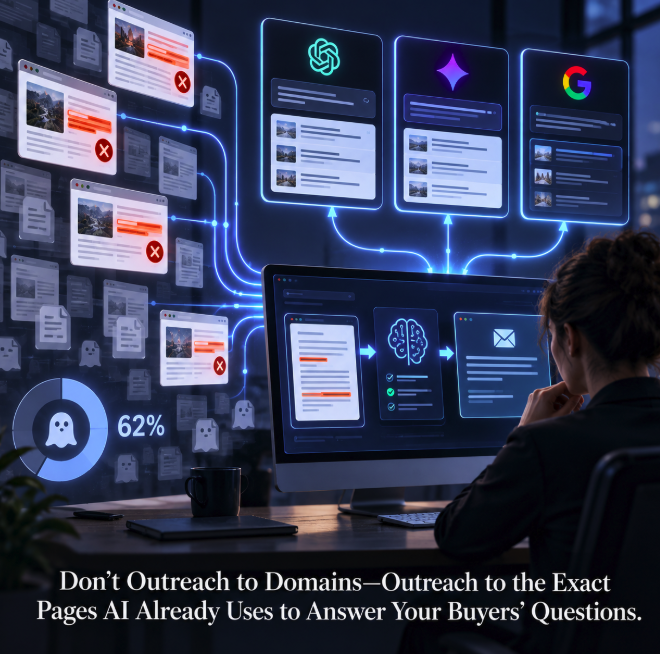
Traditional link building often starts with a domain: identify an authoritative publication, find a contact and pitch for coverage or a backlink. A new workflow from Semrush proposes a more targeted starting point for AI search. Instead of asking which domains look authoritative, it asks which exact pages ChatGPT, Gemini and Google AI Mode are already citing when they answer the prompts that matter to your buyers—and whether those pages mention your competitors but omit, underrepresent or misdescribe your brand.
The official Semrush workflow, published September 21, combines citation data from Prompt Tracking with automated page analysis in Claude Code. It is a practical methodology rather than evidence from a controlled experiment, so it does not establish that editing a cited page will cause an answer engine to mention a brand. What it does provide is a concrete way to turn AI citation monitoring into an off-page outreach pipeline built around URLs that have already appeared in relevant AI answers.
The target changes from the domain to the cited page
Semrush defines AI citation outreach as finding pages that answer engines cite and trying to get a brand represented accurately on those pages. The distinction from conventional prospecting is important. A large publisher may have thousands or millions of URLs, but only a small subset may repeatedly surface for the evaluation-stage questions a company's prospective customers ask. Under this model, the valuable outreach target is not simply the publisher's domain authority; it is the individual page's observed relationship with a relevant prompt.
Semrush recommends prioritizing pages using several signals, including how frequently the URL is cited, how closely its associated prompts match the brand's market, whether competitors already appear on the page, the size of the brand's representation gap, publisher authority and the practical feasibility of outreach. That creates a different prospect list from a standard backlink campaign. A niche comparison article repeatedly cited for a high-intent buyer question may deserve attention even if another publication has stronger conventional SEO metrics.
This page-level approach fits with other evidence showing that AI visibility cannot be reduced to traditional rankings or domain-level authority. NetContentSEO recently examined research finding that 55% of top AI citations did not rank in the traditional top 10 for the corresponding tracked query. The implication is not that classic SEO metrics have stopped mattering, but that observing what AI systems actually retrieve can reveal opportunities that a conventional SERP-only prospecting process may miss.
Prompt Tracking supplies the source list
The Semrush process begins by defining the prompts a company wants to monitor. Prompt Tracking can collect responses from ChatGPT, Gemini and Google AI Mode, with the campaign configured around a location and a set of awareness- and evaluation-stage questions. Semrush specifically cautions against filling the set with branded prompts because doing so can artificially inflate the apparent visibility of the company being measured.
Inside the Sources report, users can see which webpages were cited for the monitored prompts and whether their brand appeared in the corresponding answers. The list is then exported as a CSV. At that point, the raw citation log becomes an outreach dataset: URLs can be inspected not merely because an AI system cited them, but because they are associated with questions that map to the brand's prospective customers.
This is also where the method differs from chasing a generic list of frequently cited domains. A domain may be important in aggregate while an individual article is irrelevant to a particular product category. Conversely, one specific comparison page can repeatedly appear for a commercially important prompt even if the rest of the site contributes little to the monitored answer set. Page-level evidence preserves that distinction.
Claude Code turns hundreds of URLs into a review queue
Semrush's automation layer uses Claude Code to process the exported URLs at scale. The proposed project includes a context file describing the task, a concise brand-facts document containing approved positioning, pricing, products, competitors and known inaccuracies, and an analysis command that tells Claude how to inspect and classify source pages.
The workflow can exclude pages that are unlikely to be realistic outreach prospects, such as the company's own domain, social networks, certain knowledge bases, directories and vendor help centers. Semrush advises handling review platforms separately and, notably, does not recommend automatically excluding competitor domains: a competitor's editorial comparison page could still represent a potential correction or inclusion opportunity depending on the context.
Claude then categorizes pages into practical states such as brand not mentioned, underrepresented, outdated or inaccurate, negative, no clear opportunity or manual review. The output is saved into CSV files so a human can validate the recommendations before anyone contacts a publisher. Semrush is explicit that this human step is essential because Claude can make factual mistakes and may classify borderline pages differently across repeated runs.
The guide illustrates that limitation with an H&M example in which Claude correctly identified an underrepresentation opportunity but miscounted how many times the brand already appeared on the page. That kind of error would be minor in an internal analysis but potentially damaging in outreach: pitching a publisher with an incorrect description of their own article is an easy way to undermine credibility. Automation therefore reduces the discovery workload; it does not remove editorial verification.
The 62% “ghost citation” problem explains why citations alone are not enough
Semrush also repeats a finding from its earlier research with Kevin Indig: 62% of measured AI citations did not result in an explicit brand mention, a phenomenon it calls “ghost citations.” The number is useful because it exposes a measurement problem in GEO. A website can appear in an answer's source set while the generated response never names the brand, meaning citation counts and brand visibility are not interchangeable metrics.
NetContentSEO recently explored a related distinction in research proposing an “absorption” metric for AI search. That framework argues that a page can be cited without materially shaping the generated answer. Semrush's ghost-citation statistic approaches the issue from a brand perspective: being selected as a source does not guarantee that the brand itself becomes part of the answer.
That makes the outreach workflow more interesting than a simple attempt to manufacture additional citations. Its real objective is to close the gap between the sources answer engines already use and the information those sources contain about a company. If a frequently cited comparison page includes three competitors but not a fourth credible option, the missing company has an identifiable representation gap. If the page already mentions the brand but carries obsolete pricing or product information, the opportunity becomes a correction rather than a request for inclusion.
Outreach becomes a data-maintenance problem as much as a link-building problem
Semrush recommends handing human-reviewed opportunities to outreach specialists with the page URL, associated prompts, citation count, classification, recommendation, owner, outreach date and outcome. The suggested pitch is deliberately low-friction: start with a specific correction or useful update rather than sending a publisher a long list of demands. That resembles good digital PR practice, but the source-selection logic is new because the prospect was discovered through observed answer-engine citations.
This reframes part of off-page optimization as information maintenance. If AI systems repeatedly retrieve third-party pages to answer product-comparison questions, inaccurate information on those pages can propagate into generated answers. Updating a source can therefore have two potential benefits: improving what human readers see on the publisher's site and improving the information available to systems that later retrieve the page. The second effect is plausible, but the Semrush workflow does not experimentally prove that a publisher update will be absorbed into a future answer or how quickly that might happen.
That caveat matters because AI citation behavior is volatile. A page cited this month may disappear from the answer set next month, and an edit may coincide with a model, retrieval or ranking change that makes attribution difficult. Semrush consequently recommends re-exporting citation data each month and checking whether targeted pages remain cited, whether the brand begins appearing in answers associated with those pages and whether new source opportunities emerge.
This is not traditional link building with an AI label
The workflow still overlaps with link building and digital PR, but its optimization target is different. Traditional outreach often prioritizes sites based on topical relevance, authority, expected referral traffic and potential ranking value. AI citation outreach begins with observed source usage in a defined prompt set. A backlink can be useful, but Semrush's stated objective is broader: getting accurate and sufficiently prominent brand information onto pages that answer engines already consult.
That distinction also changes how success should be measured. Winning a placement is not the endpoint. Teams need to return to the same prompt panel and observe whether the page remains a source, whether the brand is subsequently mentioned, how it is characterized and whether visibility changes across engines. Without that measurement loop, a company may secure an edit on an apparently valuable page without knowing whether the AI systems it cares about ever use the updated information.
The strongest idea in Semrush's September workflow is therefore not the Claude Code automation. Automation makes hundreds of pages manageable, but the strategic shift happens earlier: prospecting starts with the exact URLs already present in AI answers. For teams trying to influence how their brands are represented in generative search, that produces a much more specific question than “Which authoritative sites should we pitch?” The question becomes: “Which pages already help answer our buyers' questions, and what do those pages currently say—or fail to say—about us?”
That is a measurable workflow, not a guarantee of causality. But as GEO moves beyond counting citations toward understanding where answers obtain their information, page-level outreach offers a practical bridge between AI visibility tracking, digital PR and the ongoing maintenance of a brand's third-party information footprint.