

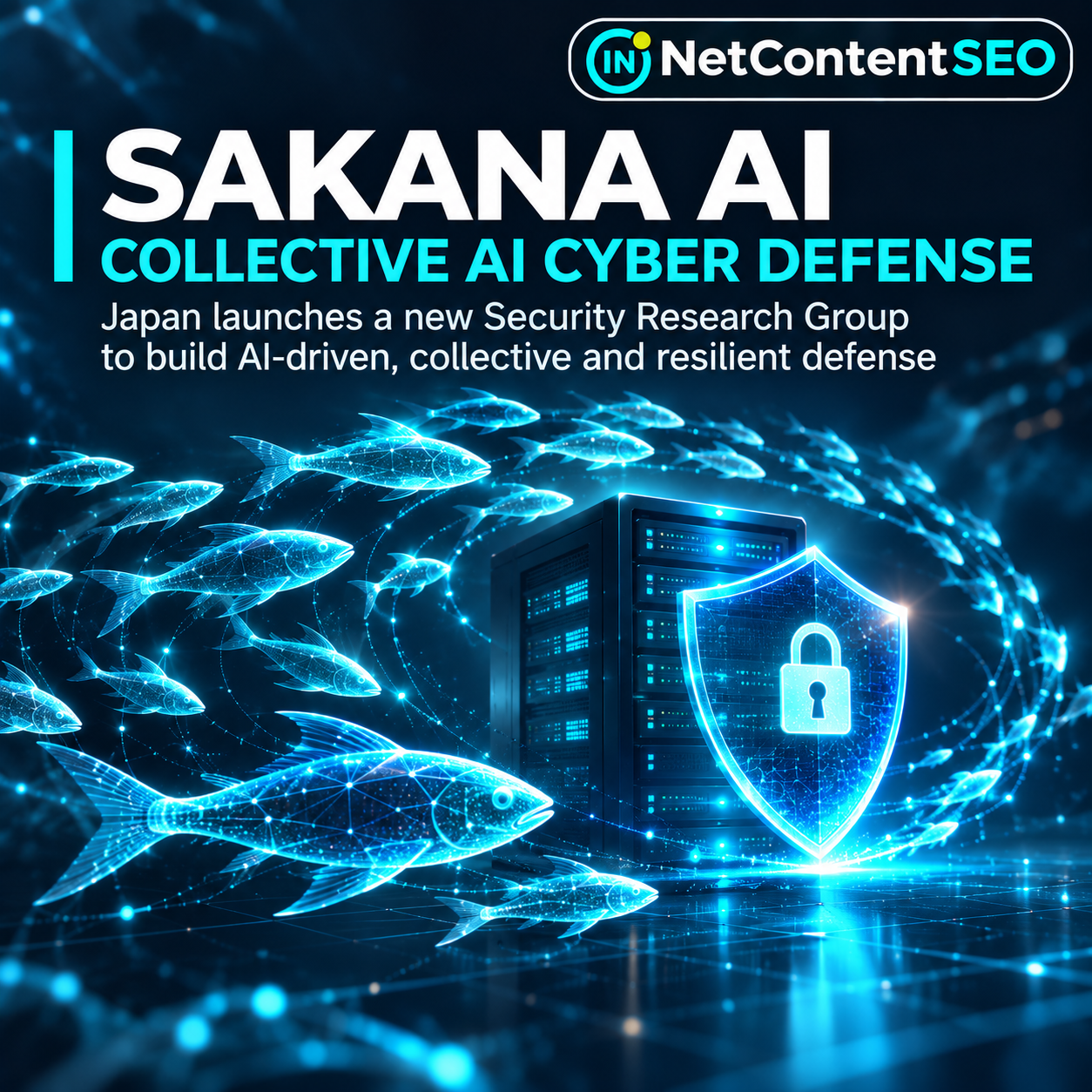
Japan-based Sakana AI has launched a Security Research Group to investigate collective AI-driven cyber defense and the security of AI systems themselves. Announced on November 20, 2026, the independent R&D initiative aims to share research, reproducible benchmarks and defensive guidance with government, industry and academia. Its central argument is that cybersecurity cannot be solved simply by discovering vulnerabilities faster: software and AI systems need security built into their design.
What Sakana AI announced
According to Sakana AI's official announcement, the group is led by Akihiro Umegai, Chief of Security Research, and David Ha, Sakana AI's co-founder and CEO. It is positioned separately from the company's commercial activities and describes its mission as public-interest research. The program combines two major themes: using AI for collective defense and securing the AI systems—including privileged defensive agents—on which that defense would rely.
The announcement is a research agenda, not the launch of a fully deployed nationwide autonomous cyber-defense network. Its planned work includes secure-by-design methods, shared defensive signals across organizations, safe automated patch verification, access control and reproducible evaluation.
Why faster vulnerability detection is not enough
Sakana AI points to the growing volume of vulnerability disclosures and the operational gap between machine-speed discovery and slower organizational remediation. Citing NIST, it reports a 263% rise in CVE submissions between 2020 and 2025 and says submissions in early 2026 were almost one-third above the equivalent period in 2025. These are submission figures, not proof that AI alone caused the increase: the announcement explicitly notes administrative factors and changes in reporting alongside AI-assisted discovery.
The group argues that patching every discovered issue after release creates an expensive recurring cycle. Many successful intrusions still exploit familiar classes of weakness, including inadequate input validation, broken authorization and memory-safety problems. Its preferred long-term strategy is to prevent these classes of defect during software architecture and development, then complement that upstream effort with operations, detection and response.
Security as a built-in quality requirement
Drawing on the Kano model of quality management, Sakana AI describes security as a “must-be” quality: users may barely notice when it works, but its absence can have severe consequences. That framing shifts responsibility from an isolated security team reviewing a finished product to engineers and organizations defining security requirements at the beginning of a project.
The company sees a particular opportunity for Japan to extend its longstanding quality-engineering tradition into secure software and AI. That is a strategic position advanced by Sakana AI, not an independently measured claim of national competitive advantage.
Collective defense: learning from one attack to protect many
The group's most ambitious research direction is a network of defensive AI agents operating across organizations. If one participant detects a malicious pattern, verified intelligence might inform protective actions elsewhere. This could potentially reduce the delay between first detection and wider defensive response.
However, this remains an open research challenge. Organizations would need to decide what information can be shared, secure consent, verify signals across different vendors, avoid propagating false positives and establish accountability when automated systems act. A malicious or mistaken shared signal could otherwise spread harm just as quickly as a legitimate warning spreads protection.
Securing the defenders themselves
Agents that inspect infrastructure, triage incidents or apply patches may need privileged access. That makes them valuable targets. Sakana AI therefore proposes limiting agent authority to specific tasks, retaining evidence of why an action was taken and ensuring that tools intended for defense cannot easily be repurposed for misuse.
These controls matter for any production agent system: a prompt injection embedded in a retrieved document, compromised tool response or overly broad permission could cause an assistant to take an unintended action. Human approval for consequential changes, least-privilege access, independent validation and rapid rollback remain essential safeguards.
Three existing research foundations
The group identifies three Sakana AI research lines as foundations rather than claiming they already solve enterprise cybersecurity. Digital Red Queen explores adversarial co-evolution, with AI-generated programs competing against earlier versions. ShinkaEvolve studies sample-efficient code improvement and may help develop detection rules or candidate patches under limited evaluation budgets. Fugu-Cyber coordinates specialized models for cyber tasks.
Sakana AI reports Fugu-Cyber results of 86.9% on CyberGym and 72.1% on CTI-REALM. Those are company-reported benchmark results; the announcement does not provide a full comparative evaluation setup or show that the scores translate directly into real-world incident response. The group explicitly identifies that gap as a research question.
What this means for SEO and AI Search
There is no announced direct impact on Google rankings, Bing indexing or AI Overview citations. The relevance to SEO is operational and infrastructural. Modern publishers and search platforms increasingly depend on crawlers, content-management systems, APIs, analytics pipelines, RAG retrieval and AI agents. Each component introduces potential weaknesses that can undermine content integrity, user trust or service availability.
For AI Search applications, protecting retrieval sources and tool outputs is especially important. An agent that retrieves an attacker-controlled page or document must not treat its contents as privileged instructions. Systems also need reliable source provenance, constrained tool permissions and checks before writing to production databases or publishing content. These are sound engineering implications of the threat model, not features Sakana AI has promised to deliver to publishers.
For SEO teams, the consequence of compromised infrastructure can be concrete: unauthorized page changes, malicious redirects, injected links, polluted structured data, compromised analytics or unavailable content. Preventive security practices therefore protect the reliability of the search experience even when they do not function as direct ranking factors.
Practical priorities for publishers and agent developers
- Map exposed systems: inventory CMS installations, APIs, plugins, authentication flows, crawler endpoints and AI-connected tools.
- Apply least privilege: give each agent only the access required for its task; separate reading, drafting, publishing and administrative permissions.
- Validate inputs and outputs: treat retrieved webpages, uploaded documents and external tool responses as untrusted data.
- Use staged publishing: require human approval for production changes and maintain reversible deployment and content workflows.
- Keep audit trails: record what an agent read, which tools it called, which changes it proposed and who approved them.
- Test for recurring weaknesses: include authorization checks, injection resistance, credential handling and secure configuration in development and release reviews.
- Evaluate agent defenses: measure false positives, missed incidents, unsafe actions, recovery time and the quality of shared signals, not only benchmark scores.
Open science and responsible disclosure
Sakana AI says the group intends to be vendor-neutral and publish reproducible research, defensive playbooks and evaluation conditions. It also acknowledges the dual-use nature of cyber research: findings that help defenders may also help attackers. Its responsible-disclosure policy is still being developed, with a stated intention to coordinate vulnerability reports and avoid releasing directly exploitable material.
The commitment to openness is meaningful, but the quality of future outputs will depend on whether independent researchers can reproduce experiments and whether proposed techniques work in heterogeneous production environments.
The bigger picture
Sakana AI's announcement illustrates a broader challenge for agentic AI: systems that act autonomously need security guarantees as carefully designed as their capabilities. Collective defense could help organizations respond faster, but reliable prevention, authorization, verification and accountability must come first. For SEO and AI Search practitioners, the immediate takeaway is not a new optimization technique. It is the importance of securing the software and agents that increasingly create, retrieve, distribute and act on information.
Primary source: Sakana AI, “Introducing Sakana AI's Security Research Group,” November 20, 2026.