

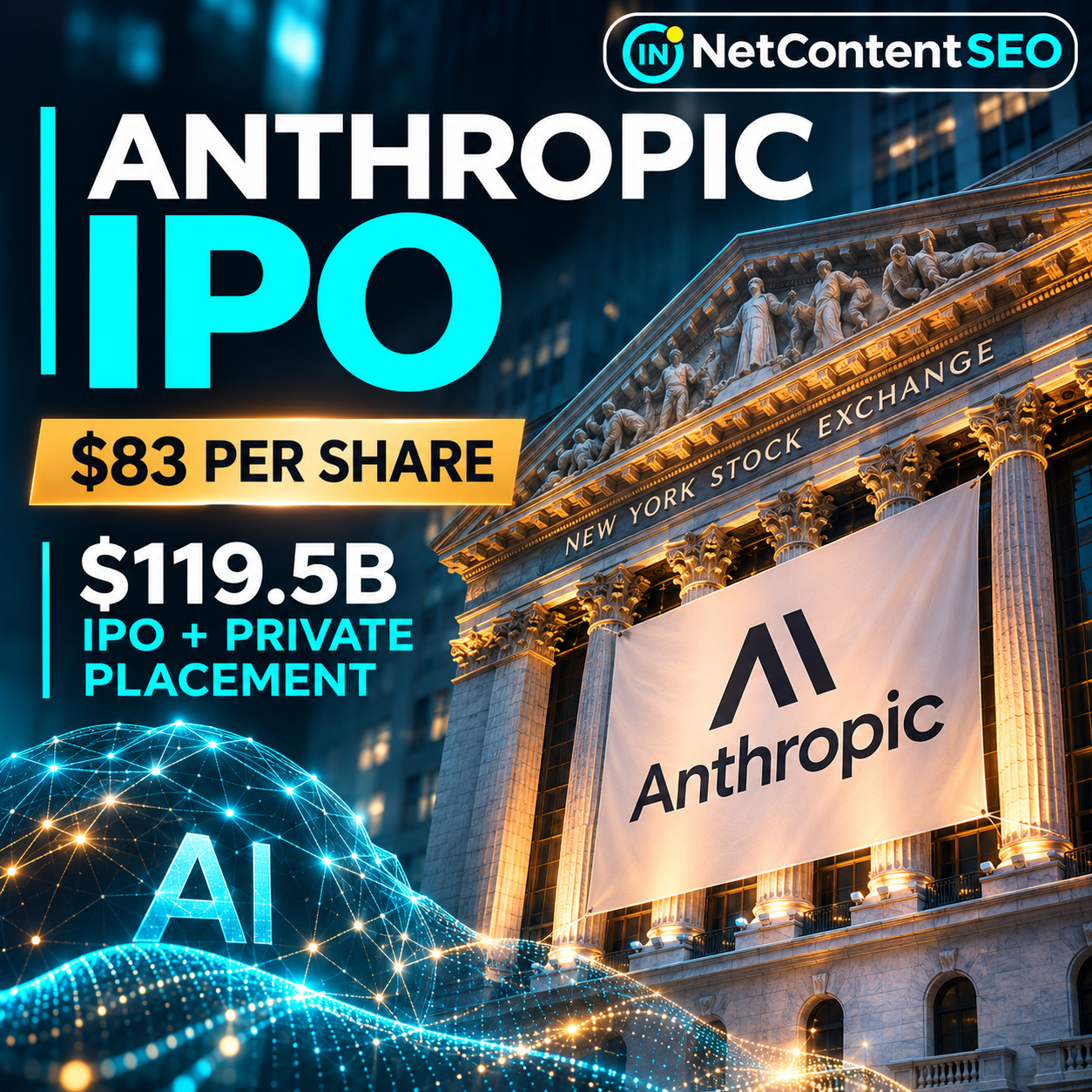

Anthropic has completed one of the largest public offerings in technology history, with approximately $93.5 billion in gross IPO proceeds and a separate $26 billion private placement to major semiconductor and technology companies. The company announced the closing on November 20, 2026, after its Class A shares began trading on the Nasdaq Global Select Market under the ticker ANT on November 19. The event does not directly change search rankings, but it is relevant to the capital, infrastructure and competitive dynamics shaping AI assistants and future AI Search experiences.
The verified numbers behind Anthropic's IPO
According to Anthropic's official closing announcement, the offering sold 1,127,000,000 Class A shares at $83 per share. That total includes the full exercise of an option for an additional 147 million shares. Of the shares sold, 1,103,351,354 were issued or sold by Anthropic and 23,648,646 were sold by existing shareholders. Gross IPO proceeds totaled approximately $93.5 billion before fees and expenses, of which approximately $91.6 billion went to Anthropic. The company received no proceeds from the selling shareholders' portion.
The SEC-filed pricing document confirms the $83 price, the base 980 million-share offering, the 147 million-share option, the ANT ticker and the planned November 20 settlement. The closing announcement confirms that the additional shares were in fact sold. These are financing proceeds, not Anthropic's valuation, revenue or profit.
The additional $26 billion from strategic technology investors
Alongside the public offering, Anthropic closed a private placement of 313,253,007 Class N shares at the same $83 price, for approximately $26 billion. The named buyers were AMD, Broadcom, Google, Micron, Microsoft, NVIDIA and TSMC Partners. The combined gross amount of the IPO and private placement was approximately $119.5 billion before expenses, including the IPO shares sold by existing shareholders.
That investor list is notable because it spans chips, memory, manufacturing, cloud infrastructure and AI distribution. However, a financial investment does not by itself prove a new exclusive supply agreement, a particular model deployment or preferential search placement. The announcement specifies the share purchases, not a detailed product roadmap for each participant.
Why an AI company needs this scale of capital
Training and serving frontier AI systems require extensive compute infrastructure, specialist personnel, data systems, safety evaluation and global distribution. Anthropic's IPO prospectus discusses uses of proceeds that include computing infrastructure, hiring and retention, and possible investments or acquisitions, while also identifying anticipated tax withholding obligations related to equity compensation. These are broad intended uses; they should not be read as a commitment to spend a fixed amount on any one AI Search product.
For the industry, the transaction illustrates the scale of financial resources now associated with frontier AI competition. It may give Anthropic more flexibility to invest in models, infrastructure and products, but greater funding does not guarantee better model quality, lower prices or commercial success.
What changes for Claude and AI-powered discovery?
Claude is part of a broader shift toward AI systems that synthesize information, work across documents and tools, and assist with multi-step tasks. If Anthropic uses additional resources to improve model capabilities, tool use, reliability or distribution, those developments could influence how users research products, compare services and discover publishers. That is a plausible strategic consequence, not a feature announced in the IPO closing release.
Crucially, Anthropic's public listing does not establish that Claude has changed its citation policy, browsing behavior, source selection or referral practices. SEO teams should not present a financing event as an algorithm update.
Implications for SEO and AI Search
First, competition among AI interfaces may intensify. As AI developers gain access to more capital, they may expand products that compete for the attention previously concentrated in conventional search engines. Publishers should measure their visibility across relevant discovery surfaces instead of assuming Google organic search captures the entire user journey.
Second, the cost of answering questions matters. Inference capacity, latency, tool use and access to reliable sources influence whether an AI product can offer useful research experiences at scale. More financing could support infrastructure investment, but it does not automatically make every AI answer cheaper or more accurate.
Third, citation and referral behavior must be observed directly. A brand mentioned in an AI answer may gain awareness without receiving a visit. A cited page may generate qualified traffic, but citation counts alone cannot establish revenue impact. Track referral sessions, assisted conversions, brand demand and changes in content discovery wherever reliable data is available.
Fourth, publishers still need complete, trustworthy answers. Original evidence, accurate dates, clear entity names, useful caveats and practical next steps are valuable regardless of which AI assistant a user chooses. The IPO does not create a new markup requirement or an Anthropic-specific SEO ranking factor.
What marketers and publishers should monitor
- Product changes, not stock-market headlines: watch official Claude updates for changes to search, browsing, connectors, tool use and attribution.
- Actual referral traffic: inspect analytics for identifiable AI assistant referrals while recognizing that some influence may not produce a directly attributed click.
- Answer accuracy and brand representation: periodically test relevant factual queries and document citations, omissions and outdated information.
- Competitive economics: compare published API prices, reliability and capabilities when choosing AI tools for editorial or search workflows.
- Source quality: maintain current, accessible pages with evidence that humans and authorized AI systems can evaluate.
- Platform dependence: diversify acquisition channels rather than relying on a single assistant or search provider.
What the IPO does not tell us
The closing announcement does not provide evidence of immediate changes to Google Search, Bing, Claude's retrieval architecture or AI citation rankings. It also does not establish that Anthropic's IPO proceeds equal its market capitalization: valuation depends on the company's broader outstanding share structure, not only the shares sold in the offering. Nor is the full $119.5 billion combined gross amount cash received from public investors alone; it includes a private placement and shares sold by existing holders.
The larger significance
Anthropic's November 2026 listing marks a major financial milestone for the company behind Claude. The combination of a $93.5 billion gross public offering and a $26 billion private placement highlights how deeply AI development is connected to the world's semiconductor and infrastructure ecosystem. For SEO and AI Search professionals, the appropriate response is to follow what the company builds next, measure how people discover information through AI products and avoid mistaking financial momentum for a confirmed change in search visibility.
Primary sources: Anthropic IPO closing announcement, November 20, 2026; Anthropic IPO pricing announcement, November 18, 2026; SEC pricing filing; SEC prospectus.