

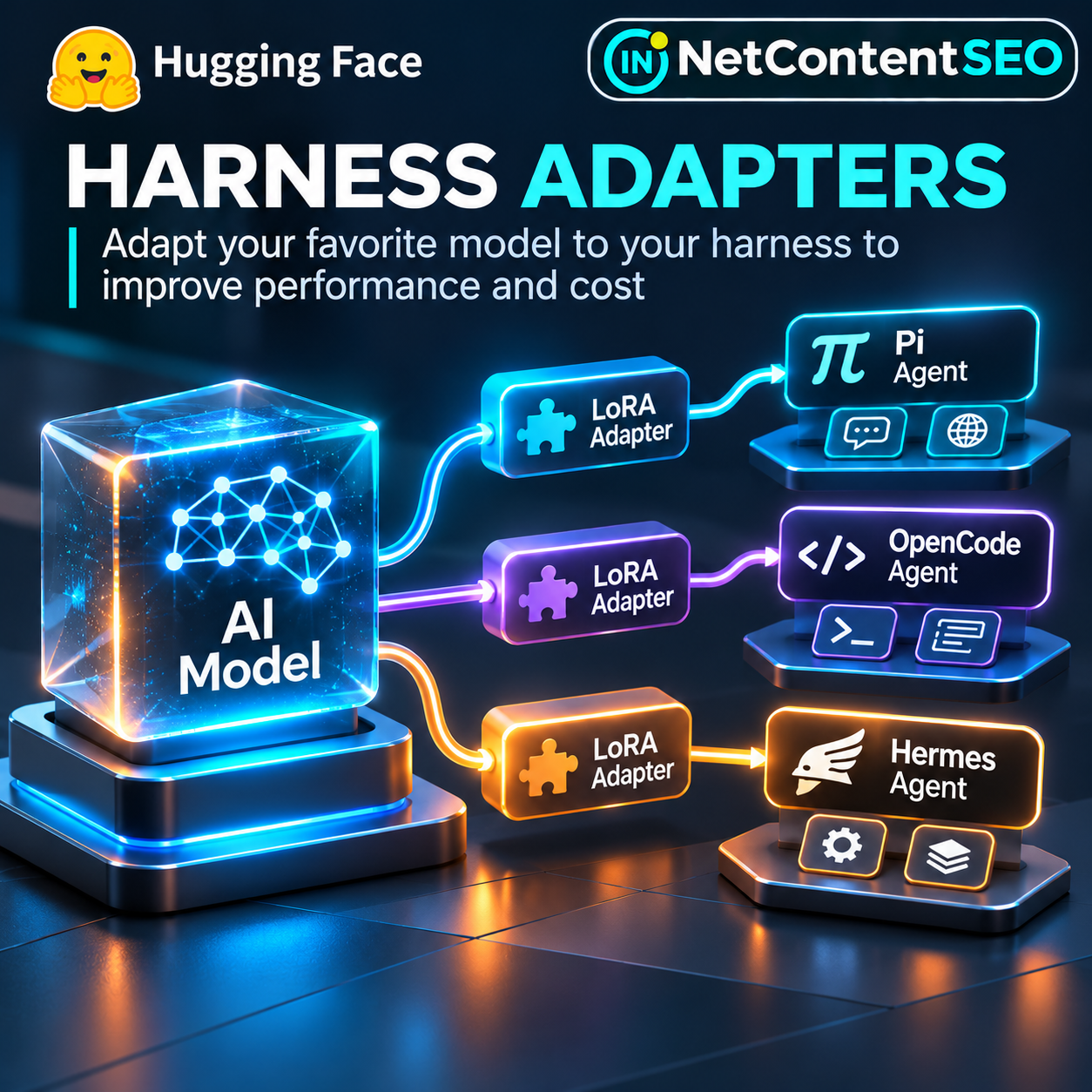
Hugging Face is exploring a practical way to make AI agents more efficient: adapt a model to the software environment that actually runs it. Its harness-adapter research uses small, reinforcement-learning-trained LoRA modules to specialize a shared base model for different agent harnesses. The reported experiments suggest that agent success rates can improve while tool calls and token consumption fall. For SEO and AI Search, the significance is architectural rather than a direct ranking change: cheaper, more reliable agents could make multi-step research and automation more viable.
What is an agent harness?
A language model does not execute a complex workflow on its own. An agent harness supplies system instructions, available tools, the interaction loop, permissions, time limits and the way results are returned to the model. The same base model may behave differently when placed in Pi, OpenCode or Hermes Agent because each environment shapes how it chooses and uses tools.
A harness adapter is a small set of additional model weights, commonly implemented with Low-Rank Adaptation (LoRA), trained for the tasks and tool interactions of a particular harness. Rather than retraining the entire model, developers keep the base model largely unchanged and switch the lightweight adapter appropriate to the environment.
What Hugging Face's primary research establishes
In the November 6, 2026 Hugging Face community research post, the team describes training adapters inside unmodified Pi, OpenCode and Hermes agent harnesses. The recipe uses verifiable reinforcement-learning tasks, including coding repairs, new implementations and question answering. Training combines TRL's asynchronous GRPO trainer with environments constructed using OpenEnv and Harbor. A SafeAgents proxy checks tool calls to help block unsafe or reward-hacking behavior during training.
The original research emphasizes evaluation on held-out tasks rather than only training-set success. It also reports that one base model can serve multiple LoRA policies, allowing the system to load different adapters for different harnesses without maintaining a complete independent copy of the base model for each one.
The November 20 follow-up linked in the brief, “Introducing harness adapters: adapt your favorite model to your harness to improve performance and cost,” could not be retrieved directly during this review. Third-party summaries of the follow-up describe experiments with Qwen3.8-27B and a merged multi-harness adapter. Their reported figures should be treated as project claims pending direct verification of the exact primary article and evaluation tables.
The reported performance and efficiency results
Secondary accounts of the November 20 work report that a Qwen3.8-27B adapter for Pi improved first-attempt performance on Terminal-Bench while reducing average tokens per task from approximately 2.9K to 1.5K in one comparison. Another analysis reports a merged adapter improving the average score across six harness-and-benchmark combinations from 55.5% to 63.5% with reasoning enabled. These figures describe specific experimental settings; they are not independently verified universal improvements.
It is essential to distinguish fewer tool calls from lower total cost. Tool calls may involve paid APIs, inference tokens, remote execution and latency. An adapter that reduces unnecessary actions may improve overall economics, but training itself has a cost, and deployment savings depend on workload, model pricing and infrastructure. Hugging Face's earlier primary research includes a concrete infrastructure comparison: evaluating multiple LoRA checkpoints on one shared base model can be substantially cheaper than merging and serving full weights one at a time.
How the training approach works
First, developers collect representative tasks that can be checked objectively. These might include fixing a reproducible bug, answering a question against a known dataset or building code that must pass tests. The agent performs the task inside its actual harness. A verifier scores whether the result works, while an additional incentive can reward fewer tool calls for successful outcomes.
Next, reinforcement learning adjusts the adapter rather than the full base model. The process captures the model's interaction with the harness, including tool requests and their results, to learn a policy better suited to that environment. This is different from merely adding a longer prompt or a larger list of tools. It changes model behavior through training.
Finally, teams evaluate the trained adapter against the original model using unseen tasks, comparable budgets and the same harness version. A useful test includes task success, first-attempt completion, token use, tool-call count, latency, safety incidents and cost per completed task. An adapter that saves tokens but fails more often may not deliver real value.
Why this matters for AI agents at scale
Many organizations are experimenting with agents that can browse, retrieve documents, execute code, query databases and update business systems. As the tool catalog grows, agent behavior can become less predictable and operating costs can accumulate across repeated tasks. Harness-specific adaptation offers a potential middle path between using a generic model for everything and training an entirely separate model for every workflow.
There is also a trade-off: specialization can tie a policy to a particular toolset, prompt format or harness version. A successful adapter for one coding environment may not transfer cleanly to a different environment, and updates to tools or permissions may require fresh evaluation. The appropriate benchmark is always the target workflow, not a headline score in isolation.
SEO and AI Search implications: indirect, but meaningful
No direct Google ranking effect has been announced. Harness adapters do not alter Google Search indexing, AI Overview citations or the visibility rules of any major search engine. They are a developer-facing approach to training more effective tool-using models.
The possible AI Search connection is downstream. A research agent may need to search the web, inspect sources, extract structured facts, compare options and produce an answer with citations. If its underlying model becomes better at using those tools with fewer failed steps, such workflows may become cheaper and more reliable. That could make agentic discovery and task completion more common, but this remains an inference, not an outcome measured by the harness-adapter experiments.
For publishers, the practical priorities remain accurate content, discoverable pages, clear source attribution and useful structured information. A more efficient agent still needs trustworthy evidence. For businesses exposing tools or APIs, reliable schemas, explicit permissions and predictable error handling can matter as much as the underlying model's intelligence.
What developers and SEO teams should test
- Define real workflows: use representative tasks such as technical SEO audits, source verification, data extraction or content-quality checks.
- Establish a baseline: measure task completion, tool calls, latency and token usage with the unmodified model.
- Keep evaluation tasks separate: use unseen tasks to reduce the risk of mistaking memorization for general improvement.
- Protect credentials and data: sanitize trajectories before sharing or training, and restrict tool permissions during agent execution.
- Compare total economics: account for training cost, hosting, failed attempts and human review, not only tokens per successful run.
- Re-evaluate after changes: harness updates, model revisions and new tools can invalidate earlier performance gains.
What remains uncertain
The reported November 20 Qwen3.8-27B figures need to be read alongside the full experimental setup, including benchmark versions, reasoning settings, task selection and confidence intervals. The available evidence does not show that every model or non-coding agent will achieve the same improvements, nor that a merged adapter will always match individually optimized specialists. Independent replications and production measurements would strengthen the conclusions.
The bigger picture
Harness adapters shift the optimization question from “Which model is best?” to “Which model-and-agent combination completes this workload most effectively?” That is a useful change in perspective for developers building AI systems with real operating costs. For SEO and AI Search, the immediate lesson is not a new optimization trick, but a reminder that the future of search may depend as much on the reliability and economics of agents as on the language models powering them.
Sources: Hugging Face community primary research, November 6, 2026; Hugging Face follow-up supplied in the brief (not directly retrievable during verification); Independent secondary analysis of the November 20 experiments.