

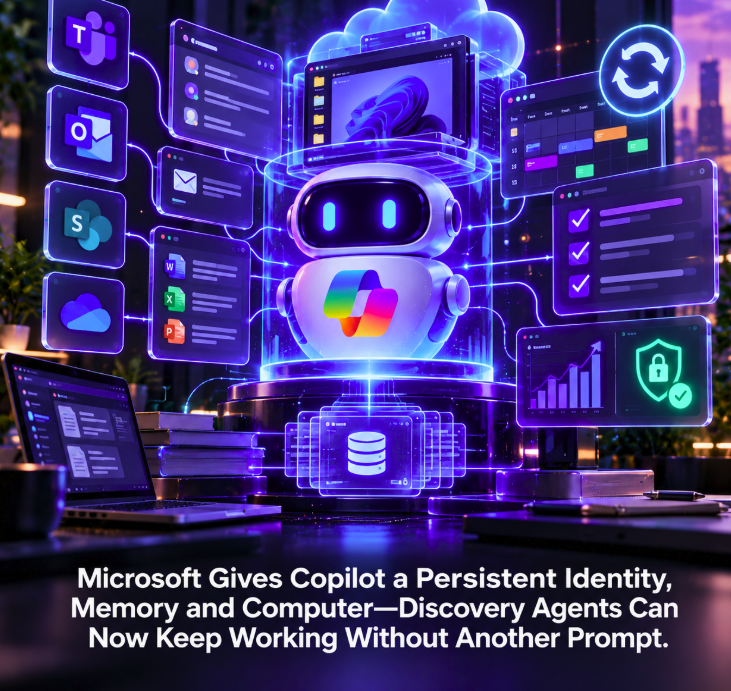

Microsoft is turning Copilot from an assistant that waits for the next interaction into an agent that can remain present between interactions. The company’s new Autopilot capability is designed to keep working after the user moves on, monitoring channels, following threads, running recurring tasks and resuming projects days later without requiring another prompt to restart the workflow.
Microsoft announced the new Copilot experience on September 25, alongside Home and Code. Autopilot, previously called Scout, is expanding to private preview at the end of September. Microsoft describes it as a persistent, proactive and personal agent that lives inside an organization’s tenant with its own identity, memory, computer and workspace. It is cloud-hosted, so its work can continue while the user is offline or focused elsewhere.
The agent no longer disappears when the conversation ends
The architectural change is continuity. Conventional assistants are largely interaction-driven: the user opens a conversation, supplies a request, receives an answer and later returns with another prompt. Even when conversation history persists, the system generally waits for the person to initiate the next step. Autopilot is built around a different model. The user gives the agent a name, role and goal, and the agent can continue advancing that objective over time.
Microsoft says Autopilot can watch channels, follow up on threads, run recurring work and pick a project back up days later. The company’s example is a supplier-review process in which the agent creates a schedule and workback plan, prepares meetings, handles follow-ups and reaches out to stakeholders for updates. The important element is not the particular procurement scenario; it is that the workflow has state and duration that survive beyond one chat session.
This makes memory operational rather than merely conversational. Remembering a prior discussion is useful, but a persistent agent also needs to remember the objective, what has already happened, which resources belong to the project, what remains unresolved and when another action should occur. The memory becomes part of an ongoing work process.
Autopilot gets its own identity, memory, computer and workspace
Microsoft’s description is unusually explicit about the resources assigned to the agent. Autopilot lives inside the customer’s tenant with its own identity, memory, computer and workspace. Those components turn the agent into something closer to a durable digital worker than a temporary model invocation.
An identity gives the system a governed actor that can be recognized inside enterprise infrastructure. Memory provides continuity across time. A computer gives it an execution environment rather than limiting it to generating text. A workspace gives ongoing tasks somewhere to persist their artifacts and state. Microsoft says permissions, auditing and governance sit behind the agent while the user defines its objective and boundaries.
This broader architecture echoes a pattern NetContentSEO has been tracking across the agent ecosystem. In our analysis of OpenAI’s Agents API, persistent sessions, managed execution, retrieval and tool access similarly moved beyond the idea of a stateless model endpoint. Microsoft is applying the persistence model directly to workplace delegation inside Copilot.
Discovery changes when the agent can monitor instead of search once
For search and discovery, persistent agents create a different interaction model. A traditional search begins with a query at a particular moment. Even an AI research assistant usually starts because a user asks a question. An always-on agent can instead monitor an information environment and act when something relevant changes.
That means discovery can become conditional and continuous. An agent responsible for a supplier process might monitor messages, documents and organizational data for updates. Another agent could revisit a project when a deadline approaches or when new information arrives. The user does not necessarily need to formulate a fresh search query each time because the agent already carries the goal and context forward.
The shift matters for publishers, software vendors and businesses thinking about AI-mediated visibility. Machine discovery increasingly may not begin with a human typing a keyword. It can begin with a persistent agent deciding that new information is relevant to a goal it was given days earlier.
Persistent context becomes infrastructure
Autopilot is built on Microsoft IQ, the company’s unified intelligence layer for enterprise AI. Microsoft says this allows Copilot and agents to understand organizational context while remaining governed within the Microsoft environment. The September announcement also expands Copilot’s grounding in Fabric IQ, Dynamics 365 and Power Platform data and workflows.
The distinction between active model context and durable organizational context becomes important here. Long-running agents cannot simply keep every message, document and event indefinitely inside one model prompt. They need systems that preserve relevant state and retrieve it when needed. NetContentSEO recently examined this architecture in our analysis of source-linked context graphs, where durable organizational memory sits outside the model’s immediate context window and can be retrieved later.
Microsoft does not describe Autopilot’s memory implementation in enough technical detail to equate it with any specific retrieval architecture. What the company does confirm is the product-level result: the agent has its own memory and can resume projects after days. That makes persistent state a first-class part of the Copilot experience rather than something the user must reconstruct manually.
The agent also needs somewhere to act
Persistence becomes more consequential when combined with a computer. An agent that remembers a goal but cannot interact with tools remains largely advisory. Microsoft says Autopilot has its own computer and appears where employees already work, including Teams, Outlook, chats, channels and documents. Users can @mention it like a colleague, while permissions and audit controls govern what it can do.
Microsoft is also introducing Copilot Managed Runtime, hosting infrastructure that lets code execute within the company’s Microsoft 365 environment. The runtime supports applications built through Cowork, Code and Copilot Studio and is being opened to third-party and professional developers. Although Microsoft presents Autopilot as its own product capability, the broader launch shows the company building execution infrastructure around increasingly long-running agentic work.
The trend is visible outside Microsoft as well. In our coverage of Meta Muse, the key shift was a personal agent equipped with a dedicated cloud computer and browser that could continue working after the user left the app. Microsoft’s implementation is enterprise-oriented, but both point toward agents that possess durable execution environments rather than existing only inside answer boxes.
Recurring work removes the prompt as the universal trigger
The most important interface change may be almost invisible: not every action needs a new prompt. If an agent can run recurring work, monitor a channel or continue a project according to an existing objective, then natural-language prompting becomes one way to initiate work rather than the trigger for every individual action.
This is a meaningful departure from the current mental model of generative AI. Users have been trained to think in turns: ask, receive, refine. Persistent agents introduce schedules, events and changing external state as triggers. The agent can decide that the next step is due because time passed, a stakeholder responded or a monitored context changed.
For discovery systems, this could create a growing class of machine-originated retrieval events. The human sets the objective once; the agent later decides when it needs more information. Websites and services may increasingly encounter automated visitors whose immediate retrieval was not preceded by a contemporaneous human query.
Persistence also raises the governance stakes
A long-running agent with memory and a computer creates more capability, but also a larger governance surface. A temporary assistant can make a mistake within one interaction. A persistent system can potentially carry an incorrect assumption forward, repeat an action or retain access across a longer workflow. Microsoft emphasizes that Autopilot operates with permissions, audit and governance and that users define objectives and boundaries.
This is why identity matters as much as memory. Enterprises need to know which agent performed an action, which permissions it used and how its activity can be reviewed. Treating the agent as a governed identity creates a basis for those controls that is harder to achieve when automation operates through shared or opaque credentials.
Microsoft is also separating the economics of these workloads from everyday Copilot interactions. The company says Cowork, Code and Autopilot are long-running agentic capabilities that use usage-based billing rather than relying only on a conventional user subscription. Persistent work consumes resources even when the user is not actively prompting the system, making cost management another part of agent governance.
Copilot is becoming an environment for delegated work
Autopilot arrives as part of a broader redesign in which Microsoft divides Copilot into Home, Code and persistent agentic capabilities. Home combines conversational Chat with Cowork delegation, while Code lets users create applications, trackers, dashboards, automations and workflows from natural language. Autopilot extends that progression from delegated tasks toward delegated continuity.
The result is a Copilot that increasingly resembles a work environment rather than a chatbot. Some tasks remain quick questions. Others become end-to-end delegated projects. Still others persist in the background, watching for the moment when more work needs to happen.
For the web and the emerging agent-discovery ecosystem, that final category is the one to watch. When an AI has a persistent identity, memory, computer and goal, discovery no longer has to wait for another person to type another query. The agent can return to the information environment on its own schedule—and the next wave of machine traffic may be driven as much by unfinished objectives as by fresh prompts.