

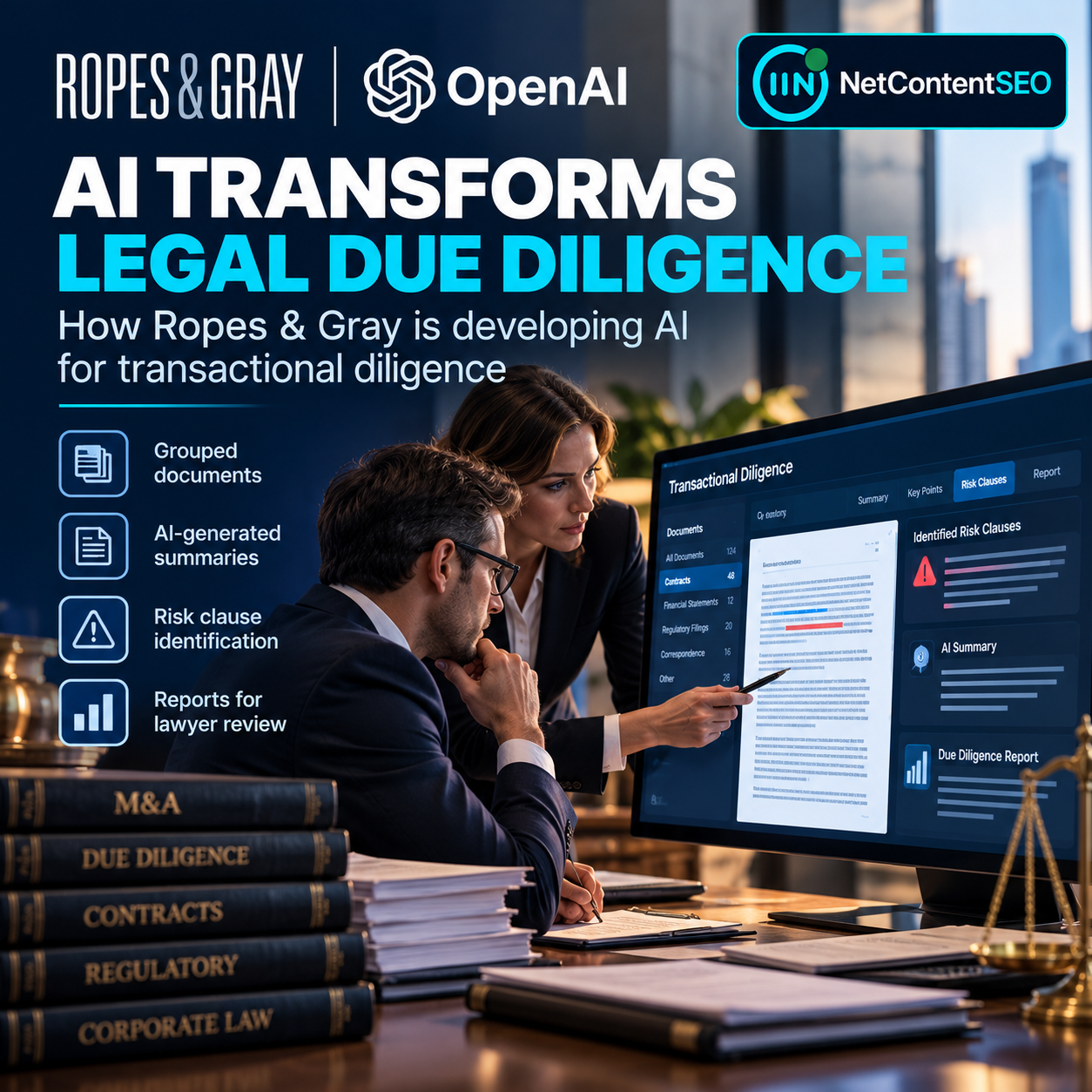

Legal due diligence has long depended on lawyers reviewing large collections of contracts, identifying risks and translating findings into advice for clients making high-stakes transaction decisions. Ropes & Gray is now developing a proprietary AI-powered diligence tool with OpenAI to help its lawyers work through that first stage more efficiently, without handing the final judgment to software.
In an October 29, 2026 case study, OpenAI describes a system that inventories a transaction data room, groups related documents, drafts summaries and assembles a report using the law firm's own methodology and format. The workflow is designed around attorney review: lawyers can inspect the underlying contracts, intermediate summaries and categorization before advising clients.
Why transactional due diligence is a demanding AI use case
Before an acquisition, legal teams must assess whether a target company's obligations, contractual restrictions and potential liabilities could change the economics or structure of the deal. Important provisions may be scattered across master agreements, amendments, schedules and related contracts. Reviewing an individual document without understanding its relationship to the rest of the data room can miss context.
That is why the Ropes & Gray project is more ambitious than simple document summarization. The tool is intended to identify relevant files, organize them by themes and issues, and support analysis of relationships across the data room. Its initial development has focused on material commercial contracts.
How the AI-assisted workflow operates
The system performs a first pass through large volumes of material, grouping documents and producing structured summaries. It then prepares a draft diligence report in Ropes & Gray's established format. Lawyers examine both the summaries and the original source documents, confirm the grouping, investigate exceptions and refine the report before its findings inform client advice.
According to OpenAI, the development team compared AI-generated drafts with lawyer-authored diligence reports from completed transactions. The firm used those comparisons to improve its review rubric and reporting format. That iterative evaluation matters because legal accuracy is not simply a question of producing fluent text; the system must identify the issues that lawyers would consider material to a particular deal.
Lawyers remain responsible for the final advice
Ropes & Gray emphasizes that its attorneys must be able to stand behind every deliverable. The tool is intended to reduce the time spent on repetitive initial review so lawyers can focus on evaluating risk, questioning assumptions and recommending transaction strategies. Human review is not a ceremonial approval at the end of the process: access to source documents and interim work products is built into the workflow.
This is a useful distinction for businesses evaluating enterprise AI. A system may produce a convincing report while still overlooking an amendment or misreading a clause. Source traceability, clear review responsibilities and structured quality checks are therefore as important as the speed of generation.
Hours instead of weeks: ambition versus verified outcomes
In its September 2026 announcement, Ropes & Gray described an ambition to produce detailed, issue-level diligence reports in hours rather than weeks. OpenAI's subsequent case study describes the design and testing process, but does not provide an independent benchmark demonstrating that all transaction types consistently achieve that turnaround. The reported goal should not be confused with a universally measured performance result.
The case also does not disclose a public product price, a complete implementation architecture or independently audited error rates. Those omissions matter when comparing a proprietary legal workflow with off-the-shelf AI document tools.
What this means for enterprise AI and professional services
The collaboration illustrates a broader shift from generic chat interfaces toward AI systems designed around established professional procedures. Ropes & Gray's value is not just the model's ability to read contracts, but the firm's ability to encode its review process, identify meaningful issues and verify the results against original evidence.
For legal technology teams, the transferable lesson is to build around a defined workflow rather than automate a vague job description. That includes clear document provenance, consistent report structure, tests against expert-written examples, confidentiality controls and an explicit human decision point.
For clients, the relevant question is not whether AI was used, but whether the process improves the quality, timeliness and defensibility of legal advice. Ropes & Gray says its broader approach includes enterprise-grade security and attorney oversight, though external evaluation of this particular system's results remains limited.
The next phase: institutional knowledge
OpenAI's case study also points to a longer-term goal: helping attorneys draw on the firm's collective experience, rather than treating each review as an isolated project. Such systems could potentially make past expertise easier to find and apply, provided firms address confidentiality, permissions, reliability and review.
For now, the most concrete development is a proprietary diligence workflow that combines automated document organization with lawyer-led verification. It offers a practical example of how AI can support highly specialized professional work without replacing professional accountability.
Sources: OpenAI: How Ropes & Gray is developing AI for transactional diligence; Ropes & Gray's September 2026 announcement.