

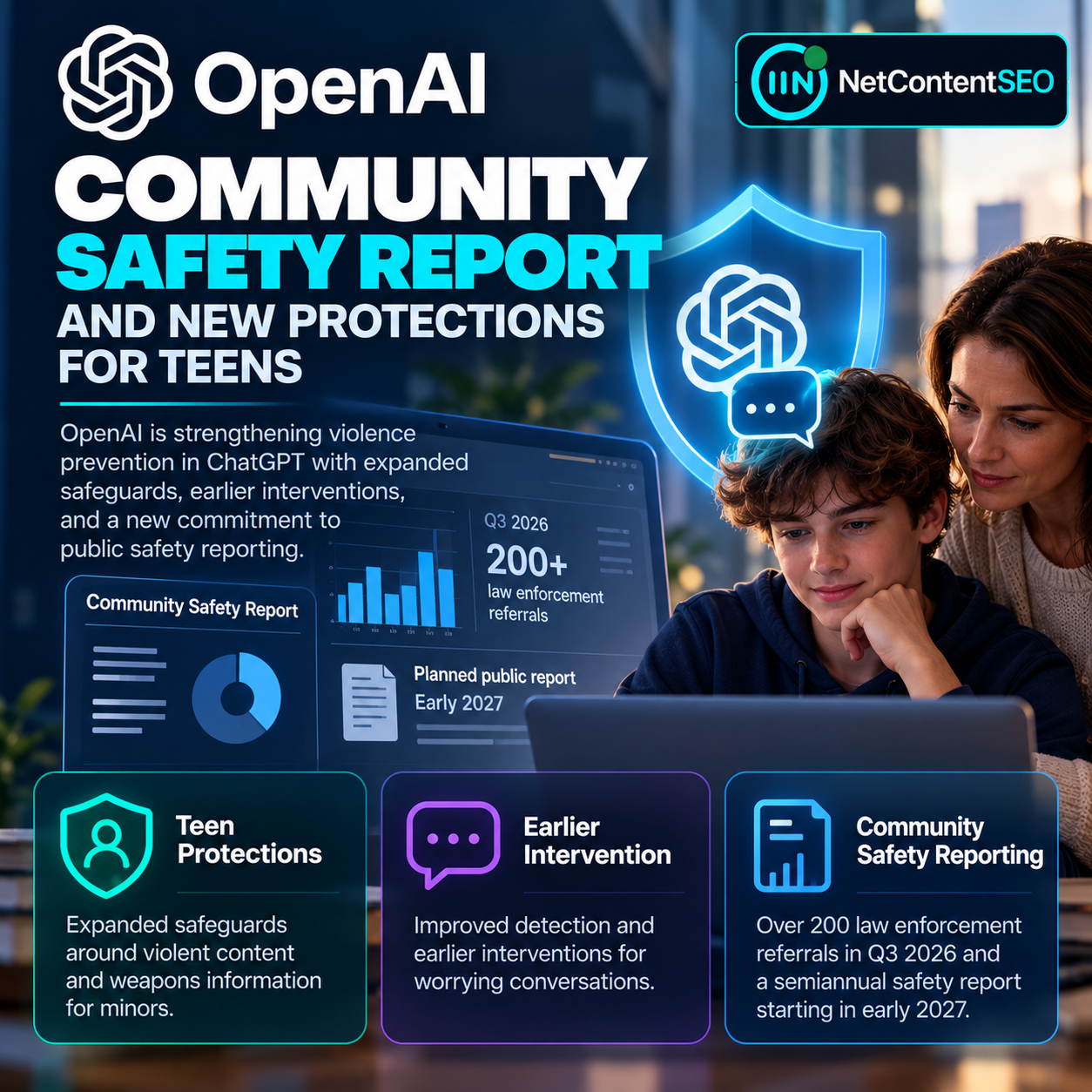

OpenAI announced a new set of community safety measures on October 30, 2026, combining tighter limits on violence-related information in ChatGPT, stronger protections for teenage users and a commitment to publish recurring reports about its safety practices. The company says it made more than 200 referrals to law enforcement in the third quarter of 2026, a figure that illustrates the scale of cases escalated for potential real-world harm but does not, by itself, establish the effectiveness of those referrals.
The announcement, Community safety report and new protections for teens, outlines changes that will begin rolling out over the coming weeks. It also sets a timetable for a public Community Safety Report, with the first edition planned for early 2027.
A new twice-yearly Community Safety Report
OpenAI says its first Community Safety Report will cover the second half of 2026 and appear in early 2027. Subsequent reports are planned every six months. The company intends to explain how it trains its systems to identify potentially harmful behavior, how cases are investigated and escalated, and what policy changes or technical mitigations follow from that work.
The reports are expected to include anonymized examples and relevant data about violence-related safety concerns. That could give researchers, policymakers and the public more visibility into how a major AI service evaluates risk. However, the report has not yet been published, so its eventual level of detail and the extent to which independent observers can assess the results remain open questions.
More than 200 law-enforcement referrals in Q3 2026
OpenAI states that it made more than 200 referrals to law enforcement during the third quarter of 2026. The company says it escalates cases involving credible and imminent threats of violence, with trained reviewers and mental-health or behavioral specialists helping assess difficult situations.
Referral counts should be interpreted carefully. They do not reveal the total number of users, the number of threats ultimately substantiated, the rate of false positives or the number of incidents prevented. Those distinctions matter when evaluating safety systems that operate at large scale and may affect users' privacy and access.
Stronger boundaries around descriptions of past mass attacks
The company is tightening how ChatGPT responds to questions about historical mass attacks and the individuals responsible. Users should still be able to learn about the events, their impact on victims and communities, and warning signs that can support prevention. But OpenAI says its models will provide fewer operational details, including specific information about weapons and equipment and comparisons that could amplify an attacker's notoriety.
These restrictions are intended to apply regardless of the user's age or stated reason for asking. The goal is to preserve legitimate educational and preventive discussion without producing information that could make serious violence easier to imitate.
Earlier intervention when conversations raise warning signs
A single question can appear harmless even when a pattern across recent interactions suggests escalating risk. OpenAI says it is strengthening ChatGPT's ability to respond more conservatively when earlier conversations indicate possible violence-related warning signs.
The company is also developing automated interventions for conversations that show fixation on violence or serious harm to others. In such cases, ChatGPT may end the conversation to interrupt the pattern. Repeated interventions may result in a temporary account pause. OpenAI describes these capabilities as ongoing work rather than a completed, universally deployed system.
This approach raises a difficult design challenge: identifying meaningful patterns while minimizing mistaken interventions against people discussing violence for journalism, research, personal safety or other legitimate reasons. OpenAI says it is working with relevant experts to improve recognition and response.
Additional safeguards for users under 18
For teenagers, OpenAI is extending restrictions on practical information about weapons and security systems that could be misused to facilitate violence. The tighter rules are intended to apply even when a request appears benign and there is no identified violent intent.
The company emphasizes that teens should still be able to seek help with de-escalation, violence prevention and contacting trusted adults. This distinction is important: stronger safeguards are not meant to block every discussion of a sensitive subject, but to reduce access to details that could enable harm.
Age prediction and parental notifications
OpenAI says its age-prediction system evaluates signals over time and can move an account into the under-18 experience when appropriate. Adults who are mistakenly placed in that experience can verify their age through Persona, the company's age-verification partner, to remove additional teen restrictions.
Parental controls already let linked families manage certain settings and receive notifications in specified serious safety situations. OpenAI expanded alerts in July 2026 to include cases where a teen's account was deactivated for violating policies on violence. It is now working toward additional notifications when an account is paused after repeated violence-related discussions. These planned notifications should not be described as already available to every parent.
What the announcement means for AI governance
The October announcement illustrates a shift toward layered safety systems that combine model behavior, analysis of patterns over time, account enforcement, human review and potential real-world escalation. No single safeguard can reliably address every risk. In particular, automated systems must balance early detection with the possibility of false positives, privacy concerns and the need for legitimate access to information.
Public reporting could improve accountability if it provides consistent definitions, useful denominators, evidence of outcomes and enough methodological detail to understand changes over time. Without those elements, headline figures alone are difficult to interpret. The planned 2027 report will be an important test of how much operational transparency OpenAI is prepared to provide.
What happens next?
OpenAI says the newly described safeguards will begin rolling out over the next few weeks, with further refinements informed by expert feedback and observed use. The first Community Safety Report is expected in early 2027 and will cover July through December 2026.
For parents, educators and organizations using AI, the practical takeaway is to distinguish current protections from announced improvements, review available parental controls and follow future transparency reports for evidence about implementation. AI companies have an important role in preventing misuse, but real-world safety also depends on families, trained professionals, policymakers and appropriate public authorities.
Sources: OpenAI, Community safety report and new protections for teens (October 30, 2026); OpenAI, Our commitment to community safety (April 28, 2026); OpenAI, Rolling out age prediction.