

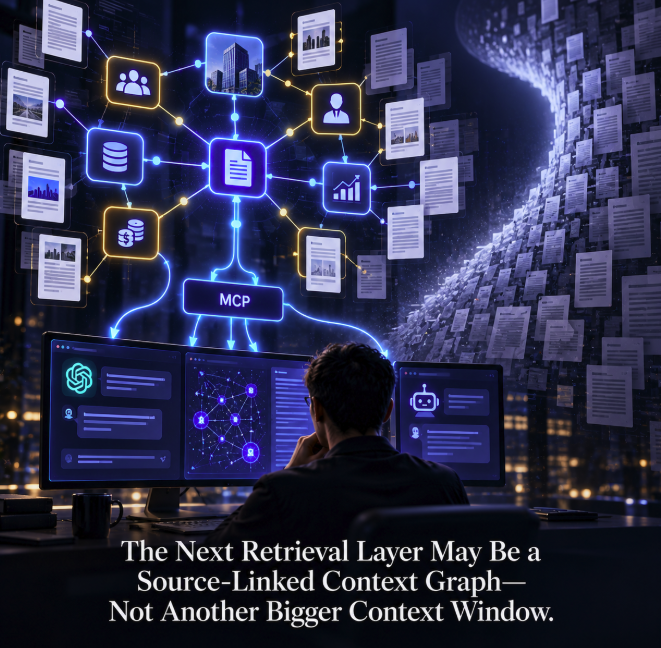

The race to give AI agents more context is often framed as a model problem: make the context window larger, load more documents into it and hope the model can keep track of everything that matters. An OpenAI case study on V7 points to a different architecture. Instead of repeatedly stuffing company history into a prompt, V7 Go extracts facts from enterprise files, connects entities and relationships in a persistent Context Graph, preserves evidence back to the original source and lets agents retrieve that structured memory when they need it.
The official OpenAI case study, published September 21, describes V7 Go as an agentic platform for mission-critical workflows across document-heavy industries including finance, insurance and real estate. OpenAI says the system uses GPT-5.6 Luna to extract information from millions of files and organize it into the Context Graph, while more reasoning-intensive workflows can use GPT-5.6 Terra and Sol. The performance numbers in the case study are reported by V7 rather than presented as independent third-party validation, an important distinction when interpreting the benchmark results.
The problem is not just retrieving a document
Enterprise questions often depend on relationships spread across many sources. A fund may be named differently in separate systems. A financial figure may have been restated in a newer report. A person, company, policy or transaction may appear across spreadsheets, PDFs, emails and data rooms without a single document containing the complete answer. Traditional retrieval can find relevant files, but the agent may still need to reconstruct those relationships from scratch every time a new request arrives.
V7's Context Graph is designed to make that reconstruction persistent. When new information enters the system from repositories such as SharePoint or Google Drive, V7 Go identifies entities, relationships, facts, attributes and metrics and connects them to new or existing graph records. Crucially, the graph preserves cited evidence back to the original source. The agent therefore gets not only a stored fact but also a route back to the document that supports it.
This source linkage changes the meaning of “memory.” A model's active context is temporary working space. A graph can instead serve as a durable organizational record that survives beyond one conversation or one agent run. V7 says recent exchanges can remain in the model's active context while older information is stored in the graph and retrieved later when relevant.
A context graph is not simply RAG with a different label
Retrieval-augmented generation usually begins by searching a document collection for chunks that appear relevant to the user's question, then supplying those chunks to the model. That remains useful, and V7 has not abandoned it: OpenAI says V7 Go can still search the underlying documents with RAG when the graph does not contain enough information.
The Context Graph adds another layer before that fallback. Instead of requiring the agent to rediscover the same connections on every request, the system maintains structured relationships among the entities and facts it has already extracted. A query can traverse those relationships directly, potentially avoiding dozens of repeated searches and reducing the amount of raw text that must be loaded into the model's working context.
OpenAI describes graph traversal in this implementation as an order of magnitude cheaper and faster than long-context approaches. That is a claim about V7's architecture rather than a universal rule for every graph system, but the design principle is straightforward: if a company repeatedly asks questions about the same entities, documents and relationships, it may be more efficient to organize that knowledge once than to make the model reread the underlying corpus for every task.
The evidence remains attached to the fact
The most consequential part of the architecture may be provenance rather than graph traversal itself. V7's graph preserves cited evidence to the original source when it creates or updates records. For enterprise agents, this creates an auditable path between a generated conclusion and the material on which that conclusion depends.
That matters because a structured memory can become dangerous if incorrect information is merely made persistent. A wrong extraction stored without provenance can be reused repeatedly and acquire the appearance of institutional truth. Source-linked records make verification possible: an analyst can inspect the original report, contract, spreadsheet or other document behind the extracted fact rather than accepting the graph entry solely because an AI system produced it.
OpenAI's case study illustrates this with document-heavy financial workflows. A private-equity screening process can extract financials, deal terms and management details from a Confidential Information Memorandum while citing the risk fields used before generating a screening note. The objective is not merely to summarize faster; it is to retain a traceable chain from the final analysis back through the structured context to its documentary evidence.
V7 reports a 69% gain over the HERB baseline
V7 also tested whether structuring enterprise context in this way changes retrieval performance. According to the OpenAI case study, V7's retrieval-only system outperformed the official baseline on HERB—a benchmark designed around finding and connecting information distributed across enterprise systems—by 69%. V7 also reports a 38% reduction in hallucinations on queries for which the available information did not contain an answer.
Those numbers should be read with the right scope. They are vendor-reported results from a particular retrieval system and benchmark setup, not evidence that knowledge graphs generally improve every agent by the same amount. They also do not mean hallucinations disappear. OpenAI itself continues to describe hallucinations as an unresolved property of language models, particularly when systems are encouraged to guess instead of recognizing that the evidence is insufficient.
The reduction on unanswerable questions is nevertheless conceptually important. A useful enterprise retrieval layer should not only find correct information when it exists; it should also help the agent recognize when the company's data does not support an answer. A graph that tracks entities and evidence can make absence more legible than an enormous pile of text in which the model is implicitly encouraged to find something that looks relevant.
MCP turns the graph into shared infrastructure for agents
V7 Go exposes Context Graph querying and ingestion through an MCP server. OpenAI says customers can use that server from ChatGPT and other compatible clients, while Codex can create V7 Go workflows through MCP. This turns the graph from an internal feature of one application into a context layer that multiple agent interfaces can query.
The pattern resembles what is already happening with specialized business databases. NetContentSEO recently covered how Ahrefs exposes live SEO data to ChatGPT, Claude and Copilot through MCP. In that case, the specialized system supplies current marketing data while the assistant becomes the conversational interface. V7 extends the same architectural idea to institutional memory: the specialized layer organizes a company's own knowledge, and compatible agents retrieve it as needed.
This separation can become increasingly important as organizations deploy more than one agent. If every assistant builds its own isolated memory from scratch, teams risk duplicating extraction work and creating inconsistent versions of company knowledge. A shared, permissioned context layer offers a different model: multiple agents can work over the same structured source of organizational facts while still using different models or interfaces for reasoning and execution.
The graph can preserve history without keeping everything in the prompt
Long-running agents create a particular memory problem. Keeping every past exchange and every relevant document in active context eventually becomes expensive and noisy, even as model context windows grow. V7's approach is to separate short-term conversational state from longer-term organizational memory. Recent interactions remain available to the model, while older information can be retrieved from the graph when a later task makes it relevant again.
This is closer to a memory hierarchy than a single giant context window. The model gets immediate working context for the task in front of it, structured long-term context for known entities and relationships, and underlying document retrieval when the graph alone is insufficient. Each layer solves a different problem instead of asking one prompt to carry the entire history of the organization.
There is also an operational benefit to keeping that memory current. V7 says it is working toward workflows that can trigger when facts in the Context Graph change. If a fund report is restated, for example, the system could identify analyses that still rely on the old numbers and flag them for review. That moves retrieval infrastructure toward active dependency tracking: not only remembering what the company knew, but understanding which downstream work depends on facts that have since changed.
Better context may matter more than simply deploying more agents
The OpenAI case study includes several additional V7-reported results. The company says agents can complete 50- to 100-step workflows in minutes with an auditable trail, asset managers have reduced a full-day deal-screening process to 15 minutes, a financial-services team cut more than 100 hours of review to under 10, and insurance teams reduced claims-processing errors by 13.5% compared with a manual baseline after agents received historical knowledge of prior claims and policies. These figures describe V7 customer deployments and should be interpreted as provider-reported outcomes rather than broadly generalizable benchmarks.
The more durable takeaway is architectural. Larger context windows solve a real problem by allowing models to inspect more information at once, but they do not automatically resolve entity identity, version history, repeated relationships, provenance or shared memory across agents. A source-linked graph attempts to solve those problems before the model begins reasoning.
That does not make graphs a replacement for long context or RAG. V7's own design uses all three. The graph holds structured institutional memory, document retrieval supplies evidence that has not yet been captured or is too detailed for the graph, and the model's context window provides the immediate working set for the current task. The interesting development is the division of labor among those layers.
As AI agents move from isolated question answering into workflows that persist across months, repositories and teams, retrieval may increasingly become a systems-design problem rather than a contest to fit more tokens into one prompt. V7's Context Graph is one vendor's implementation, and its benchmark gains require independent scrutiny. But the underlying idea is likely to matter beyond V7: durable agent memory becomes much more useful when facts retain their relationships, their history and, above all, the evidence showing where they came from.