

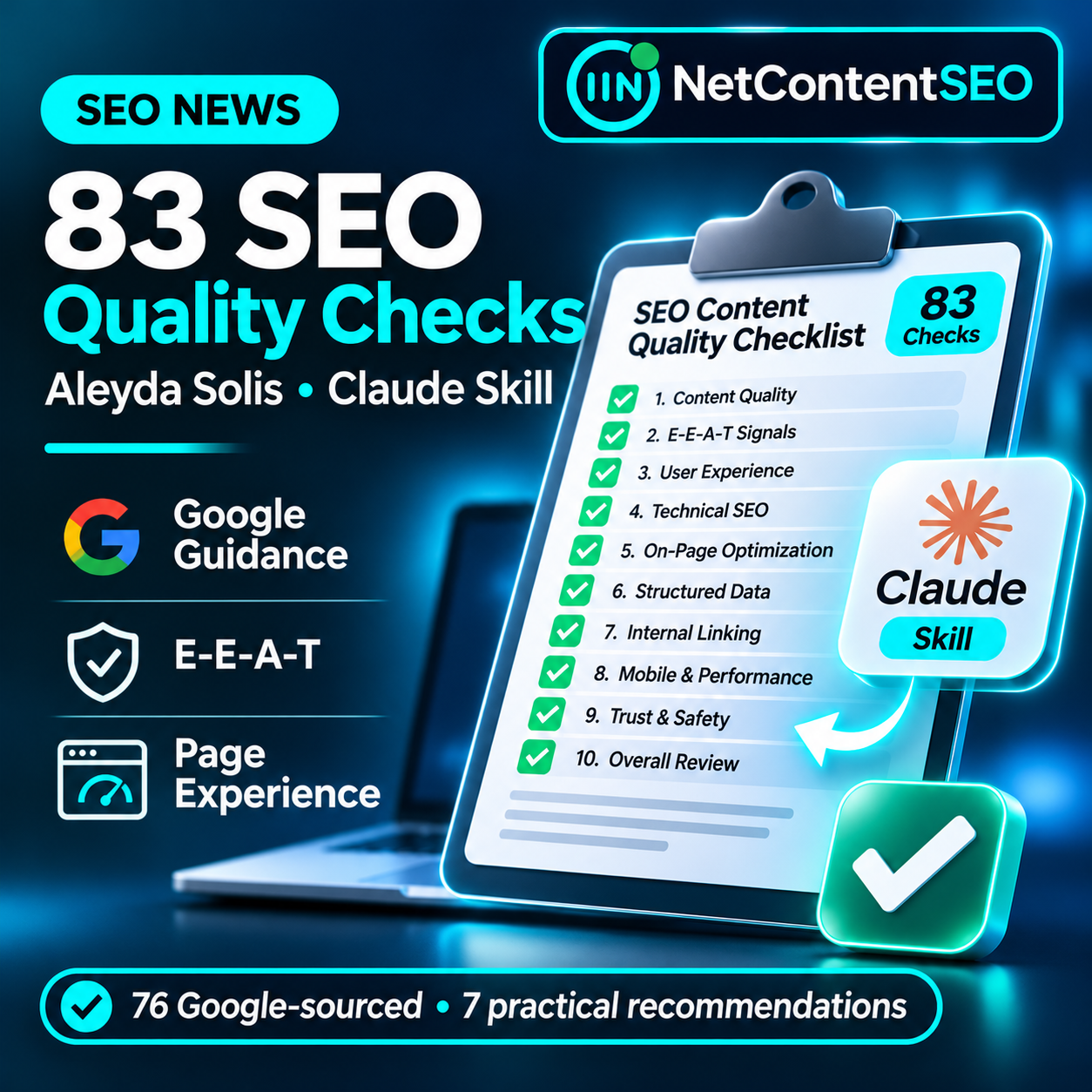

Aleyda Solis has updated her Google Content Quality, E-E-A-T, Helpfulness and Page Experience Checklist and released a companion Claude Skill to help assess pages systematically. Announced on November 2, 2026, and detailed by PPC Land on November 3, the update translates public guidance into 83 checks across 10 areas. Seventy-six checks refer to 11 Google documents; seven are Solis's own practical recommendations. It is an independent practitioner resource, not an official Google audit or ranking score.
What is inside the 83-point checklist?
The spreadsheet groups questions into purpose and satisfaction (9), content quality (12), trust and authorship (13), AI and production (5), content policy risks (10), reviews and comparisons (11), page experience (9), maintenance (4), search presentation (8), and editorial validation (2). These areas cover more than keywords or technical configuration: they ask whether a page fulfills its purpose, demonstrates genuine knowledge, supports claims with evidence and offers a usable experience.
Each row identifies the relevant scope, instructions for assessing it, source guidance, evidence to record and a review status. The available assessment states are Not assessed, Meets, Partly meets, Does not meet and Not applicable. There is no numeric weighting or total score. That design matters because a checklist is useful for finding specific improvements, not for pretending that quality can be reduced to a proprietary number.
Google guidance versus editorial judgment
The source mapping is explicit. Seventy-one checks are classified as Google Search guidance, five cite the Search Quality Evaluator Guidelines, and seven are practical recommendations from Solis. The 76 sourced checks span 11 Google documents, with the largest contribution—31 checks—coming from the guidance on creating helpful, reliable, people-first content.
Other sources include Google's review-writing guidance, spam policies, page experience documentation, Core Web Vitals, AI-generated content guidance and AI features in Search. The checklist distinguishes direct quotations from adapted questions and summaries. This distinction prevents a useful editorial suggestion from being misrepresented as an official ranking requirement.
Why E-E-A-T is treated as evidence, not a score
E-E-A-T stands for experience, expertise, authoritativeness and trustworthiness. The checklist does not claim that Google assigns a public E-E-A-T score to websites. Instead, its trust and authorship checks ask reviewers to examine observable evidence: original research or first-hand material, meaningful author background, credible references, accurate claims and transparent responsibility for content.
Some questions are conditional. High-stakes topics may require specialist review; product comparisons should demonstrate the basis of their recommendations; sites handling transactions should make contact and support information easy to find. A personal blog and a financial advice page should not be audited as though their risks and obligations were identical.
The Claude Skill: from spreadsheet to evidence-backed audit
Solis also released a downloadable Claude Skill called eeat-helpfulness-assessment. The reported version is 1.2.1, dated October 29, 2026. It packages instructions, checklist data, presets and worked examples so Claude can produce a documented assessment and a prioritized improvement plan. Crucially, the skill instructs the model not to fabricate problems and to accept that an audit may produce zero findings.
The tool must also explain that its output is an expert assessment of inspected evidence, not Google's own rating, an E-E-A-T score, a certification, or a prediction of rankings or AI citations. That limitation is central to using the tool responsibly. Automated review can organize evidence and flag concerns, but it cannot reliably infer facts that are absent from the supplied material.
Where automation needs human verification
Not all 83 checks can be judged from a public page alone. The spreadsheet scopes 54 checks to individual pages, 12 to the whole site, nine to templates and eight to editorial workflows. A reviewer may need real-user Core Web Vitals data, Search Console access, content production records, correction histories or internal approval processes. If the evidence is unavailable, the correct outcome is Not assessed, not an invented pass or fail.
For performance, the checklist uses familiar field-data thresholds: Largest Contentful Paint of 2.5 seconds or less, Interaction to Next Paint of 200 milliseconds or less and Cumulative Layout Shift of 0.1 or less, assessed at the 75th percentile. Laboratory proxies should not be mislabeled as equivalent field measurements.
Implications for SEO and AI Search
The update arrives as publishers try to understand how content quality translates into visibility across traditional search and AI-generated answers. The strongest lesson is methodological: document what a page actually demonstrates. Original evidence, clear sourcing, accurate facts, helpful explanations and transparent editorial ownership are more defensible than simply adding AI-targeted keywords or generating more pages.
For SEO teams, the checklist can structure reviews across content, engineering and editorial operations. For AI Search work, it provides a way to examine whether information is sufficiently clear, attributable and verifiable to be interpreted by other systems. But no published evidence shows that passing these checks directly improves AI Overview inclusion, AI citations or organic rankings.
How to use the checklist without turning it into checklist theater
Start with representative pages and templates rather than marking every item as relevant everywhere. Record URLs, examples and measurable evidence. Separate confirmed defects from opportunities and unresolved questions. Prioritize improvements by user impact and business risk, not by the number of boxes checked. Reassess after substantive changes, and do not change publication dates merely to appear fresh.
The Claude Skill may speed up the first pass, but an experienced reviewer should validate important conclusions, especially around legal claims, medical or financial information, accessibility and sitewide technical performance. The most useful deliverable is a traceable plan of improvements, not a claim of compliance with Google's ranking systems.
The bigger picture
Solis's release is notable for its source transparency and its explicit limits. It turns public Google guidance into a repeatable workflow while acknowledging that editorial recommendations, rater guidance and ranking systems are not interchangeable. The 83 checks offer a practical audit framework; the Claude Skill makes it easier to execute. Neither should be sold as a shortcut to guaranteed search visibility.
Source: PPC Land, November 3, 2026, “Aleyda Solis turns Google's content quality guidance into 83 checks”. The original checklist and Claude Skill are attributed to Aleyda Solis; Google has not endorsed the tool.