

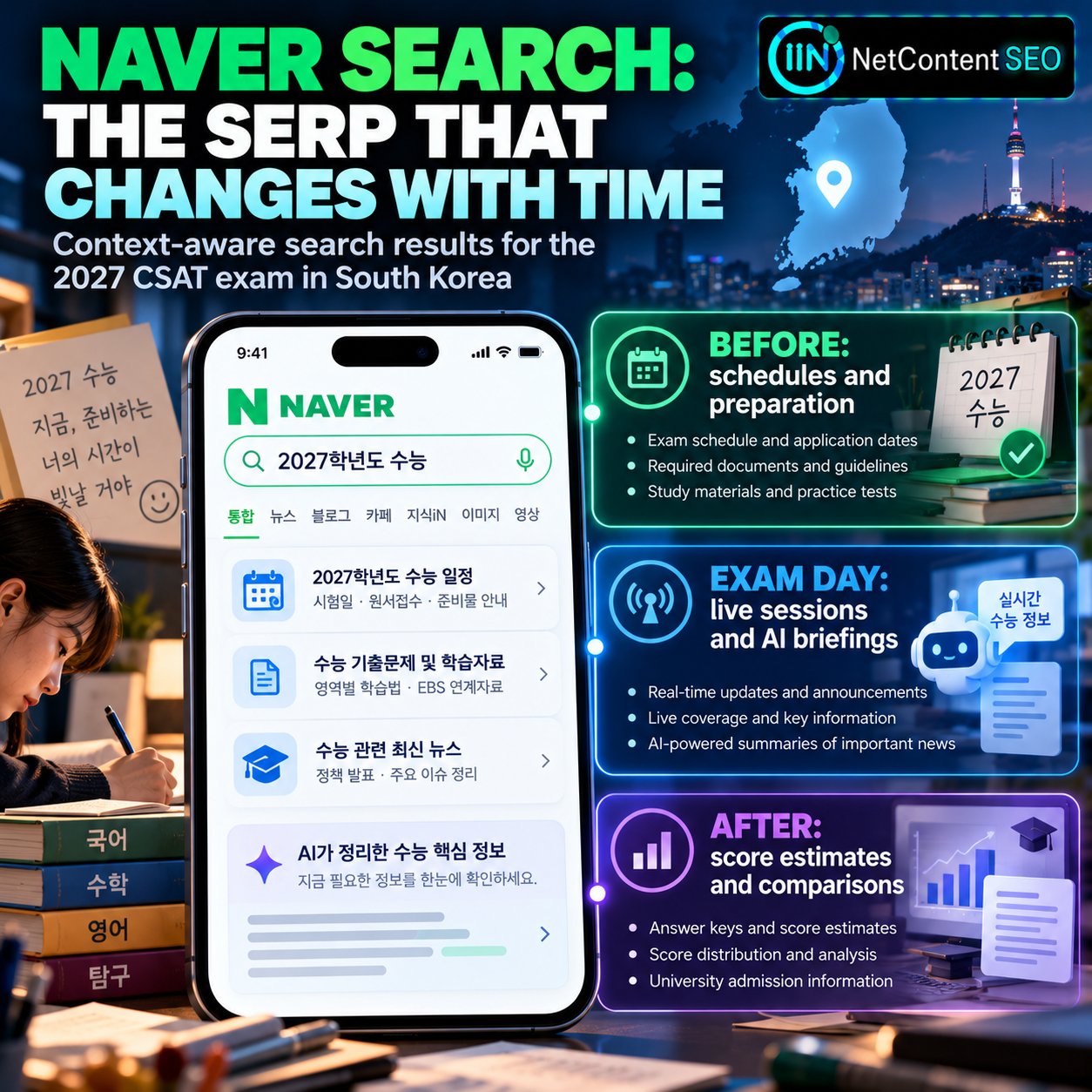

Naver is redesigning its education search experience around a deceptively simple question: what information does a student need right now? Ahead of South Korea's 2027 College Scholastic Ability Test (CSAT), the country's major search platform has announced a search interface that changes what it emphasizes before, during and after the exam. It brings together official schedules, real-time information, AI-generated briefings, predicted grade thresholds and community content.
In an official corporate announcement dated October 23, 2026, Naver said its updated CSAT search would launch on October 27. The user's original source is a post from the official Naver Search blog, but that individual blog page could not be fetched directly during verification. The core product claims below are therefore grounded in Naver's accessible primary press release, not assumed details from the inaccessible blog post.
For SEO professionals, this is a useful example of time-aware search results: a search engine adapting its interface to the stage of an event and the user's likely intent. It is not an announced update to Naver's organic ranking algorithm.
What is the 2027 CSAT, and when does it take place?
The College Scholastic Ability Test, commonly called Suneung (수능), is South Korea's national university entrance examination. Despite the “2027” academic-year label, the exam is scheduled for November 19, 2026, as confirmed by the South Korean Ministry of Education.
It is a high-stakes event for students, families, schools and universities. Search demand evolves sharply across the preparation period, the exam day and the subsequent admissions cycle. Naver's redesign attempts to organize those changing information needs within one search experience.
Before the exam: practical preparation information
Before the CSAT, Naver says its search results will highlight core logistical details such as the examination schedule, subject timetable and required materials. It will also provide access to previous exam questions from the Korea Institute for Curriculum and Evaluation (KICE), the institution responsible for the test.
This is an example of a search engine prioritizing authoritative reference information when users need to prepare for a scheduled event. A student searching several weeks before the exam is likely to need a different answer from someone searching on the morning of the test.
The distinction matters for content strategy: a single evergreen page may answer background questions, but an event-driven search experience also needs timely, verified details. Publishers should clearly identify the official source and last update for information that could affect a student's preparation.
On exam day: live sessions and AI-generated briefings
On the day of the examination, Naver plans to show which exam session is currently in progress. After individual subject sessions finish, it will provide AI briefings summarizing the latest news and analyses from admissions institutions.
This moves beyond a static search result. The engine is using time, event status and fresh third-party information to present a more immediate overview. It also illustrates a practical use of generative AI in search: synthesizing multiple reports into a concise update while retaining the need for reliable underlying sources.
For publishers, the critical distinction is between an official examination fact and an interpretation from an admissions organization. AI summaries can help users navigate fast-moving information, but they should not be treated as an official scoring announcement or as proof that every summarized prediction is correct.
After the exam: predicted grade thresholds and score comparisons
Once the exam ends, the search experience shifts again. Naver says it will display predicted grade cutoffs from multiple admissions institutions, allowing users to select subjects and optional subject tracks and compare raw scores, standardized scores and percentile information in one interface.
These projected thresholds are estimates from admissions organizations, not final official grades. Naver's presentation may make them easier to compare, but students and families should still distinguish provisional analysis from the official scoring process.
The company also plans a November tool that would let users enter provisional scoring results, estimate grades and compare university application options using institution-specific conversion scores. The October 23 announcement described this as forthcoming functionality, so it should not be reported as already available.
Official data, creator clips and Naver Café in one search journey
Naver's education search strategy goes beyond official databases. The company says results will also feature clips from specialist education creators and relevant posts from Naver Café, its community platform. A dedicated 2027 CSAT Lounge will bring together real-time reactions, exam experiences and supportive messages.
This blend is distinctive because different content types serve different needs. Official schedules and past papers provide reference accuracy; admissions analyses provide interpretation; community discussions provide first-hand experiences and social context.
For users, combining these sources can make the search journey feel more complete. For SEO teams, it means visibility may depend on participation in multiple Naver surfaces rather than on traditional website pages alone.
The bigger shift: search intent changes with time
Search intent is usually discussed in categories such as informational, navigational, commercial and transactional. Naver's CSAT experience demonstrates an additional dimension: temporal intent.
Before the exam, the user wants preparation details. During the exam, the same broad query may indicate a need for live status and trustworthy updates. After the exam, the user may be looking for score estimates, interpretations and admissions options. The words in the query may remain similar even as the most useful answer changes.
This is an editorial interpretation of Naver's announced product design, not a claim that the company introduced a new named ranking signal. It suggests that search systems can increasingly package results according to event phases, not simply keyword matching.
What does this mean for Naver SEO?
First, freshness must be evaluated in context. A schedule page should be accurate and stable, while exam-day coverage requires timely updates and visible sourcing. Updating a page for its own sake is less valuable than ensuring the information matches the user's current need.
Second, publishers should separate official facts from commentary and forecasts. A page discussing grade cutoffs should name the admissions institution, specify when the estimate was produced and avoid presenting predictions as final results.
Third, Naver's ecosystem matters. The company's inclusion of Café discussions and creator clips suggests that a broader publishing presence may support discoverability across relevant Naver experiences. This does not establish a guaranteed ranking benefit from using any one Naver product.
Fourth, content teams can structure coverage around phases of an event. A useful editorial plan may include an evergreen preparation guide, a clearly dated live-updates page and a post-event analysis hub. Each page should serve a distinct intent rather than duplicate the same generic summary.
Implications for AI Search beyond South Korea
Naver's announcement is a product-specific example, but the design pattern has broader implications. Search engines can combine structured authoritative data, real-time feeds, generative summaries and community information to answer questions that evolve quickly.
For AI Search, this creates both opportunities and responsibilities. Users benefit when answers reflect the current phase of an event. However, an AI-generated summary can also amplify errors if it fails to distinguish official information from estimates or repeats outdated reports.
Publishers that want to remain useful should emphasize verifiable facts, clear timestamps, consistent terminology and direct source attribution. These are sound information-quality practices, not evidence of a newly announced Naver ranking algorithm.
How SEO teams can respond to time-aware SERPs
Organizations covering recurring events can audit the full user journey instead of optimizing only for a static keyword. Identify what the audience needs before, during and after the event, and determine which content formats best serve each stage.
For example, sports publishers might distinguish previews, live scores and post-match analysis. Travel publishers might separate pre-departure planning, disruption alerts and post-event information. Retailers might organize content around product launches, sale periods and after-sales support. These are analogous applications of the time-aware design principle, not features that Naver has announced for those industries.
Measurement should likewise be segmented by time period and content type. A pre-event guide may decline in traffic when the event starts even if the site remains useful through a different live page. Interpreting the decline without considering intent could lead to unnecessary content changes.
What Naver has not announced
The October 23 release does not describe a new universal organic ranking factor, a new schema markup requirement or a change to Google's Search systems. It also does not prove that all AI briefings will cite every contributing publisher or deliver referral traffic to source websites.
The accessible announcement establishes a redesigned education search experience and planned features. Actual performance outcomes, publisher referral patterns and any effects on conventional Naver search visibility would require separate measurement.
NetContentSEO assessment
Naver's 2027 CSAT redesign is a clear illustration of how search can become more contextual, temporal and AI-assisted. It places the most relevant information in front of users as their needs change, while blending official data, specialist interpretation and community participation.
For SEO professionals, the lesson is not to chase an imaginary algorithm update. It is to think more carefully about the user's journey: what matters at this moment, which source can substantiate it and which format makes the information easiest to understand.
That principle may become increasingly important as search interfaces move from static result lists toward curated, dynamic experiences.
Sources: Naver Corporation, official press release, October 23, 2026; Naver Search official blog post (supplied source; direct text not accessible during verification); South Korean Ministry of Education, 2027 CSAT basic plan.