

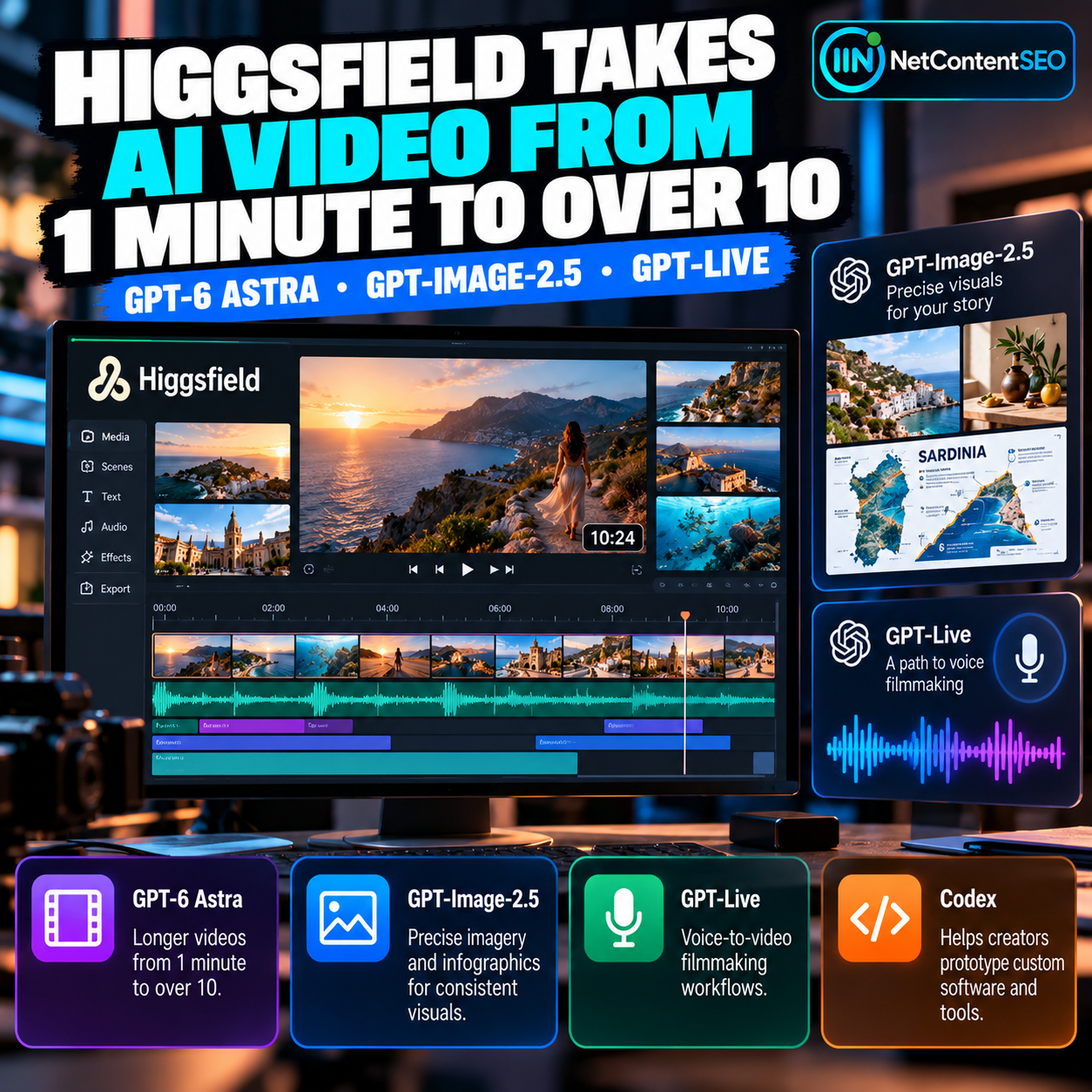

Higgsfield AI says it can now create videos longer than 10 minutes, up from a previous limit of around one minute, using GPT-6 Astra. In a customer story published by OpenAI on 13 October 2026, Higgsfield describes how OpenAI models are helping its team produce longer instructional videos, generate more precise visuals and move creative prototypes into production faster.
The story highlights three creative capabilities: GPT-6 Astra for longer video workflows, GPT-Image-2.5 for images containing readable text and detailed infographics, and a future voice-driven filmmaking experience powered by GPT-Live-1. OpenAI also describes how Higgsfield's creative team uses Codex to turn ideas into software prototypes.
From one-minute clips to videos over 10 minutes
According to Higgsfield CEO and co-founder Alex Mashrabov, videos created with the company's earlier workflow topped out at around one minute. With GPT-6 Astra, Higgsfield says creators can now produce videos exceeding 10 minutes.
The company's creative agents also handle repetitive production tasks, such as generating multiple variations of a shot. OpenAI's account says GPT-6 Astra agents can call external tools for complex manual tasks such as 3D modelling, helping address the challenge of maintaining consistency across longer videos.
Higgsfield has applied this workflow to instructional content for its YouTube channel. Work that previously required substantial manual effort can now be produced through an AI-assisted process, according to the company.
GPT-Image-2.5 for more precise visuals
Longer video is only one part of the workflow. Higgsfield also uses GPT-Image-2.5 for visual content where text legibility and precise layouts matter, including promotional materials and infographics.
For smaller businesses and creative teams, readable text inside imagery can be important for campaign graphics, product explainers and educational visuals. OpenAI's customer story presents GPT-Image-2.5 as a way to create this kind of content without requiring a large production budget. These are capabilities described by Higgsfield; results will depend on the specific task and workflow.
A future path from voice to filmmaking
Higgsfield's longer-term ambition is to let creators describe an idea aloud and watch it take shape in real time. Mashrabov calls this vision “voice to movie”: the system would understand a creator's spoken intention and render the vision while the creator talks.
OpenAI's story connects this direction with advances in planning, tool calling, image generation and voice. It describes GPT-Live-1 as part of the path toward this voice-driven filmmaking experience. The account presents this as a direction Higgsfield wants to pursue, not a statement that a complete real-time voice-to-film product is already generally available.
Codex helps creative ideas reach production
Higgsfield says its product work brings together around 200 creatives and 100 engineers. Creatives use Codex to turn ideas into software prototypes, reducing the friction between a concept and a working implementation.
Previously, moving a prototype into production required substantial involvement from front-end and back-end engineers. According to Mashrabov, GPT-6 Astra and Codex have reduced the work needed to bring those ideas into the product, allowing the team to develop and ship improvements faster.
What this means for creators and small teams
- Longer-form production: AI-assisted workflows may help teams create instructional and narrative videos beyond short clips.
- More connected workflows: creative agents can automate repetitive tasks and use external tools for complex production steps.
- Visuals with text: image generation that better handles readable text and infographics can support marketing and educational materials.
- Faster prototyping: coding assistance can help creative teams turn ideas into prototypes before committing more engineering resources.
- Voice-driven creation: the longer-term goal is to make filmmaking more conversational, with creators describing their intentions and AI handling more of the production process.
What the announcement does—and does not—establish
The source is an OpenAI customer story featuring Higgsfield's experience and statements from its CEO. It reports that the company can produce videos over 10 minutes with GPT-6 Astra and describes its use of GPT-Image-2.5 and Codex. These are company-reported results, not an independent benchmark comparing every AI video platform.
The voice-to-movie workflow is presented as an ambition for the future. The article should not be read as confirmation that GPT-Live-1 already provides a fully released, real-time filmmaking product to all users.
The takeaway
Higgsfield says GPT-6 Astra has extended its AI video workflow from around one minute to more than 10 minutes. The OpenAI customer story also highlights GPT-Image-2.5 for more precise visual assets, GPT-Live-1 as part of a future voice-to-film direction, and Codex for turning creative ideas into software prototypes. Together, these examples show how AI models can support more of the production pipeline, from creating assets to building the tools used to deliver them.