

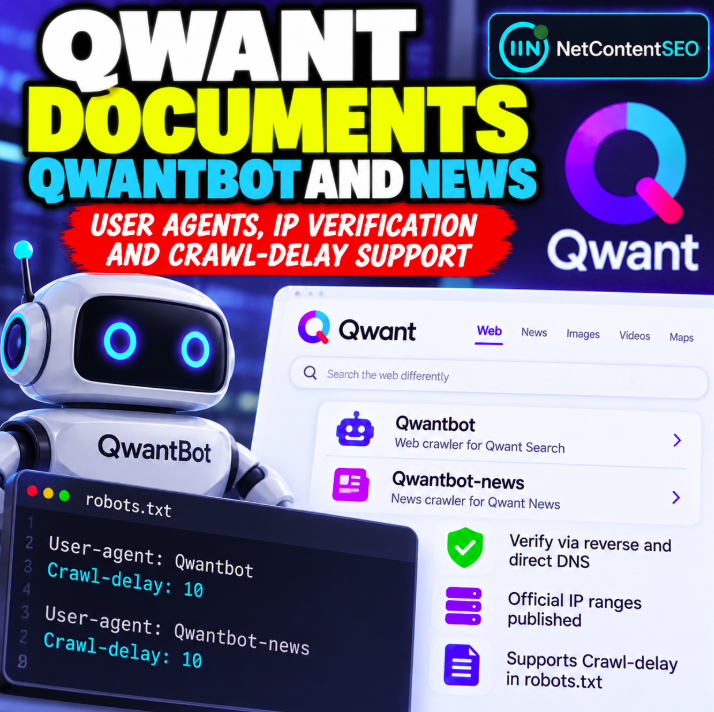

Qwant has updated its official documentation for QwantBot, describing its search and news crawlers, how website owners can verify crawler requests, and support for the Crawl-delay directive in robots.txt. The documentation update was reported on October 5, 2026, at 09:33, with no time zone specified. It documents crawler behaviour and identification; it does not establish that Qwant's crawlers were first launched on that date.
What Qwant's documentation covers
The official help page identifies two user agents: Qwantbot and Qwantbot-news. The first is associated with Qwant's search crawling, while the second is identified for news crawling. Site owners can use these names when reviewing access logs and configuring crawler rules.
The documentation also describes verification through reverse and forward DNS checks and publishes information about Qwant's IP networks. These details give administrators a way to check whether a request claiming to come from QwantBot matches the documented crawler infrastructure.
How to verify a QwantBot request
A user-agent string alone is not proof that a request comes from the genuine crawler: user-agent values can be copied. Qwant's documentation describes checking the request through reverse DNS and then confirming the result with a forward DNS lookup, alongside the published IP network information.
- Inspect the access log. Record the requesting IP address, timestamp and user-agent string.
- Check reverse DNS. Look up the hostname associated with the IP and compare it with the official guidance.
- Confirm forward DNS. Resolve the hostname back to an IP address and check that it matches the original address.
- Compare with Qwant's published networks. Use the current official documentation rather than relying on an old copied list.
Follow the precise hostname patterns and verification procedure in Qwant's own documentation. Do not assume that a request is genuine just because its user-agent contains the word “Qwant”.
QwantBot and QwantBot News
The documentation distinguishes the general search crawler from the news crawler through their user-agent names. This is useful when reviewing crawl activity or trying to understand which type of Qwant discovery may be requesting pages.
The existence of a separately named news crawler does not, by itself, guarantee that a page will be included in Qwant News or explain the ranking and selection criteria. The cited documentation concerns crawler identification and site access, not a promise of indexing or visibility.
What Crawl-delay means for robots.txt
Qwant's documentation states support for the Crawl-delay directive in robots.txt. This directive can be used to request a pause between crawler requests. Website administrators should consult the current Qwant instructions for the accepted syntax and apply a value that fits their server capacity and crawl needs.
Crawl-delay is distinct from an access prohibition. If a site needs to block a crawler from specific paths, it should configure the relevant Disallow rules as appropriate. A delay setting should not be treated as a guarantee of a specific crawl rate, nor should it be assumed to control crawlers other than those that document support for it.
What website owners should do
- Use the official documentation. Keep a reference to Qwant's current crawler guidance for future log analysis and robots.txt changes.
- Verify before blocking. Check suspicious requests instead of blocking every user-agent that resembles QwantBot.
- Review server load. If crawling is creating load, evaluate logs and choose a reasonable Crawl-delay according to Qwant's instructions.
- Separate crawling from indexing. A verified crawl request does not prove that a URL is indexed, ranked or shown in a news surface.
- Keep configurations precise. Ensure robots.txt rules match the intended crawler and paths, and test changes before relying on them.
What is confirmed—and what is not
- Officially documented: the user-agent names
QwantbotandQwantbot-news. - Officially documented: reverse and forward DNS verification guidance.
- Officially documented: publication of Qwant's IP networks and support for
Crawl-delayinrobots.txt. - Reported update date: October 5, 2026, at 09:33; the time zone was not specified.
- Not established: that the crawlers were introduced on October 5, 2026.
- Not established: any change to indexing, rankings, crawl frequency or news inclusion as a result of the documentation update.
Frequently asked questions
Which Qwant crawler user agents are documented?
The documentation identifies Qwantbot and Qwantbot-news.
How can I check whether a request is genuinely from Qwant?
Follow Qwant's documented reverse-DNS and forward-DNS verification procedure and compare the address with its published IP networks. A user-agent string alone is not sufficient proof.
Does Qwant support Crawl-delay?
Yes. The official documentation describes support for the Crawl-delay directive in robots.txt. Consult the page for the current syntax and instructions.
Did Qwant launch its crawler on October 5, 2026?
The date refers to the reported documentation update. The source does not demonstrate that the crawler itself was introduced on that date.
Does a verified QwantBot visit mean a page is indexed?
No. Verification establishes the origin of a request; it does not guarantee indexing, ranking or appearance in Qwant News.
The takeaway
Qwant's updated documentation gives site owners clearer guidance on its search and news crawler identifiers, DNS verification, published IP networks and Crawl-delay support. The update is useful technical documentation, but it should not be presented as a crawler launch or as evidence of a change to indexing or rankings. For implementation, follow the current official instructions directly.
Primary source
Qwant Help Center — Le bot Qwant (QwantBot) et le fichier robots.txt.