

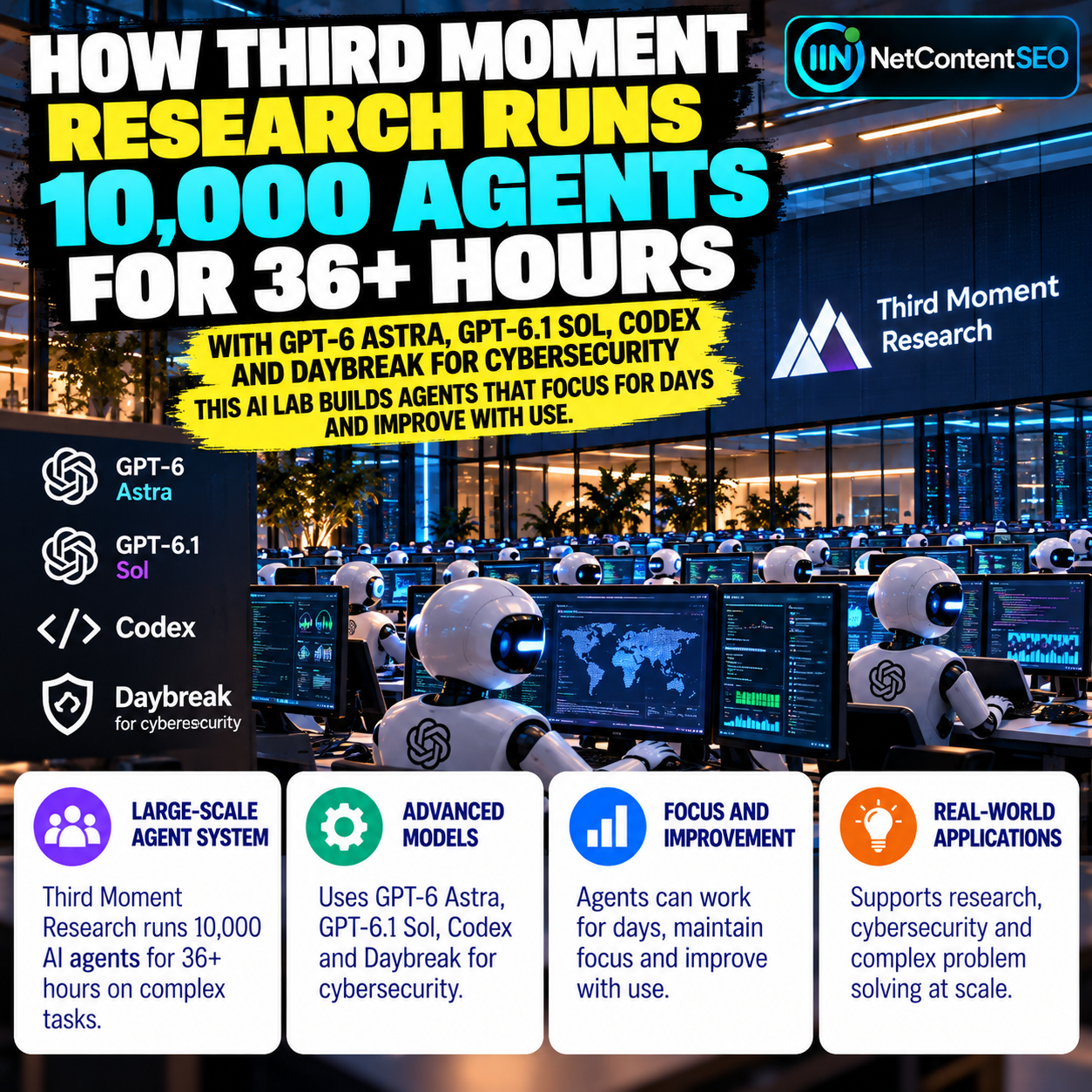

Third Moment Research says it runs 10,000 AI agents for more than 36 hours, using a combination of OpenAI models, Codex and cybersecurity tooling to tackle complex work over extended periods. In a customer story published by OpenAI, the AI lab describes a system designed to sustain focus across long-running tasks and improve through repeated use.
The workflow brings together GPT-6 Astra, GPT-6.1 Sol, Codex and Daybreak for cybersecurity. The central idea is to move beyond short, isolated interactions and build agents that can keep working on a task for many hours, using tools and feedback as part of a longer process.
What Third Moment Research is building
Third Moment Research is developing an AI lab around large-scale agent workflows. According to the OpenAI story, its system can run 10,000 agents for more than 36 hours. That scale and duration are the headline claims of the case study; the summary does not provide enough information to independently benchmark the system against other agent platforms.
Long-running agent systems face challenges beyond generating a strong individual response. They need to keep track of goals, work through multiple steps, use tools appropriately and recover when an intermediate step does not succeed. The longer the task, the more important it becomes to maintain direction and evaluate progress along the way.
The models and tools in the workflow
- GPT-6 Astra: part of the model stack used for sustained agentic work.
- GPT-6.1 Sol: another model named in the system, contributing to the lab's approach to complex tasks.
- Codex: a coding agent and development tool used within the broader workflow.
- Daybreak for cybersecurity: the cybersecurity component identified in the brief as part of the setup.
The OpenAI story presents these components as part of a combined system. The available brief does not specify the exact division of labour between every model or tool, so it would be premature to assign detailed responsibilities that are not described by the source.
Why running agents for 36+ hours matters
Many AI interactions are short: a user asks a question, receives an answer and then decides what to do next. Long-running agents aim to handle a broader sequence of steps, continuing toward a goal over time rather than stopping after one response.
That can be useful for research, software development, cybersecurity and other complex work where progress depends on repeated analysis and tool use. However, a long runtime by itself is not proof of quality. A useful system also needs reliable intermediate results, safeguards, clear objectives and ways to detect when an agent is stuck or has gone off course.
Focus and improvement through use
The brief describes agents that can focus for days and improve with use. In practice, sustained performance depends on how the system manages context, tracks its objective, uses feedback and evaluates the quality of its own work. These design choices matter because long tasks can accumulate small errors if intermediate outputs are not checked.
The public summary does not provide a complete technical specification for how Third Moment Research implements persistence, memory, evaluation or recovery. Those mechanisms should not be inferred from the headline alone. The supported takeaway is that the lab is pursuing agents designed for longer periods of work and iterative improvement.
Cybersecurity as part of the system
Daybreak is identified as the cybersecurity component in the workflow. Cybersecurity work can involve complex, multi-step analysis, making it a natural area of interest for agentic systems. At the same time, security tools require careful permission boundaries, testing and human oversight, particularly when an agent can execute actions or interact with technical environments.
The brief does not detail the precise security tasks performed by Daybreak in this system. The article therefore treats cybersecurity as a stated area of the workflow rather than claiming specific capabilities, test results or outcomes that have not been provided.
What organisations can learn from the approach
- Design around goals, not just prompts. Long-running agents need a clear objective and a way to assess progress through multiple steps.
- Make tool use deliberate. Give agents access only to the tools and permissions needed for the task.
- Check intermediate work. Longer execution should include evaluation and recovery mechanisms, not simply more time running.
- Measure task outcomes. Assess correctness, reliability and useful completion—not only the number of agents or hours they run.
- Keep human oversight appropriate to risk. High-impact or security-sensitive actions may require review and explicit approval.
What the case study does—and does not—establish
OpenAI's customer story describes Third Moment Research's approach and reports the use of 10,000 agents for 36-plus hours with GPT-6 Astra, GPT-6.1 Sol, Codex and Daybreak for cybersecurity. These are claims presented in a company-published case study, not an independent comparative benchmark.
The brief does not establish a universal performance improvement, a specific success rate or that every agent runs continuously for the full period on every task. Such conclusions would require more detail about the workloads, evaluation method and operating conditions.
The takeaway
Third Moment Research is exploring how AI agents can work at scale for extended periods, with a reported system of 10,000 agents running for more than 36 hours. The OpenAI story names GPT-6 Astra, GPT-6.1 Sol, Codex and Daybreak for cybersecurity as parts of the approach. The broader lesson for agentic AI is that sustained work requires more than powerful models: it also depends on well-defined goals, effective tool use, evaluation and safeguards.
Source
OpenAI — How Third Moment Research runs 10,000 agents for 36+ hours