

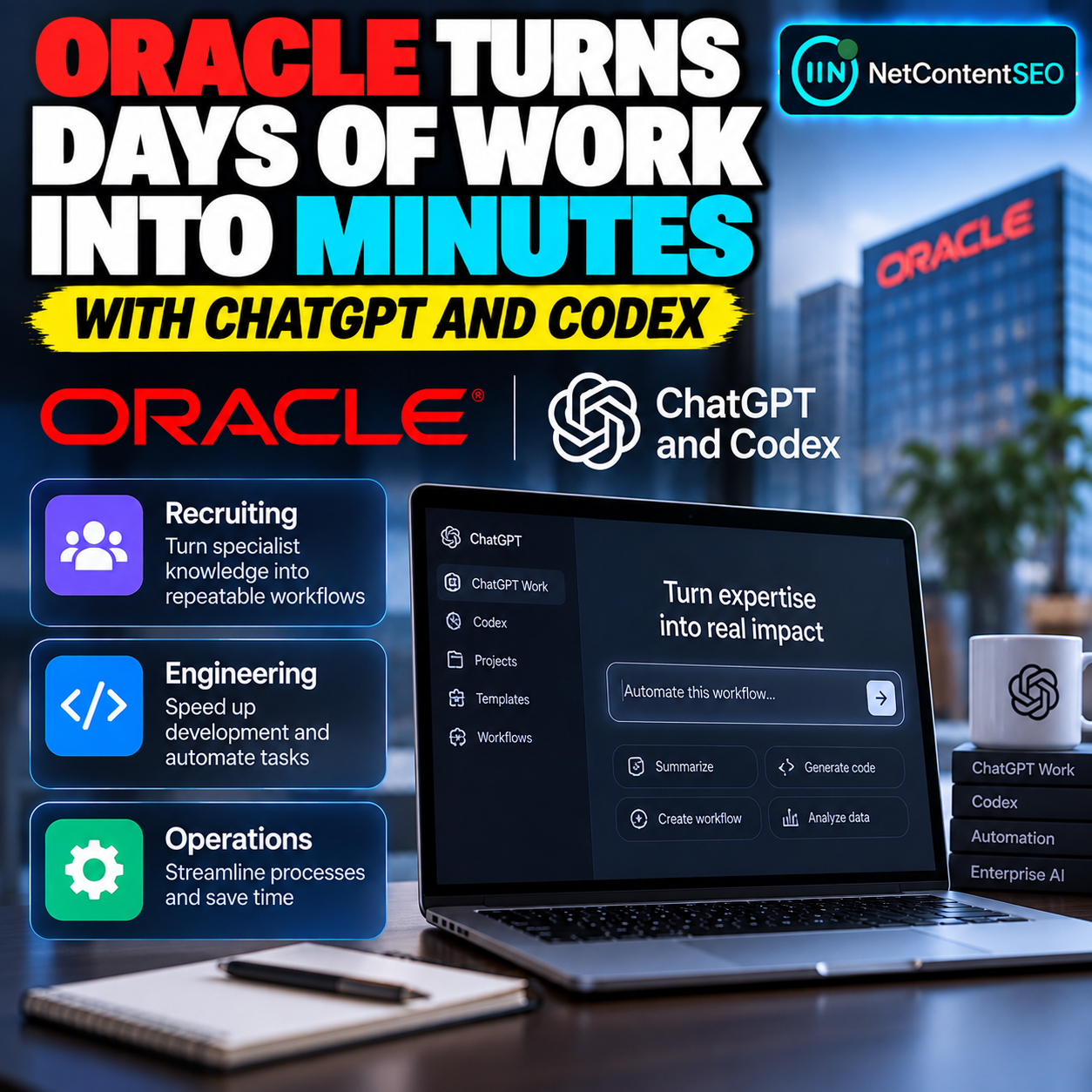

Oracle says its teams are using ChatGPT Work and Codex to turn tasks that once took days—or required months of specialist development—into workflows that can deliver results in minutes. In a customer story published by OpenAI on October 8, 2026, the company describes examples across recruiting, business analytics and production engineering. OpenAI reports 130,000 active ChatGPT users and more than 95,000 active Codex users at Oracle.
The examples are customer-reported outcomes published by OpenAI, not an independent audit. They illustrate how reusable AI-supported workflows can help employees access specialist knowledge, while Oracle's leaders stress that architecture, security, code quality and human oversight remain essential.
Recruiting research: from days to minutes
Oracle's talent acquisition team used ChatGPT Work to build a talent market intelligence tool. Given a job description, the tool researches comparable roles, benchmarks compensation and assesses the talent pool across relevant locations.
According to OpenAI's case study, this information previously took two to four days to compile. Jan Ackerman, Oracle's Senior Vice President and Global Head of Talent Acquisition, says recruiters can now prepare in around 15 to 20 minutes using the tool. OpenAI highlights a 98% decrease in the time required for talent acquisition research.
The workflow also aims to make preparation more consistent between recruiters, giving hiring managers a more repeatable set of data and insights rather than a process that varies from one search to the next.
Business users can ask for an outcome, not hunt for a report
Oracle Applications Lab built an ontology describing company objects, relationships and rules. Codex uses that structured context to help translate plain-language business questions into SQL queries and coordinate calls to internal systems.
The resulting workflow can return an analysis, report or application. OpenAI's story describes a business user who received an answer almost immediately to a question that would ordinarily have taken a couple of hours. The user checked the result against the former manual process and found that the numbers matched.
This example depends on the underlying ontology and system integration. It should not be read as a claim that an AI model can safely query any enterprise database without carefully designed context, access controls and validation.
Production engineering: incident response in minutes
Oracle's site reliability engineers use Codex to gather context relevant to an incident and surface the appropriate playbook. The aim is to reduce time spent searching for information so engineers can focus more on decisions and resolution.
Richard Lam, Group Vice President of Oracle Applications Lab, says a typical simple incident that previously took about an hour to resolve can now be handled in minutes. The case study does not suggest that every incident is automated or that engineers are removed from the process.
What Oracle's examples have in common
- Specialist knowledge becomes reusable: expertise is built into tools and workflows that more employees can use.
- People describe the outcome: users can state what they need instead of manually assembling every report or searching for every source.
- Context and integrations matter: useful results depend on structured knowledge, internal systems and clear operating rules.
- Human accountability remains: Oracle's leaders emphasise system design, security, maintainability and responsible oversight.
Oracle's leadership lessons for enterprise AI
The OpenAI case study highlights several lessons from Oracle's experience:
- Set guardrails: design architecture, security and code structure deliberately instead of leaving critical decisions implicit.
- Prototype early: use working prototypes to make ideas concrete and speed up iteration.
- Own the code: teams need to work alongside Codex and ensure generated code remains understandable and maintainable.
- Keep people responsible for results: AI can accelerate the work, but organisations still need to validate the systems and their outputs.
What the numbers do—and do not—show
OpenAI's customer story lists 130,000 active ChatGPT users and more than 95,000 active Codex users at Oracle. It also highlights a 98% reduction in the time needed for talent acquisition research. These are figures presented in OpenAI's published case study; the page does not describe them as an independent third-party audit.
The time savings refer to particular workflows and examples. They should not be generalised to every recruiting task, business query or engineering incident. Results will depend on the task, quality of the underlying systems, integration design and the level of human review required.
Frequently asked questions
How does Oracle use ChatGPT Work in recruiting?
Oracle's talent acquisition team uses a talent market intelligence tool to research comparable roles, benchmark compensation and assess talent pools from a job description. OpenAI says this preparation time fell from two to four days to about 15–20 minutes.
How does Oracle use Codex for business analytics?
Oracle Applications Lab created an ontology of internal objects, relationships and rules so Codex can help turn plain-language requests into SQL queries and retrieve information from internal systems.
How is Codex used in production engineering?
Site reliability engineers use it to collect incident context and surface the relevant playbook. Oracle reports that a typical simple incident can be handled in minutes instead of about an hour.
How many Oracle employees use these tools?
OpenAI's case study reports 130,000 active ChatGPT users and more than 95,000 active Codex users at Oracle.
Does this mean enterprise workflows can run without human oversight?
No. Oracle's leaders explicitly stress the need for sound architecture, security, maintainable code and human responsibility for the underlying systems and outputs.
The takeaway
Oracle's examples show how ChatGPT Work and Codex can turn specialist processes into repeatable workflows across recruiting, business analytics and incident response. OpenAI reports major time savings in specific cases, including a reduction from days to minutes for talent acquisition research. The broader lesson is not that AI removes the need for experts, but that well-designed tools can extend their knowledge—provided organisations retain strong system design, security and human oversight.
Primary source
OpenAI — How Oracle turns days of work into minutes with ChatGPT and Codex (October 8, 2026).