

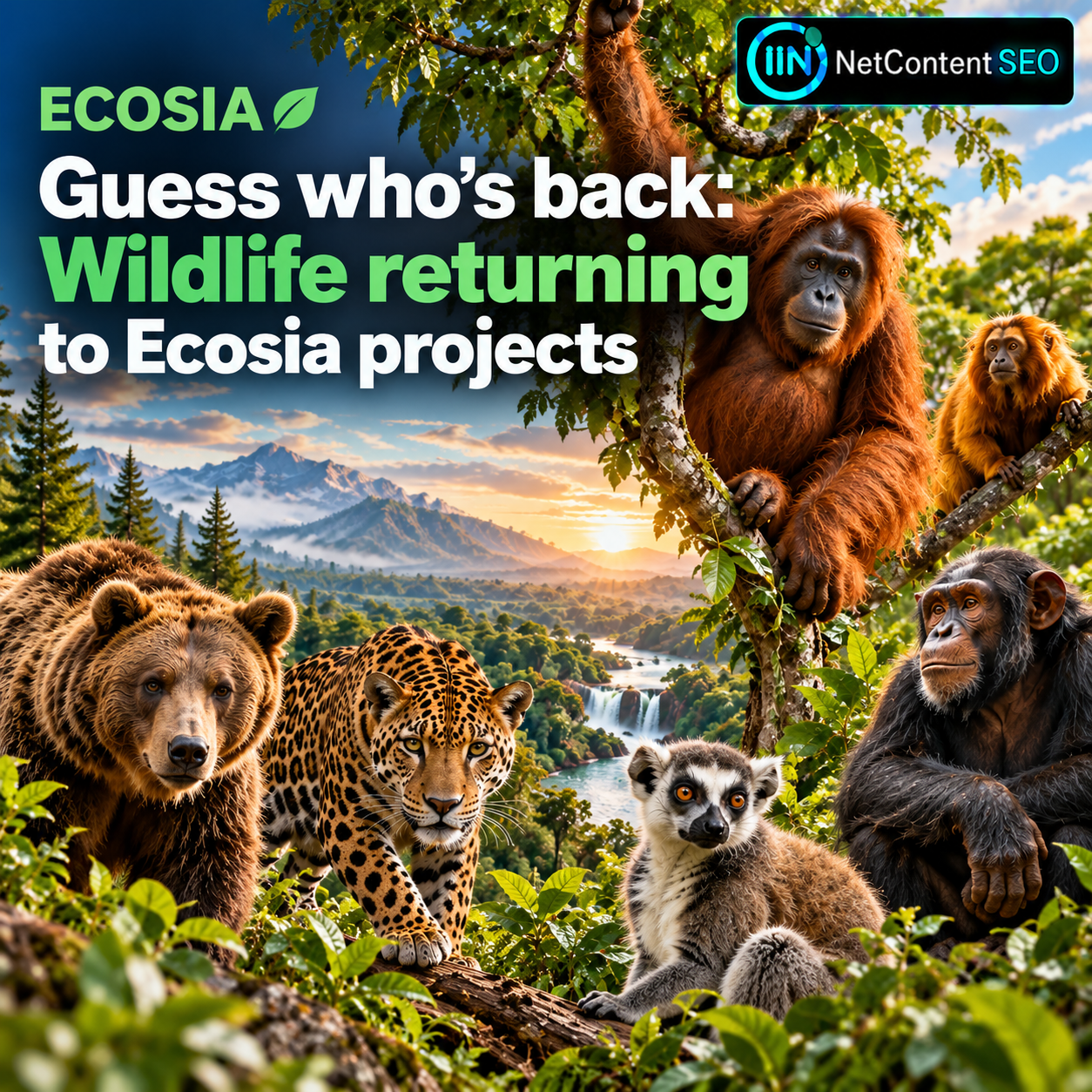

What happens after a tree-planting project begins to restore a damaged landscape? In a new report published on October 28, 2026, search engine Ecosia highlights wildlife recorded in or supported by its restoration projects, from brown bears in Romania and orangutans in Indonesia to jaguars in Brazil and lemurs in Madagascar.
The report offers a vivid reminder that forest restoration is not only about carbon storage or the number of trees planted. Healthy habitats can provide food, shelter and routes between fragmented ecosystems, while local communities benefit from more resilient landscapes.
For readers interested in search technology, sustainability and corporate impact, Ecosia provides an unusual case study: a search service that channels resources into ecological projects and reports on the work being carried out by conservation partners.
Romania: Food forests for brown bears in the Carpathians
In Romania's Carpathian Mountains, Ecosia works with Transylmagica to establish food-rich groves for bears. The project uses species including oak, European beech, wild pear, crab apple, wild cherry and cherry plum.
The idea is to provide food as bears move down from higher elevations in autumn, potentially reducing the need for them to approach villages. Camera traps near the planting sites have recorded brown bears as well as fox cubs, wolves, red deer, pine martens and lynxes.
These observations demonstrate wildlife activity in the project area. They do not, by themselves, establish a population increase or prove that restored groves have eliminated human–wildlife conflict.
Indonesia: Orangutans and tigers in the Leuser Ecosystem
In Sumatra, Ecosia supports Yayasan Forum Konservasi Leuser (FKL) and Wildlife Asia in restoring the Leuser Ecosystem through natural regeneration and agroforestry. Former oil-palm monocultures are gradually being transformed into mixed forest, with nearby natural forest supplying seeds that help regeneration.
Ecosia says almost 1.5 million trees have grown through this project so far. Camera traps have recorded Sumatran orangutans, tigers, gibbons, hornbills, pheasants and slow lorises in the restoration areas.
The Leuser Ecosystem is notable because orangutans, tigers, elephants and rhinos inhabit the same wider landscape. Reconnecting and recovering degraded habitat is therefore important for multiple threatened species, not just one flagship animal.
Brazil: Corridors for threatened primates and big cats
In Brazil's Atlantic Forest, Ecosia describes work with two conservation partners. Centro de Pesquisas Ambientais do Nordeste (CEPAN) is developing forest connections in Paraíba to support threatened primates, including the blond capuchin, while providing local residents with training to grow seedlings.
In the Pontal do Paranapanema region, Instituto de Pesquisas Ecológicas (IPÊ) works to reconnect surviving forest fragments. The corridors help wildlife move in search of food, shelter and mates. Species associated with these landscapes include the black lion tamarin, jaguar, ocelot, puma, tapir, collared peccary and blue-and-yellow macaw.
Ecosia reports that IPÊ's ecological monitoring indicates biodiversity recovery across connected forest patches. The broader lesson is that isolated patches of forest often need ecological links to support movement and genetic exchange.
Madagascar: Helping lemurs cross fragmented habitats
Madagascar contains exceptional biodiversity, including numerous lemur species found nowhere else. Fragmented forests can leave populations more vulnerable to fires, disease and reduced genetic diversity.
Ecosia's partner Tropical Biodiversity & Social Enterprise (TBSE) is working with communities to reconnect forest fragments in an area important for the conservation of seven lemur species. The restoration creates routes for animals to travel between patches in search of food and mates.
These movements also matter to the ecosystem itself. Animals can carry seeds and pollen between habitats, supporting regeneration beyond the original planting sites.
Uganda and Tanzania: Corridors for chimpanzees
Working with the Jane Goodall Institute, Ecosia supports tree corridors in Uganda and Tanzania that aim to reconnect chimpanzee habitats. The organization reports more than 3.2 million trees planted across the two projects and 59 nurseries growing native species.
As forests become fragmented, chimpanzees may travel into farmland to find food, increasing the risk of conflict with people. Habitat corridors are designed to make movement between remaining forest areas safer while supporting environmental education and local livelihoods.
The initiative also illustrates why community participation is essential. Long-term restoration is more likely to succeed when nearby residents gain tangible benefits from healthy forests and reliable water resources.
Uganda: Buffer zones around mountain gorilla habitat
In the Bwindi region of Uganda, Ecosia partners with the Change A Life Bwindi Association to restore buffer zones around Bwindi Impenetrable Forest, home to a major population of mountain gorillas.
The work aims to improve habitat connectivity while giving local communities access to useful trees outside the protected forest for products such as medicine, firewood and crafts. This approach seeks to reduce pressure on trees within the park.
It is an example of conservation and livelihoods being addressed together rather than treated as competing goals.
Why forest corridors matter more than simple planting totals
A tree counter is easy to understand, but it cannot capture the full ecological value of a restoration project. The location of the trees, the species selected, the survival of seedlings and the connections created between habitats can be just as important as the number planted.
Corridors can help wildlife reach food and breeding areas. Natural regeneration can restore more complex forest structure over time. Community-managed agroforestry can provide income and reduce pressure on remaining natural habitat.
Ecosia's description of its planting approaches explains that the organization uses multiple methods, including large-scale landscape restoration, agroforestry and assisted natural regeneration, depending on local needs.
What the wildlife sightings prove—and what they do not
Camera-trap footage, tracks and field observations provide valuable evidence that particular animals are using or moving through a location. They can help conservation teams monitor habitats and understand which species are present.
However, a photograph of a jaguar or orangutan does not automatically establish that the animal returned because of a specific planting intervention, or that its wider population is growing. Stronger conclusions require systematic monitoring over time, appropriate comparisons and population-level evidence.
That distinction does not diminish the value of Ecosia's report. It makes the environmental story more credible by separating documented observations from broader ecological outcomes that take longer to measure.
What this means for sustainable search engines
Ecosia's business model connects an everyday digital activity—web searching—with environmental funding. Its April 2026 milestone report said it had reached 250 million trees, while emphasizing local partnerships and long-term monitoring.
For the technology industry, this raises a useful question: how should companies demonstrate impact beyond headline commitments? Reporting the number of trees planted is one measure. Documenting habitat quality, wildlife activity, community benefits and long-term ecological resilience can provide a fuller picture.
The October 28 wildlife update is a partner-reported snapshot of restoration work, not an independent scientific audit. Even so, it shows why biodiversity deserves a place alongside carbon accounting in conversations about environmental technology.
NetContentSEO assessment
The most interesting part of Ecosia's latest report is not the wildlife photography alone; it is the connection between digital services, local restoration partnerships and the gradual recovery of functioning habitats.
Bears feeding in Carpathian groves, orangutans moving through regenerating Sumatran forest and primates benefiting from connected habitats all illustrate the practical aims of ecosystem restoration. The observations are encouraging, while long-term monitoring remains essential to understand lasting conservation results.
For search professionals, Ecosia remains a distinctive example of a search engine seeking to turn user activity into measurable environmental work. Its latest report encourages a broader definition of impact: not simply more trees, but healthier landscapes for wildlife and people.
Primary source: Ecosia, “Guess who's back: Wildlife returning to Ecosia projects,” October 28, 2026. Additional background: Ecosia's planting methods and Ecosia's 250 million trees milestone.