

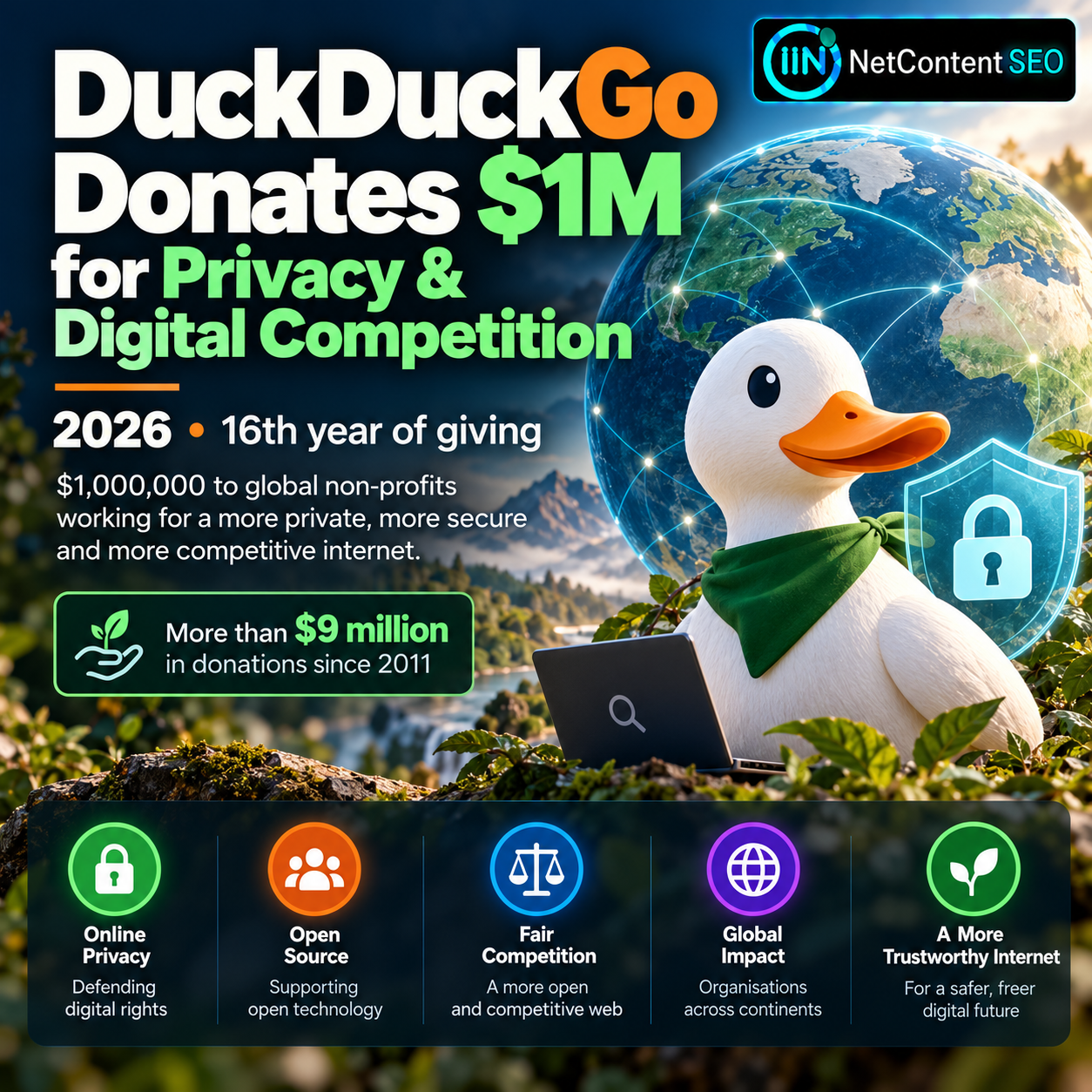

DuckDuckGo has announced $1 million in charitable donations for 2026, supporting nonprofits that work on online privacy, secure communications, open-source infrastructure and competition in digital markets. The announcement, published on DuckDuckGo's official Spread Privacy blog on October 26, 2026, marks the search company's sixteenth year of charitable giving and brings its stated cumulative donations since 2011 to more than $9 million.
For the search industry, the story is about more than corporate philanthropy. The list of recipients shows how privacy, competition policy, consumer rights and the technical foundations of a secure internet increasingly intersect. It also illustrates a form of search-engine differentiation that goes beyond search-result features: funding organizations that advocate for user choice and build tools used across the web.
DuckDuckGo's 2026 donations: the headline numbers
DuckDuckGo says its 2026 commitment totals $1,000,000. Its 2025 donation announcement reported cumulative giving of $8.05 million since 2011; the new allocation takes that figure above $9 million. These figures come from DuckDuckGo's own published announcements and represent its stated charitable commitments.
The 2026 recipients span North America, Europe, Australia and international organizations. Their work includes legal challenges to privacy violations, public-interest policy, encrypted communication, secure web infrastructure, digital-market competition and accountability in AI systems.
Public Knowledge receives the largest listed donation
Public Knowledge receives $75,000, the largest individual amount in DuckDuckGo's published 2026 recipient list. The US-based organization advocates for an open internet, freedom of expression, access to communications and policies intended to serve the public interest.
DuckDuckGo also allocates $50,000 each to ARTICLE 19, Demand Progress, the Digital Progress Institute, European Digital Rights (EDRi), Germany's Gesellschaft für Freiheitsrechte (GFF), the Open Home Foundation, Signal and Tech Policy Press.
These groups approach the internet's future from different directions. Some focus on civil liberties and privacy law; others work on competition, communications policy, journalism or practical technologies that help people control their digital lives.
Signal, Tor and open-source security receive support
The Signal Technology Foundation receives $50,000. Signal develops an encrypted communications service designed to make private messaging accessible while keeping its core technology open source. Its inclusion underscores the role that secure communication plays in a privacy-respecting internet.
The Tor Project receives $25,000. Tor maintains open-source technology and a decentralized network that help users browse with greater privacy and resist certain forms of surveillance and censorship.
DuckDuckGo allocates $30,000 to the Internet Security Research Group (ISRG), the organization behind Let's Encrypt, Prossimo and Divvi Up. Let's Encrypt is particularly relevant to website owners because it lowers barriers to HTTPS adoption through free, automated TLS certificates.
Another $25,000 goes to the Open Source Technology Improvement Fund (OSTIF), which supports security work on widely used open-source projects. DuckDuckGo's announcement highlights OSTIF's Project VLAT, which combines frontier AI models with senior security researchers and reports more than 500 security-impact findings triaged and fixed. That project description is a recipient-reported account, not an independently audited impact measure.
The Open Home Foundation, known for governing Home Assistant and other open-home projects, receives $50,000, connecting the privacy discussion to connected devices and household technology.
European privacy enforcement and digital rights
Several grants support organizations working on privacy regulation and legal enforcement in Europe. EDRi receives $50,000 for its wider network of digital-rights advocacy, while Germany's GFF receives $50,000 for legal work involving fundamental rights, surveillance and civil liberties.
noyb receives $25,000. The privacy organization is known for bringing cases involving alleged violations of European data-protection law. DuckDuckGo also names the UK's Open Rights Group ($25,000) and Portugal-based consumer litigation nonprofit Ius Omnibus ($25,000).
These organizations do not all pursue the same legal strategies, but their presence in the recipient list reflects a shared concern: privacy protections need enforceable rights and practical mechanisms, not merely reassuring product statements.
Digital competition and consumer choice are major themes
DuckDuckGo's program is not limited to preventing tracking. It also supports groups addressing competition and concentration in digital markets, a topic directly relevant to search engines, browser distribution and default settings.
Recipients include Demand Progress ($50,000), the Digital Progress Institute ($50,000), Public Knowledge ($75,000), the British Institute of International and Comparative Law ($25,000), the Bull Moose Institute ($25,000) and the Tech Oversight Project ($25,000).
The grants do not establish the correctness of any specific policy position or legal claim. They do show that DuckDuckGo is directing part of its philanthropy toward organizations that participate in debates over how digital markets should be regulated and how users can retain meaningful choice.
Internet Archive and freedom of information
The Internet Archive receives $25,000. Its preservation of web pages and other digital materials provides a public record used by researchers, journalists and internet users. Digital preservation is a different mission from private browsing, but both concern public access to trustworthy online infrastructure.
Other $25,000 recipients include OpenMedia, Digital Rights Watch, Privacy Rights Clearinghouse, Restore the Fourth and the Perl and Raku Foundation. DuckDuckGo also allocates $45,000 to the Surveillance Technology Oversight Project (S.T.O.P.), which works on civil rights and surveillance through research, advocacy and litigation.
AI accountability is part of the 2026 program
The Algorithmic Justice League receives $25,000. The organization researches and raises awareness of harms and bias associated with artificial intelligence and supports advocacy for people affected by automated systems.
AI also appears in the work of other recipients, including OSTIF's AI-assisted security initiative and organizations addressing digital-market policy and consumer data protection. The relevance to AI is therefore broader than chatbots or generative search results: it includes security, transparency, rights and competition.
Importantly, DuckDuckGo's announcement does not describe a new AI Search feature, a change in ranking signals or an adjustment to how its search engine generates or cites answers. The donation program should not be mischaracterized as an algorithm update.
What this means for SEO and the search industry
For SEO professionals, there is no immediate technical change to implement because of these donations. No new indexing requirement, schema type, ranking factor or search-console metric has been announced as part of the charitable program.
The longer-term relevance lies in the ecosystem surrounding search. Competition policy can affect the choices users have among search services. Privacy rules can influence how companies collect data and measure advertising. Security infrastructure such as HTTPS is fundamental to reliable websites, regardless of which search engine visitors use.
These connections are industry context rather than a prediction that the 2026 grants will directly change traffic, rankings or market share.
Why privacy is also an AI Search question
As AI assistants become another way people discover information, questions about personal data, user choice and transparency extend beyond conventional web search. Users may share sensitive information in conversational interfaces, while publishers and businesses seek clarity on how their content is accessed and attributed.
Organizations working on privacy rights, competition and open-source security may contribute to public debates and technical foundations relevant to AI services. However, the grant announcement does not specify that these donations are intended to change AI Search citation behavior, nor does it provide evidence of such an effect.
NetContentSEO assessment
DuckDuckGo's 2026 donation announcement is best understood as an investment in the wider digital-rights and internet-security ecosystem. The $1 million commitment supports organizations ranging from encrypted messaging and open-source security to consumer advocacy, competition policy and digital preservation.
For search marketers, it is a reminder that the future of search depends on more than algorithms: privacy expectations, user trust, open infrastructure and genuine market choice also shape the environment in which search services operate. The announced amounts and recipients are verifiable in DuckDuckGo's official post, while the eventual outcomes of the grants require separate evaluation.
Sources: DuckDuckGo, “2026 DuckDuckGo Charitable Donations,” October 26, 2026; DuckDuckGo, “2025 DuckDuckGo Charitable Donations,” September 30, 2025.