
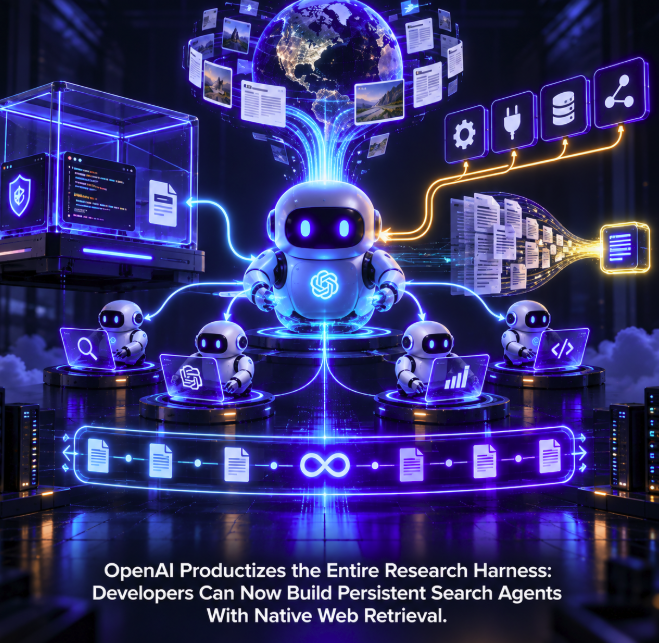
OpenAI has turned much of the infrastructure behind its long-running agents into a public developer product. The new Agents API, released in public beta on September 10, packages durable sessions, automatic context management, sandboxed execution, MCP connections, native web search, dynamic tool discovery and parallel subagents into a managed runtime rather than requiring developers to assemble those components themselves.
OpenAI describes the release in its official Agents API announcement as bringing the same kind of harness and infrastructure that powers Codex to developers through an API. The company’s API changelog confirms the September 10 public beta and says OpenAI manages session orchestration, context compaction and recovery while developers connect tools and choose an execution environment.
For research applications, the important change is that web retrieval is no longer merely a model capability developers have to surround with their own state machine. It can sit inside a persistent agent session alongside code execution, files, external MCP tools and subagents, allowing a research process to continue across turns and context windows while OpenAI manages the agent loop.
The API productizes the agent harness, not just another model endpoint
A conventional model API accepts input and returns output. Developers building sophisticated research agents on top of that primitive have historically had to implement their own loop for tool calls, conversation state, retries, context pruning, execution environments and delegation.
The Agents API architecture moves much of that work into OpenAI’s managed service. An agent defines its model, instructions, tools and MCP servers; an optional environment provides a workspace; and a durable session holds the configuration, conversation and saved work over time.
OpenAI runs the harness that coordinates model calls and tools. The application can stream progress, receive events or webhooks, steer an active task and send another task to the same session later. This is materially different from simply exposing a stronger language model because persistence and orchestration become first-class API resources.
Persistent sessions let research continue instead of restarting
The Agents API is designed for work that can last much longer than a single prompt-response cycle. OpenAI’s session documentation says the same session can be reused for follow-up messages while retaining the agent configuration, conversation and saved work.
That matters for research because useful investigations are rarely one-shot queries. An agent may collect sources, write intermediate files, receive a correction from the user, search again and then produce a final synthesis. A durable session gives those stages a common state rather than forcing the application to reconstruct the entire project on every call.
OpenAI also supports asynchronous turns. Applications can follow an agent’s work through streaming or use webhooks to learn when a long-running task finishes or needs additional input. The result is closer to operating a persistent worker than repeatedly invoking a stateless chatbot.
Automatic compaction tackles the context-window problem
Long-running research eventually collides with context limits. A naive agent either keeps sending an increasingly expensive transcript or discards earlier information and risks losing facts it still needs.
OpenAI says the Agents API automatically compacts earlier context as a session approaches its context limit, preserving information needed to continue. Developers can therefore build workflows spanning multiple context windows without writing their own summarization and compaction layer.
This is one of the least visible but most important parts of the launch. Reliable research agents need continuity over hours or days, and that requires deciding what information should remain active after the raw history becomes too large. OpenAI is now making that context-management machinery part of the product.
Automatic compaction does not make memory infallible. Developers still need to design workflows that preserve authoritative source material and important artifacts rather than assuming every detail in a long investigation will remain perfectly represented in a compressed context.
Native web search can be part of the agent itself
OpenAI’s Agents API web-search documentation exposes built-in web retrieval as a configurable tool. An agent can use live web search when it needs current information, and developers can control settings such as search context size, domain restrictions and location hints.
The integration is explicit rather than magical. OpenAI’s documentation says developers must include web_search in the agent’s tools; merely asking an agent to search in the prompt does not enable the capability if the tool is absent.
Search can operate in live mode against the current internet or in cached mode against saved web content, while it can also be disabled. This gives developers a clearer control boundary for applications that need fresh research in some tasks but predictable or restricted retrieval in others.
For a research agent, native search can now coexist with session persistence and other tools inside one managed harness. The agent can retrieve current sources, analyze them, store intermediate work in its environment and continue the investigation in a later turn.
MCP turns external data systems into agent tools
The Agents API also supports Model Context Protocol connections. According to OpenAI’s MCP documentation, an MCP server can publish tool definitions and execute calls while the Agents API discovers those tools and returns the results to the agent.
Developers can connect remotely reachable HTTP MCP servers through OpenAI’s service or connect tools through the session environment when access to private infrastructure is required. This gives the same agent a route to internal databases, documentation systems and specialized applications in addition to the public web.
That combination is especially relevant for enterprise research. An investigation may need public sources for market developments, internal documents for company context and a database query for proprietary metrics. The managed harness can coordinate those information sources rather than treating web search as an isolated feature.
Tool search addresses the problem of giving agents too many tools
Agents become less efficient when every possible tool definition is loaded into context whether or not the current task needs it. OpenAI’s launch announcement says the Agents API includes tool search that loads relevant tool definitions as needed, reducing token usage and helping preserve cache efficiency.
Once tools are available, programmatic tool calling lets the agent run calls in parallel, chain operations and filter or combine results in code. That is useful when a task involves a large volume of retrieved data but only a small portion belongs in the model’s active context.
The architectural point is important: OpenAI is treating tool selection as an orchestration problem rather than requiring developers to dump an entire integration catalog into every prompt. As agent ecosystems grow, discovering the right capability at runtime can be as important as having the capability in the first place.
Subagents can investigate independent questions in parallel
OpenAI has also made multi-agent orchestration a built-in feature. Its multi-agent documentation says a coordinator can delegate independent work to subagents, each with its own context, and then combine their findings.
For research, this creates an obvious pattern. One subagent can investigate official documentation, another can analyze market reporting and another can inspect technical evidence. They can work concurrently rather than forcing a single context to serially process every branch of the investigation.
OpenAI says subagents inherit configured MCP tools, credentials, allowed tools and web-search settings. When an environment is present, the coordinator and subagents share its filesystem rather than receiving separate sandboxes.
Parallelism can reduce elapsed time, but it does not eliminate synthesis risk. The coordinator still needs to reconcile contradictions, identify duplicated evidence and distinguish authoritative sources from weaker ones. Multi-agent architecture accelerates research; it does not automatically make the conclusions correct.
Sandboxes give the agent somewhere to actually work
Many research tasks cannot be completed entirely inside a model’s text context. Agents may need to download files, run scripts, transform datasets, inspect directories or produce artifacts. The Agents API supports execution environments for that work.
Developers can use OpenAI-hosted sandboxes or connect their own infrastructure or supported sandbox providers. The environment can give the agent a filesystem and command execution while the managed harness continues to coordinate the task.
This separates reasoning state from working state. A large set of source files does not need to be repeatedly pasted into the prompt if the agent can inspect those files in an environment when required. Intermediate calculations and generated artifacts can likewise live in the workspace rather than consuming conversational context.
For sensitive workloads, environment choice remains a design decision rather than a detail. OpenAI’s documentation says developers can use self-hosted environments when the agent needs private infrastructure, custom software or network access that should remain under the application’s control.
The API turns research architecture into configuration
Before managed agent runtimes, a developer building a persistent research assistant might need a conversation database, a job queue, a browser or search integration, a container service, a tool registry, a context-summarization system and custom logic for delegating work. None of those components is individually impossible, but the integration burden is substantial.
The Agents API does not eliminate application engineering, but it moves a meaningful portion of that stack behind one orchestration layer. Sessions, compaction, web retrieval, MCP, tool discovery, sandbox execution and subagent coordination can all be configured around the agent rather than independently reinvented.
This is why the launch is better understood as productizing a research harness than simply releasing another agents endpoint. OpenAI is exposing the operational machinery required to keep an AI worker productive across long and complex tasks.
Native retrieval still requires source discipline
Built-in web search makes retrieval easier, but it does not remove the need to evaluate evidence. An agent can find current pages and source links while still misunderstanding a claim, choosing a weak source or combining facts that do not support the same conclusion.
Developers building research products should therefore preserve provenance and design explicit source-quality rules. Domain restrictions can help when a task should rely on official documentation, while MCP can expose curated internal repositories for proprietary knowledge.
Parallel subagents can also be used for verification rather than only speed. One agent can collect evidence while another independently checks figures or looks for contradictory primary sources. The architecture gives developers more ways to structure research discipline, but the discipline still has to be designed.
Managed infrastructure introduces its own data and security decisions
The convenience of a managed harness comes with deployment considerations. OpenAI’s current Agents API documentation says the service supports data residency only in the United States and does not support Zero Data Retention. Choosing a self-hosted sandbox does not by itself make the Agents API eligible for ZDR.
OpenAI also warns that agent-generated code can access the files, credentials and network made available to its environment. Developers should isolate workloads, restrict outbound network access and grant credentials according to the minimum permissions required.
These constraints matter for enterprises deciding whether a research workflow can use the managed API or needs a different runtime model. The Agents API reduces orchestration work, but developers remain responsible for deciding what data and capabilities an agent is allowed to touch.
The new abstraction is a persistent worker, not a single response
The broader significance of the September 10 release is the abstraction OpenAI is selling to developers. The unit is no longer simply a model call that returns an answer. It is a durable agent session that can search the web, use tools, manipulate files, delegate work, compact its own context and resume later.
That is particularly powerful for research applications because research is inherently iterative. Questions change as evidence appears, sources need verification, intermediate work needs storage and separate lines of investigation often benefit from parallel execution.
OpenAI’s Agents API packages those requirements into the same managed harness. Developers still decide what the agent should do, which tools it can access and where its environment should run, but they no longer have to build every piece of the orchestration layer from scratch.
With the public beta, native web retrieval is becoming one component of a larger persistent research runtime. The competitive question for developers may increasingly move away from who can assemble the basic agent loop and toward who can design the best tools, source policies, workflows and domain-specific reasoning on top of it.