

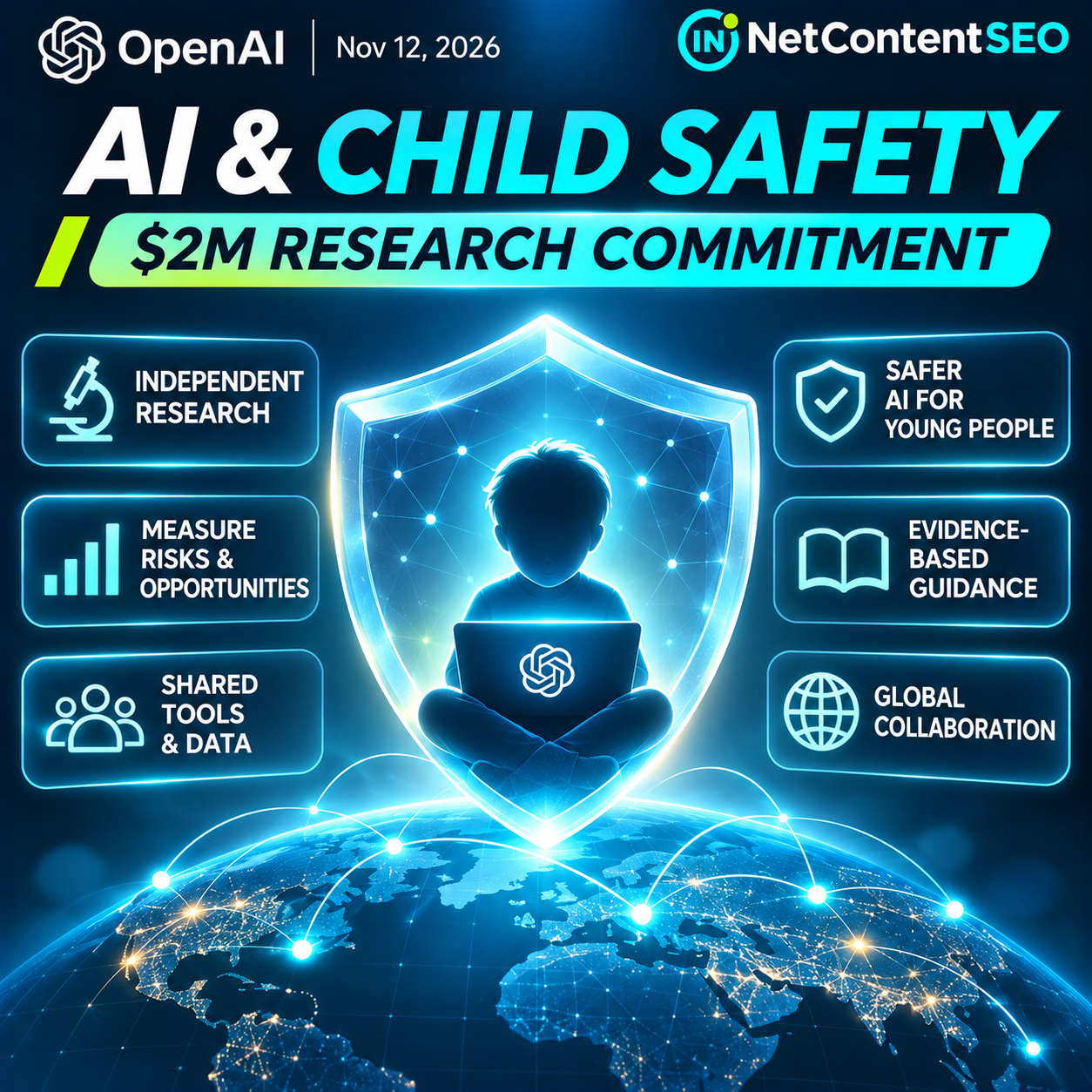

OpenAI has pledged $2 million to an international research initiative focused on AI and children's safety, according to an official announcement published on November 12, 2026. The contribution supports a scientific research network associated with the Coalition for Children's Rights and Protection in the Age of AI. Its stated purpose is to develop shared methods and tools for assessing both the risks and potential benefits of AI for young people.
The commitment follows OpenAI's signature of the Charter of Engagement for Safer AI for Children at the Paris Peace Forum earlier in the week. It is a research-funding and governance announcement, not a newly launched consumer safety feature or evidence that existing AI systems are now safe for all children.
What OpenAI announced
OpenAI says its $2 million pledge will support a scientific research network working under the coalition. The network's work is intended to create shared measurement tools that researchers can use to study AI's effects on children and assess safeguards. The company describes the effort as international and collaborative, involving research, civil society, industry and policymakers.
The official announcement does not identify individual grant recipients, provide a public application process for this specific $2 million contribution, set a publication date for the first studies, or enumerate the exact research instruments that will be produced. Those details should not be assumed.
The central distinction is between committing funding to develop evidence and demonstrating a safety outcome. A pledge can enable research, but it cannot by itself prove that a model is age-appropriate, that a specific safeguard works, or that children experience net benefits from AI use.
Why shared measurement matters
AI tools are used for schoolwork, creative projects, information seeking and personal questions. The consequences of those interactions may depend on a young person's age, developmental stage, purpose of use, social environment and the system's design. A one-size-fits-all claim about AI being good or bad for children is therefore a poor substitute for carefully defined evidence.
Researchers need common definitions, comparable evaluation methods and transparent reporting. For example, a safety study might distinguish exposure to inappropriate content from a model's response when a minor asks for help, or measure whether a parental safeguard works under realistic conditions rather than only in a controlled demonstration. Those are examples of useful evaluation questions, not a published specification of the coalition's research agenda.
Shared tools could also help independent teams reproduce results across products and countries. That possibility is particularly important when models and interfaces change quickly. A result measured on one version of an AI assistant may not remain valid after a major update.
Research independence and publication of negative results
OpenAI says the charter includes safeguards intended to preserve the independence of the scientific work. Research teams retain control of their conclusions, and findings are to be published even when results are negative or inconclusive.
This is a substantive commitment because research funded by a technology provider can face perceived or actual conflicts of interest. The credibility of the initiative will depend on whether investigators can publish unfavorable findings, explain their methods, disclose limitations and report uncertainty without sponsor interference.
However, the November announcement does not provide the full governance framework, contracts, review procedures, conflict-of-interest rules or data-access terms in the article itself. The independence commitment is official, but its implementation must be evaluated as research projects and outputs become available.
What kinds of risks and opportunities need evidence?
Potential areas for measurement include age-appropriate content, harmful or manipulative responses, privacy, excessive reliance on an assistant, and the effectiveness of interventions when a young person encounters a concerning interaction. On the opportunity side, research could investigate learning support, accessibility, creativity and the ability to explore information safely.
These are relevant questions, not findings established by the $2 million announcement. Studies need to distinguish short-term user satisfaction from longer-term outcomes, and to account for differences among age groups, cultures and settings. Evidence from adult users cannot simply be transferred to children.
Research involving minors also raises ethical requirements around informed consent, age-appropriate assent, confidentiality and handling sensitive information. These considerations affect what data can responsibly be collected and what conclusions can be drawn.
How this relates to OpenAI's earlier $5 million teen research programme
The November commitment is not OpenAI's first recent research-funding announcement concerning young people. On September 8, 2026, OpenAI announced a separate $5 million grant programme supporting independent research into how generative AI affects adolescents aged 13–17.
That programme invited proposals on social and emotional development, patterns of AI use, contextual differences and interventions. Its published application deadline was October 6, 2026, and it outlined grant-selection and ethics requirements. The November $2 million coalition contribution has a different stated mechanism: supporting shared measurement through an international scientific network.
Both announcements are relevant to the same broader policy debate, but they should not be presented as a single $7 million programme without evidence that their budgets, governance and projects are administratively combined. The official pages describe distinct commitments.
What OpenAI says about youth AI regulation
OpenAI connects the new pledge to its support for stronger youth AI safety rules. In the November statement, the company calls for age-appropriate safeguards by default, parental tools, regular risk assessments, mitigation measures and accountability. It also says it intends to engage with European policymakers as the EU Kids Act develops.
This is a statement of policy support, not a confirmation that the EU Kids Act has been enacted or that the coalition's future research will determine the content of legislation. Governments, regulators, civil-society organizations and independent experts may disagree about the appropriate design, enforcement and trade-offs of youth AI protections.
For policymakers, shared research can be valuable when it supplies reproducible evidence about whether a safeguard reduces harm and what costs or limitations accompany it. For providers, it may inform product design and evaluation. For families and educators, useful research should eventually translate into understandable guidance rather than opaque technical scores.
What does this mean for AI Search and digital discovery?
The immediate SEO impact is limited. The funding announcement does not introduce a new Google or Bing ranking factor, a ChatGPT citation metric, or a change to publisher eligibility in AI answers. Its relevance to NetContentSEO is indirect but important: the way young people access information through conversational AI depends increasingly on safety rules, age-sensitive product design and evidence-based evaluation.
In an AI-assisted search environment, a child may receive a synthesized answer rather than a list of links. That makes the accuracy, suitability, provenance and presentation of information important. An assistant can also recommend a source, summarize its contents or decline to answer a request. These decisions affect what information is encountered, although the November pledge provides no measurements of resulting referral traffic or citation visibility.
For publishers serving students and families, the practical priority remains high-quality, age-appropriate information with clear authorship, sourcing and context. Content about sensitive subjects should be especially careful about uncertainty, professional boundaries and the difference between general information and individualized advice. None of those practices guarantees that an AI system will cite a page.
What should publishers and AI product teams monitor?
- Track the coalition's published research. Look for actual study protocols, datasets, evaluation tools and findings rather than relying on the funding announcement alone.
- Check research independence. Review authorship, funding disclosures, publication policies and whether negative or inconclusive findings are released.
- Separate measured outcomes from aspirations. A new benchmark or proposed safeguard is not proof of improved real-world child safety.
- Examine age and context. Avoid applying conclusions from adults or older teens to younger children without supporting evidence.
- Review data governance. Research involving minors should explain consent, privacy protections, retention and ethical oversight.
- Monitor product changes independently. New parental controls, age-assurance systems or content safeguards require separate release verification and evaluation.
- Keep GEO claims precise. Do not describe safety research as a new search ranking signal or claim that it improves AI citations without relevant evidence.
What remains unknown?
As of the November 12 announcement, OpenAI has not provided a detailed public timetable for the coalition's research deliverables, the names of funded investigators, a complete methodology, or evidence of improved safety outcomes resulting from this contribution. It also has not specified a new publisher-facing discovery or citation feature associated with the funding.
The research programme's success will be more meaningfully assessed when independently scrutinizable methods and results appear. The most useful outputs would help distinguish which protections work, for whom, under what conditions and with what limitations.
Frequently asked questions
How much did OpenAI commit to children's AI safety research?
OpenAI announced a $2 million commitment on November 12, 2026, supporting a scientific research network under the Coalition for Children's Rights and Protection in the Age of AI.
What is the Children First declaration?
OpenAI says it signed the Charter of Engagement for Safer AI for Children at the Paris Peace Forum. The charter establishes shared principles and a research programme aimed at safer, age-appropriate AI.
What will the money fund?
According to OpenAI, it will support shared research and measurement tools for assessing the risks and opportunities AI presents for children. The announcement does not list individual funded projects or recipients.
Will the research be independent?
OpenAI says the charter protects researchers' independence and allows publication of negative and inconclusive findings. The implementation of those safeguards will need to be assessed as work progresses.
Is this the same as OpenAI's $5 million teen research grant programme?
No. The September 2026 $5 million programme and the November $2 million coalition contribution are separately announced initiatives with different stated structures.
Does the announcement introduce new ChatGPT parental controls?
No. It announces research funding and a charter commitment. Any new parental control or product safeguard should be verified through a separate product announcement.
Has the research already shown that AI is safe for children?
No. The purpose is to improve the evidence base. The announcement reports a funding commitment, not completed research demonstrating safety.
Will this change SEO rankings or AI Search citations?
No such effect is documented. The connection to SEO and GEO concerns the broader design of trustworthy, age-appropriate information experiences, not a confirmed ranking or citation change.
When will results be available?
The November 12 announcement does not provide a firm public release date for the first research findings.
The bottom line
OpenAI's $2 million commitment is a concrete funding announcement and part of a broader effort to build evidence about AI and young people's wellbeing. The emphasis on shared measurement and research independence is important, especially if unfavorable findings can be published openly.
But the essential test lies ahead: will the initiative produce credible, transparent research that changes how AI systems are evaluated and made safer for children? Until that evidence exists, the responsible description is a research commitment with clear ambitions—not a demonstrated safety breakthrough.
Sources
- OpenAI — Supporting research on AI and children's safety, November 12, 2026.
- OpenAI — Funding grants for new research into AI and teen development, September 8, 2026.
- OpenAI — Commitment to child safety and Safety by Design principles, April 23, 2024.
- OpenAI — Introducing the Child Safety Blueprint, April 8, 2026.