

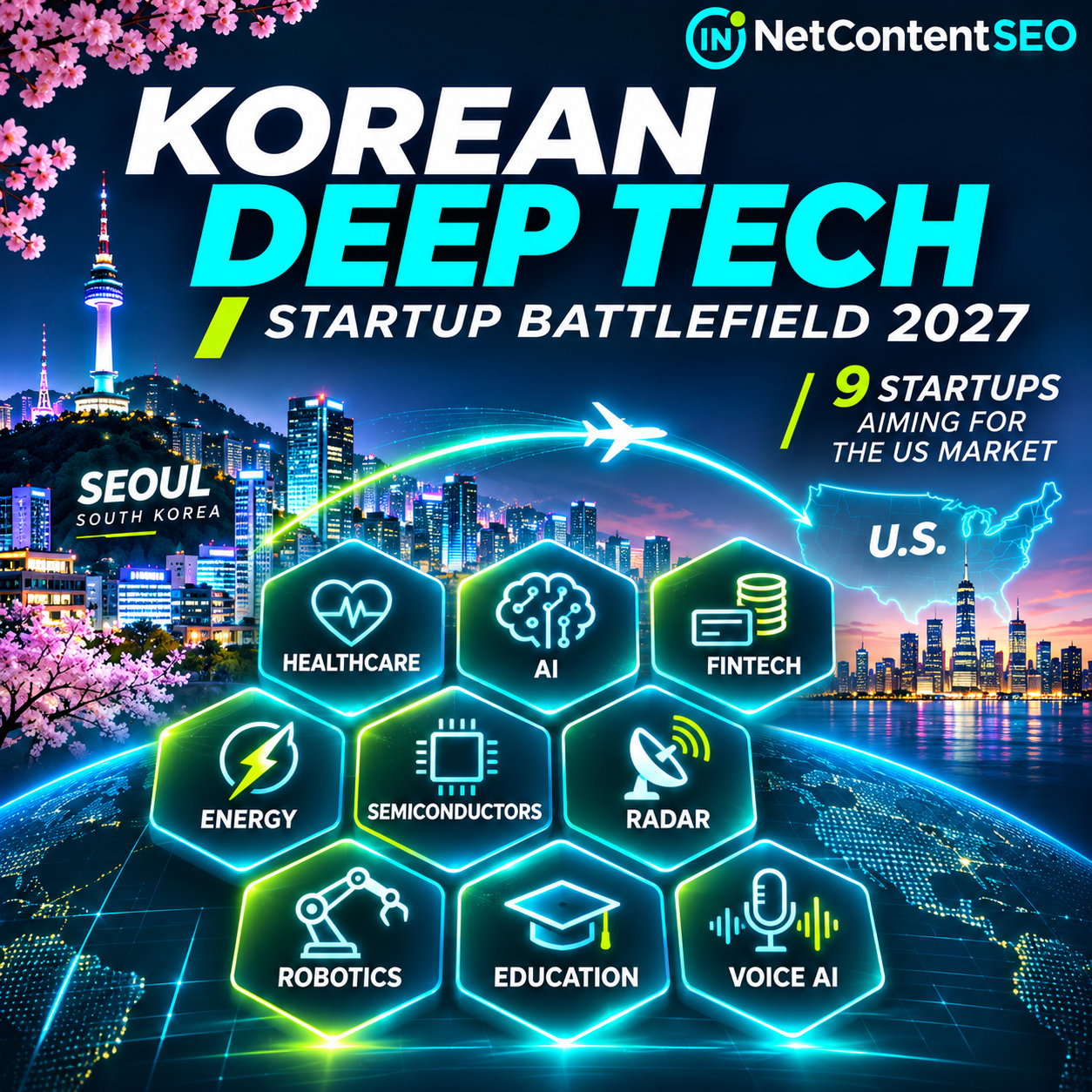

Nine South Korean startups are competing for a route into TechCrunch's Startup Battlefield 200 at Disrupt 2027, according to a November 12 TechCrunch report. Their ambitions extend well beyond an event appearance: all nine are seeking opportunities to enter the US market, bringing technologies spanning healthcare, fintech, energy, semiconductors, robotics and artificial intelligence.
The contest, held in Seoul in connection with DETO 2026, highlights an important pattern in the global AI economy. Innovation is not confined to general-purpose language models. It also includes the chips that make computation cheaper, sensors that enable autonomous systems, and specialized AI that interprets voices, medical images and educational documents. For SEO and AI Search professionals, the story is about how these emerging companies become discoverable, credible and understandable in a market where they have little established brand recognition.
Verification note: The supplied TechCrunch page was not directly retrievable during this review. A same-day secondary report provides the nine-company lineup and says Voinosis won the Seoul selection. Company descriptions and performance figures below are attributed accordingly. Where independent technical or clinical verification is unavailable, we distinguish startup claims from established results.
Who are the nine Korean startups?
The reported lineup spans several layers of the technology stack. Some companies develop AI applications, while others build physical components or systems that could support the next wave of AI-enabled products.
Voinosis: voice analysis for cognitive screening
Voinosis is developing AI technology that analyzes speech characteristics such as pitch, pauses, rhythm and response timing to identify potential signals associated with changes in brain health. The company reportedly won the Seoul selection. According to secondary coverage, its screening process takes less than five minutes, and the company reports 88% accuracy in a study involving 146 participants. These are reported company figures, not independently validated evidence of diagnostic effectiveness or regulatory approval in the United States.
Its target customers reportedly include hospitals, elder-care facilities, insurers and individuals. The US opportunity would depend on clinical validation, privacy compliance, healthcare partnerships and the intended regulatory classification of the product. A voice-based screening tool should not be presented as a medical diagnosis without appropriate evidence and authorization.
Awesome Lab: alternative heating technology
Awesome Lab is developing ThermoFlux, a heating system described as using water electrolysis and ionization. The company aims to supply core modules to equipment manufacturers rather than only selling finished products. Its proposed US entry route includes partnerships with boiler, water-heater and HVAC companies.
Claims about lower energy consumption and carbon emissions require testing against specific reference systems, operating conditions and energy inputs. Without independently reviewed comparative data, they should be treated as company claims rather than proven efficiency gains.
Crosshub: identity verification and cross-border payments
Crosshub's IDBlock platform combines identity verification and payment-related functionality for international travelers. Its reported approach uses self-sovereign identity concepts and zero-knowledge proofs, technologies that can allow some claims to be verified without disclosing all underlying personal data.
For US expansion, interoperability with financial institutions, identity standards and compliance regimes would be crucial. Cryptographic design alone does not establish regulatory approval, consumer adoption or commercial availability.
DeepFusion AI: 4D radar for autonomous systems
DeepFusion AI works on radar-based perception for autonomous mobility, robotaxis, maritime monitoring and defense applications. The company describes systems that combine sensing modalities to detect objects and movement in difficult environments.
For autonomy, technical evaluation needs to consider detection accuracy, false positives, latency, weather performance and integration with other sensors. Reported capabilities should not be equated with proven deployment at commercial scale.
EFLOW: compact high-torque motors and actuators
EFLOW develops motors and actuators intended for robotics, drones, satellites and mobility applications. The reported proposition is higher torque from a more compact package, potentially useful when designers must minimize size and weight.
In the US market, engineering validation, durability, supply-chain reliability and qualification for specific use cases will matter more than a headline torque claim. Robotics suppliers often need to document repeatability and long-term operating performance before winning production contracts.
Otition Medical: AI-assisted ear examination
Otition Medical is developing devices for body-temperature measurement and imaging of the ear canal and eardrum. Secondary coverage reports that its AI component was trained using approximately 55,000 eardrum images and that the devices hold medical certification in South Korea.
Korean certification should not be confused with authorization to market a particular medical device in the United States. Any US clinical or commercial rollout would need to address the applicable FDA pathway, evidence requirements and patient-data obligations.
Riibotics: faster warehouse robot deployment
Riibotics focuses on making warehouse automation easier to install and operate. Its reported proposition includes deployment in as little as one day through simplified infrastructure, mapping, middleware integration, task programming and safety checks.
That time frame is a company-reported capability, not a universal installation guarantee. Actual deployment speed depends on the warehouse layout, robot fleet, software integrations, safety assessment and operating requirements.
Ternell: energy-efficient memory for AI chips
Ternell is developing a memory approach called T-SRAM, described as using an additional state compared with conventional two-state memory. Secondary reporting attributes to the company test results on a 28-nanometer chip, with reported memory-density improvements of 33% to 102% and reductions in data-access energy of 55% to 71% against selected SRAM comparisons.
Those figures are potentially significant for AI hardware, where data movement and memory efficiency can constrain performance and energy use. They remain reported experimental results, however, and should not be generalized to every process node, workload or commercial chip without further validation.
Testbank: converting printed learning materials into interactive content
Testbank's Solve application is designed to convert printed study materials and publisher PDFs into interactive digital exercises. Its AI reportedly identifies question and answer areas while retaining the original layout, enabling learners to write responses and receive automated assessment.
This is an example of AI applied to document structure rather than open-ended text generation alone. For international expansion, important questions include publisher rights, educational accuracy, accessibility, language support and how automated grading handles ambiguous answers.
What did Voinosis actually win?
According to the November 12 secondary report, Voinosis won the Seoul competition among the nine startups seeking a place in the 2027 Startup Battlefield 200. That result should be described precisely: it is a local selection outcome, not proof that the company has won the international Startup Battlefield competition at Disrupt 2027.
TechCrunch's official 2026 Startup Battlefield announcement explains the broader programme: a curated group of 200 early-stage companies exhibits at Disrupt, with selected finalists competing on stage. The 2026 competition advertised a $100,000 equity-free award for the winner. Those are documented details of the 2026 edition; they should not automatically be assumed to be identical in 2027 until TechCrunch publishes that year's rules.
Likewise, the nine companies seeking entry should not be confused with the eight Korean companies previously named in the 2026 Startup Battlefield 200 cohort. The two groups concern different competition cycles.
Why South Korea's deep-tech pipeline matters
South Korea has an established industrial base in semiconductors, electronics, manufacturing and connected technologies. The reported startup lineup shows how founders are extending that expertise into AI infrastructure and domain-specific systems.
Three themes stand out. First, AI value is increasingly tied to physical-world performance, including sensors, motors and medical devices. Second, energy and compute efficiency are strategic problems, not merely hardware details. Third, specialized AI applications must establish trust through evidence, integration and compliance rather than model capability claims alone.
These themes are editorial analysis of the companies' reported work, not an assertion that all nine have achieved commercial scale or technical superiority.
What this means for SEO and AI Search
For a Korean startup entering the United States, visibility is not simply a matter of translating its homepage into English. Investors, enterprise buyers, journalists and AI assistants need to resolve the same fundamental questions: What does the company do? Which problem does it solve? What evidence supports its claims? Where is the product available? Who can use it?
Those questions create a practical connection to entity SEO and generative engine optimization (GEO). An emerging brand may be mentioned in a news article but remain poorly represented in AI-generated comparisons if its website lacks clear product definitions, documentation, leadership information and verifiable evidence.
However, no evidence from the competition establishes that appearing at Startup Battlefield directly increases AI citations, Google rankings or referral traffic. Event exposure can create opportunities for coverage and third-party references, but those outcomes must be measured independently.
Multimodal discovery: voice, vision and documents
Several of the companies illustrate why AI Search is expanding beyond text. Voinosis works with speech patterns; DeepFusion AI with radar and spatial sensing; Otition Medical with medical images; and Testbank with structured educational documents.
These are different forms of machine interpretation. They do not all constitute search products, but they demonstrate why organizations increasingly need to describe capabilities across multiple data types. A product's written specification, technical diagrams, demonstrations, test reports and regulatory information can each serve different audiences and discovery workflows.
For a website, the actionable principle is straightforward: make essential product facts accessible as readable text even when the product itself is visual, audio-based or hardware-intensive. Technical media should supplement, not replace, accurate descriptions and evidence.
A practical US-market visibility checklist for Korean startups
- Establish a canonical English-language identity. Use consistent company, product and founder names across the official website, press materials and professional profiles.
- Describe the product without unexplained jargon. State the problem, intended users, deployment requirements and what the technology actually does.
- Publish verifiable evidence. Separate prototypes, laboratory tests, clinical studies, certifications and commercial deployments. Link to original documentation where possible.
- Clarify market availability. Identify whether the product is available in South Korea, seeking US partners, running pilots or commercially available in the United States.
- Explain regulatory boundaries. Healthcare, fintech and autonomous systems face different US obligations. Avoid implying approval that has not been obtained.
- Make technical content discoverable. Provide accessible documentation, product specifications, descriptive headings and useful media alternatives.
- Use appropriate structured data. Organization and Product markup may help communicate supported facts, but there is no proven universal boost to AI citations from schema alone.
- Build independent corroboration. Seek credible coverage, research partnerships, customer references and technical validation rather than relying solely on promotional claims.
- Measure distinct outcomes. Track branded search demand, qualified referrals, AI answer mentions, visible citations, demo requests and actual US business opportunities separately.
How should AI Search teams cover emerging startups responsibly?
Reporting on early-stage technology requires careful attribution. A startup's own performance figures may be interesting, but a claim of high accuracy, energy savings or rapid deployment is not equivalent to a reproducible independent result.
For AI-generated research summaries, that distinction is even more important. If a model repeats an unverified claim without attribution, readers may mistake promotional information for established fact. Publishers should state who made the claim, what was tested, the sample size when available and which limitations remain unknown.
Companies can help by maintaining accessible original documentation, clearly dated updates and unambiguous descriptions of development stage. These practices support more accurate research and citation, although they cannot guarantee inclusion in AI answers.
Frequently asked questions
How many Korean startups are competing for Startup Battlefield 200 in 2027?
The November 12 report describes nine startups competing through a Seoul selection event for a route into the 2027 programme.
Which company won the Seoul selection?
Same-day secondary reporting identifies Voinosis, a company developing voice-based cognitive screening technology, as the winner. That is distinct from winning the final international competition.
Who are the nine companies?
The reported lineup is Voinosis, Awesome Lab, Crosshub, DeepFusion AI, EFLOW, Otition Medical, Riibotics, Ternell and Testbank.
What industries do they represent?
They span AI-enabled healthcare, energy, fintech, autonomous sensing, robotics, semiconductor memory and educational technology.
Are all nine already operating commercially in the United States?
No such conclusion is supported. The reported common goal is US market entry, and individual availability, partnerships and regulatory status need separate verification.
Has Voinosis's medical accuracy been independently confirmed?
The reported 88% screening accuracy in 146 participants is a company-attributed figure in secondary coverage. It should not be treated as independent proof of clinical diagnostic performance.
What is Startup Battlefield 200?
It is TechCrunch's programme selecting 200 early-stage startups for exposure at Disrupt. Its precise competition terms and awards should be checked for each edition.
Does participation guarantee funding?
No. Exposure to investors and a competition opportunity do not guarantee investment, commercial contracts or market success.
Why is this relevant to SEO and GEO?
Emerging international companies need clear, credible, accessible information so people and AI research systems can understand their products. Competition participation alone is not a ranking or citation signal.
Is this a confirmed new AI Search platform?
No. It is a startup competition involving several AI and deep-tech companies, not the launch of a new search engine or AI citation service.
The bottom line
The nine-company Seoul lineup is a useful snapshot of South Korea's expanding deep-tech ambitions. The companies are addressing practical constraints in healthcare, compute, industrial automation, payments and education, while seeking access to a much larger US market.
For NetContentSEO, the broader lesson is about international discoverability: emerging technology brands need more than impressive product claims. They need accessible explanations, evidence that survives scrutiny and consistent identities across trusted sources. In an AI-mediated research environment, being correctly understood can be as important as being found.
Sources and verification
- TechCrunch, November 12, 2026 — Nine Korean startups vie for a spot in Disrupt 2027's Startup Battlefield 200 (supplied source; direct retrieval unavailable during review)
- Finansial Insight, November 12, 2026 — Secondary coverage identifying the nine startups and reported Seoul winner
- TechCrunch, August 20, 2026 — Official 2026 Startup Battlefield 200 programme and cohort announcement
- MoneyToday, September 6, 2026 — Earlier Korean startup participation in the 2026 cohort, a separate competition cycle