

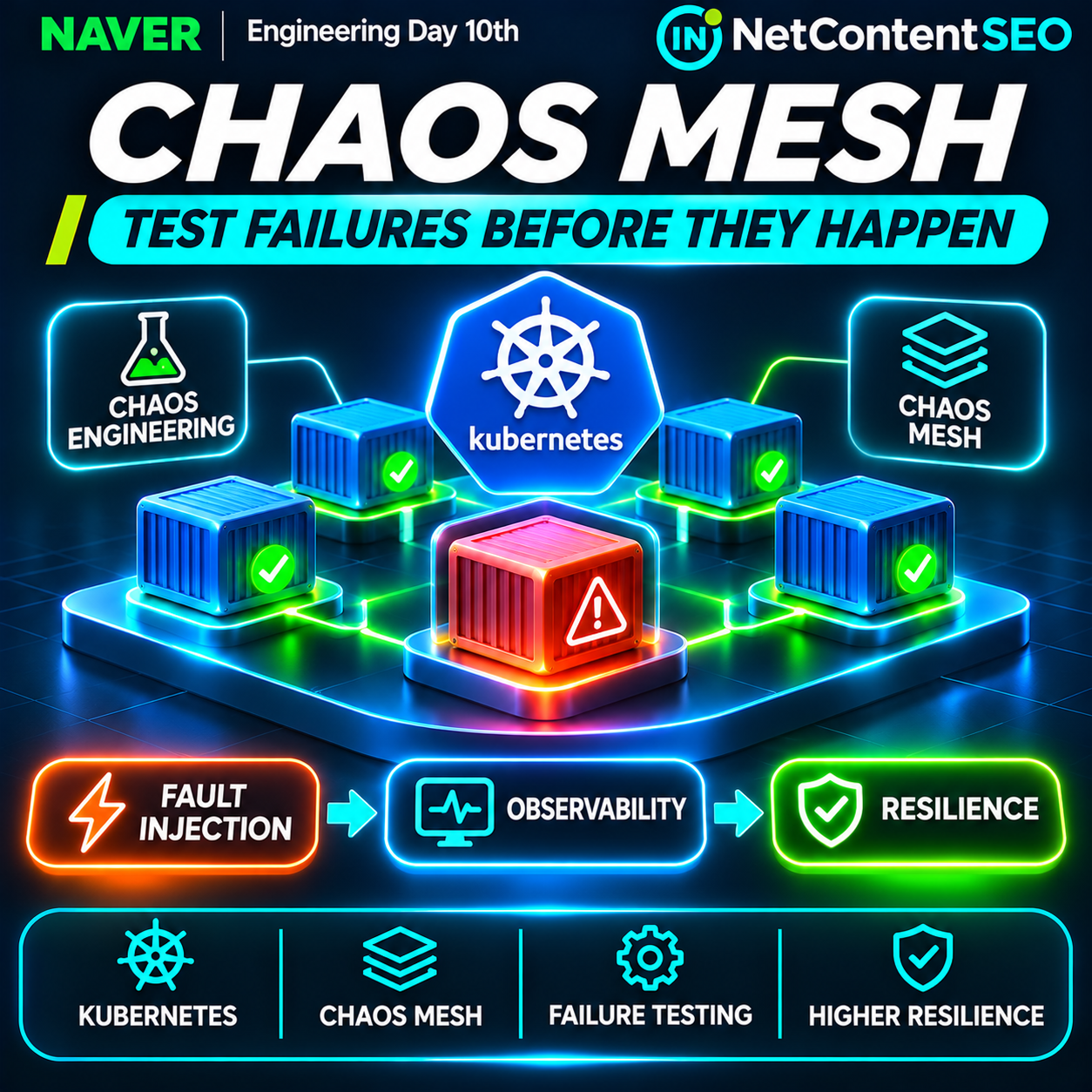

Production reliability is not something a Kubernetes team can prove simply because its application is running. A service may look healthy until a pod disappears, a network connection slows down, or a dependent component becomes unavailable. A NAVER D2 Engineering Day 10th session, titled “Chaos Mesh로 Kubernetes 앱의 장애 내구성 검증하기” (“Validating Kubernetes Application Fault Resilience with Chaos Mesh”), addresses that problem through controlled infrastructure-failure simulation.
The published Korean session outline covers the foundations of chaos engineering, Chaos Mesh's fault-injection mechanisms and workflows, practical service integration, test automation and precautions. It does not disclose specific test results or uptime improvements in the summary provided. The broader lesson for teams running search, AI and content services is straightforward: test the failure modes you can anticipate before they become incidents users experience.
What NAVER's Engineering Day session covers
The session is part of NAVER's internal engineering knowledge-sharing program, Engineering Day, whose selected presentations are published through NAVER D2. Its stated audience is developers considering chaos engineering. The talk is organized into an introduction to chaos engineering, a first part introducing Chaos Mesh and its injection mechanisms and workflow capabilities, and a second part about applying the approach to real services, controlling failures, configuring automated tests and handling precautions.
That outline is evidence of the presentation's scope, not proof that NAVER rolled out a specific cluster-wide testing program, reduced outages by a measured percentage or deployed any particular experiment in production. The linked D2 page could not be independently retrieved in full during research; the session description supplied with the source is the basis for statements about its contents.
What is chaos engineering?
Chaos engineering is the practice of deliberately introducing controlled failures into a system to test whether it continues to behave within acceptable limits. Instead of waiting for a real incident to expose hidden dependencies, teams form a hypothesis about how the service should respond, introduce a representative fault, observe the outcome and improve the system when the hypothesis fails.
For example, an API team might hypothesize that losing one replica will not prevent users from completing requests. A test can terminate a selected pod and measure request success, latency, recovery time and any unexpected cascading effects. If the service fails despite having multiple replicas, the experiment has uncovered a resilience problem that routine happy-path testing missed.
Chaos engineering is not the same as indiscriminately breaking production systems. Successful practice depends on tightly scoped targets, explicit authorization, monitoring, rollback procedures and predefined abort conditions. Teams should begin in isolated nonproduction environments and only consider production experiments when they have established operational safeguards.
What is Chaos Mesh?
Chaos Mesh is an open-source, Kubernetes-native chaos engineering platform. Its official documentation describes fault simulations for pods, networks, DNS, HTTP, I/O, stress, time and other infrastructure behaviors. It represents experiments through Kubernetes custom resources, allowing operators to define and manage controlled failures with familiar Kubernetes tooling.
According to the official architecture documentation, the platform includes a controller manager to coordinate experiments, a daemon to carry out supported fault injections and an optional dashboard for configuring and observing tests. The daemon can require elevated privileges to affect network, filesystem and runtime behavior. That makes security review and access controls essential, not optional extras.
Chaos Mesh is not a monitoring product by itself and does not replace application logs, metrics, traces, synthetic checks or incident response. It supplies controlled disruptions; the team still needs to define what a healthy application looks like and how to evaluate the results.
Which failures can a Kubernetes team simulate?
The project's documented fault types support several practical scenarios. Pod failures test whether replicas, readiness checks and orchestration recover as expected. Network faults introduce delay, loss or partitions to reveal timeout and retry problems. DNS faults test assumptions about service discovery. HTTP faults can expose fragile client behavior when upstream requests fail. Stress and I/O faults help teams inspect the impact of constrained resources or storage delays.
The most valuable scenario is not necessarily the most dramatic. A modest increase in network latency between a web application and its API can uncover excessive retry traffic, connection pool exhaustion or slow fallback behavior. A single unhealthy dependency can sometimes cause more user-visible disruption than a full node outage if the application does not degrade gracefully.
How Chaos Mesh workflows work
Individual experiments test one failure at a time. Real incidents often involve several conditions and a recovery sequence. The official Chaos Mesh Workflow documentation describes orchestration of experiments in series or parallel, with customized tasks and conditional branching.
A team could use a workflow to establish a baseline, introduce network delay, check application health, remove the fault and verify recovery. Another workflow could combine a pod failure with a dependent service's increased latency, provided the environment is safe and the expected behavior is clearly defined.
Workflow automation makes tests repeatable. It does not automatically make them safe. Every step still needs a scoped target, time limit, observability and a recovery path.
A safe, actionable first experiment
For a team adopting chaos engineering, the first objective should be to learn whether a single, noncritical service behaves as designed when a bounded failure occurs. The following process is an editorial implementation example derived from the tool's documented capabilities, not a claim that NAVER used these exact steps.
- Choose an isolated environment. Use a staging or dedicated test cluster with representative workloads. Obtain authorization from the service owner and avoid production data or live customers.
- Define steady state. Record a baseline for successful requests, latency, error rates and the service's ability to complete its core transaction.
- State a hypothesis. For example: terminating one test replica should not prevent a healthy second replica from serving requests, and the system should restore its intended replica count.
- Limit the blast radius. Select one namespace and a specific labeled test workload. Review RBAC, the Chaos Mesh installation and the exact resources the experiment could affect.
- Prepare observation and recovery. Confirm access to Kubernetes events, application metrics and logs. Set a short experiment window and document how to stop it.
- Run one controlled failure. Start with a single pod disruption or modest network delay, not simultaneous cluster-wide faults.
- Compare results with the hypothesis. Did requests fail? Did retries amplify load? How long did recovery take? Were alerts triggered?
- Fix and repeat. Document the defect, assign an owner, update the service or configuration, and rerun the same experiment to verify improvement.
Consult the version-specific Chaos Mesh documentation before installing or applying manifests. Kubernetes permissions, supported fault mechanisms and configuration requirements may differ by release and cluster environment.
What should teams measure?
A chaos experiment should be evaluated against measurable service behavior rather than the mere fact that a fault was successfully injected. Useful signals include availability, request success rate, latency percentiles, throughput, queue depth, error budgets, time to detect a failure and time to recover. For a checkout or booking service, the most meaningful outcome may be whether users can complete the transaction correctly while one component is impaired.
Define thresholds before the test. If the system already has a service-level objective, use it to frame the hypothesis. A result that stays within acceptable limits may support confidence in the tested scenario, but it does not prove the application is immune to every other failure.
Automation without creating new risks
The NAVER session outline explicitly includes test configuration, automation and precautions. The operational challenge is to turn experiments into repeatable validation without allowing a scheduled test to create an uncontrolled outage.
Start by running approved experiments manually in nonproduction. After the team understands their effects, encode the scenarios as version-controlled definitions and run them at a predictable cadence. Require review for changes to target selectors, permissions and fault intensity. Monitor each run and preserve the ability to abort immediately.
Because Chaos Mesh can perform privileged operations through its daemon, security teams should assess the installation architecture, access controls and isolation boundaries. The tool's ability to inject faults is powerful precisely because it can affect real workloads.
Why this matters for SEO and AI Search infrastructure
Search visibility is often discussed in terms of crawling, indexing, ranking and AI citations. But the underlying website and its APIs must remain reachable for users and automated systems to consume their information. An outage can disrupt page delivery, structured-data retrieval, API-backed product details, booking flows or the content pipeline that keeps information current.
Chaos engineering helps teams test those dependencies. A publisher might simulate the loss of a cache or content API and verify that essential article content remains available. An e-commerce site might test whether product pages degrade safely when inventory data is temporarily unavailable. A travel platform might examine whether a booking journey handles an upstream timeout without showing a misleading confirmation.
These are engineering scenarios, not reported results from NAVER's presentation. Chaos Mesh does not improve Google rankings or guarantee citations by itself. Its potential SEO benefit is indirect: more dependable delivery, fewer user-visible failures and better recovery from incidents that could otherwise affect access to content.
AI agents make reliability more consequential
Agentic applications increasingly chain several operations together: retrieve information, inspect options, call a tool and complete a task. If one API fails or times out, the assistant may deliver incomplete information or fail to finish the workflow. Resilience testing can expose whether agents retry appropriately, avoid duplicate actions and distinguish a failed operation from a successful one.
For an AI-powered support agent, for example, a test could introduce a temporary delay in a nonproduction knowledge retrieval service. The team would verify that the agent either obtains valid information or clearly reports that it cannot confirm the answer, rather than inventing a response. A transactional agent also needs idempotency and reliable state handling to avoid duplicate bookings or payments after retries.
These requirements are not new search ranking factors. They are prerequisites for trustworthy automated services, particularly when the user's journey extends beyond reading an answer.
What the NAVER session does not establish
The available session summary does not quantify uptime improvements, reveal a public production deployment, identify the exact fault scenarios used in a NAVER service or claim any measurable SEO impact. The documentation from the Chaos Mesh project independently confirms what the platform can do; it should not be treated as evidence that NAVER implemented every feature.
Similarly, the fact that NAVER shares a Kubernetes engineering session does not imply a change to Naver Search's ranking systems, HyperCLOVA X or its AI discovery products. The connection to SEO and AI Search is an operational interpretation grounded in the general need for reliable services.
Frequently asked questions
What did NAVER publish?
A NAVER D2 Engineering Day 10th session about using Chaos Mesh to validate the fault resilience of Kubernetes applications, including injection mechanisms, workflows, service application, automation and precautions.
Is Chaos Mesh a Kubernetes monitoring tool?
It is primarily a fault-injection and chaos engineering platform. Teams still need separate observability tools and measurable health criteria to assess outcomes.
Can Chaos Mesh test network failures?
Yes. Official documentation describes NetworkChaos capabilities for scenarios such as delay and packet loss, subject to supported configurations and permissions.
Can Chaos Mesh run experiments automatically?
Yes. Its Workflow and scheduling capabilities support repeatable and orchestrated experiments. Teams must establish safeguards before automation.
Should teams run chaos tests directly in production?
Not as a starting point. Begin in a controlled nonproduction environment, establish observability and recovery, then assess whether tightly scoped production experiments are appropriate.
Does chaos engineering prevent every outage?
No. It reveals weaknesses in tested scenarios and can improve preparedness. It cannot guarantee that all possible failures have been covered.
Does Chaos Mesh directly improve SEO or AI citations?
No direct ranking or citation effect is established. Its relevance is to service availability, dependable content delivery and the resilience of systems that support search and agentic interactions.
What is a good first test?
A narrowly scoped, reversible disruption of a noncritical test workload, measured against a clearly stated service-health hypothesis.
The bottom line
NAVER's Chaos Mesh session highlights a mature engineering principle: reliability should be tested under failure conditions, not assumed from normal operation. Chaos Mesh offers Kubernetes-native tools to simulate disruptions, orchestrate scenarios and support repeatable validation. The value comes from choosing realistic faults, defining measurable outcomes and improving the system after each experiment.
For publishers, search platforms and AI-agent operators, resilient infrastructure is not a substitute for good content or search optimization. It is the foundation that keeps useful information and services available when components fail.