

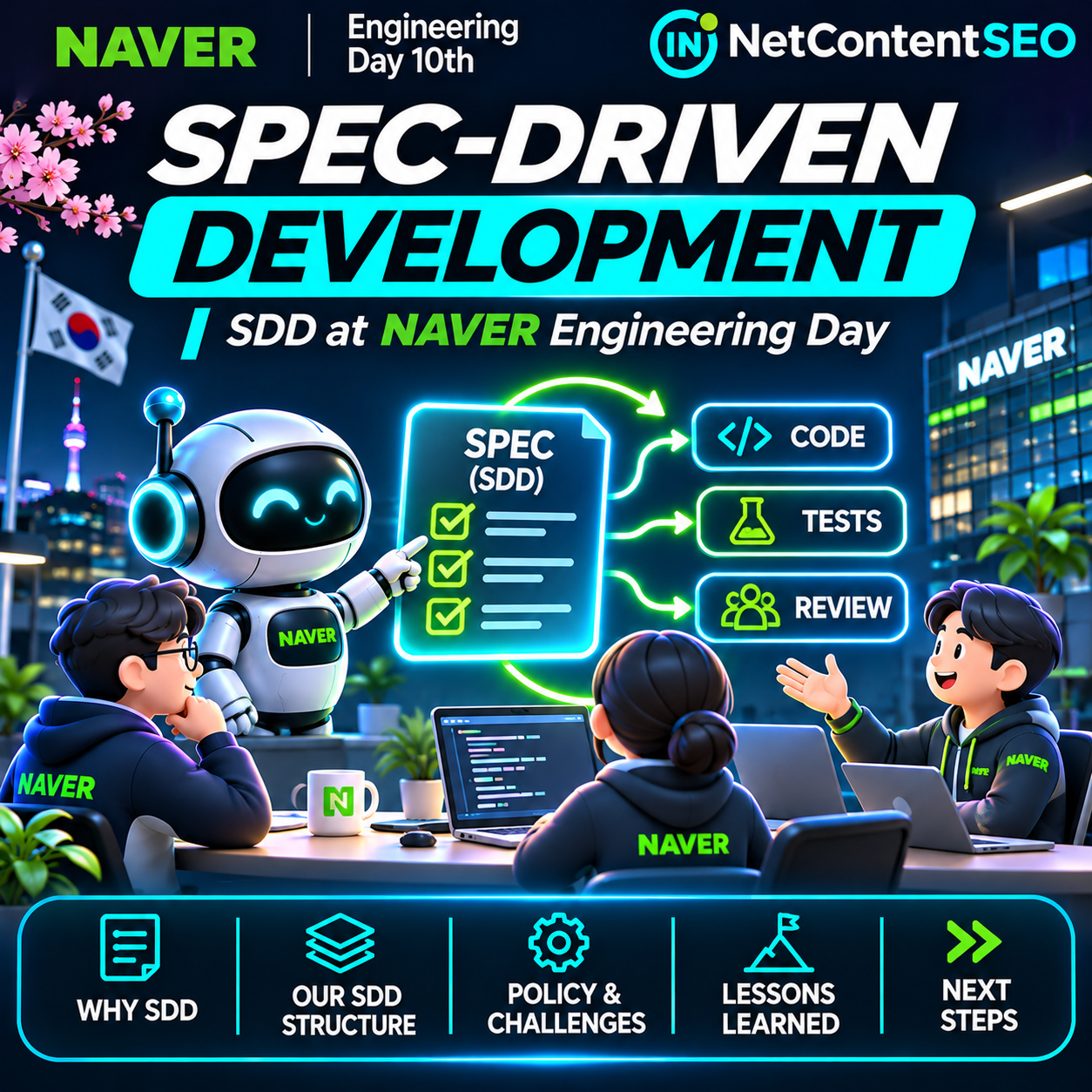
NAVER has shared an Engineering Day session on how one internal team adopted spec-driven development (SDD) as a team policy, including the decisions, trade-offs and unresolved questions involved in making the approach stick. The Korean-language session, 우리 팀만의 스펙 주도 개발 정착기 (“How Our Team Established Spec-Driven Development”), is presented through NAVER D2 as part of the company's tenth Engineering Day program.
The public description confirms the presentation's focus: why the team introduced SDD, how it structured the approach, seven areas of policy debate and the next challenges. It does not disclose detailed policy rules, productivity metrics or implementation outcomes in the supplied summary. The video and its full contents could not be independently reviewed during this research. Those limits matter: this is an engineering-experience report, not evidence that NAVER has mandated SDD company-wide or demonstrated a quantified performance gain.
What NAVER announced
NAVER D2 is the company's developer knowledge-sharing channel. The new session comes from NAVER Engineering Day 10th, an internal technical exchange event whose selected presentations are shared publicly. The stated audience is developers considering the adoption of spec-driven development.
The session outline contains four main parts: the background and reason for adopting SDD; the structure the team selected; seven questions encountered while defining team policy; and remaining challenges and future work. That sequence is revealing because it frames SDD as a team operating practice, rather than a prompt template or an AI coding product.
The announcement does not identify a specific commercial SDD framework, list the seven policy decisions or state which AI coding assistant the team used. Claims about a particular tool stack, approval gate or measured improvement would therefore be speculative.
What is spec-driven development?
Spec-driven development is a software-development approach in which an explicit specification guides implementation, testing and review. Instead of starting from an informal request and treating the resulting code as the only durable artifact, a team records intended behavior, constraints and acceptance criteria in a form that people—and potentially AI coding tools—can use throughout delivery.
A useful specification answers practical questions: What problem are we solving? What should the system do? What should it not do? Which inputs and outputs are expected? How will we know the implementation works? Who approves changes when requirements conflict?
SDD is related to requirements engineering, design-by-contract and test-driven development, but the terms are not identical. A specification describes the intended behavior and constraints. Tests verify selected properties of an implementation. Neither replaces the other. The particular workflows described below are general implementation guidance, not confirmed details of NAVER's internal policy.
Why teams are revisiting specifications in the AI coding era
AI coding assistants can generate code quickly, but speed at the implementation stage does not guarantee that the resulting software meets business requirements. An underspecified request can produce a plausible feature that omits edge cases, conflicts with existing architecture or fails an operational constraint.
A durable specification can help developers and AI tools share the same understanding of a task. It can also make reviews more concrete: reviewers can compare behavior with documented requirements instead of relying on the original prompt, which may have been incomplete or lost in a long conversation.
That is a plausible reason SDD is attracting interest, not a claim about the specific motivation of NAVER's team. The public session summary says the team will explain its background and adoption reasons, but it does not supply those reasons in full.
What makes team-wide SDD different from writing a spec once?
The hardest part of adopting SDD is often deciding how the specification becomes part of ordinary development work. A one-off document can go stale as soon as code changes. A team policy has to define when specifications are required, how they are reviewed, who can change them and what happens when code and specification diverge.
NAVER's session explicitly addresses the structure of its team's SDD approach and seven policy-related concerns. The exact seven concerns were not available from the public summary. To make the implications actionable, the following are seven questions teams should independently consider, not a reconstruction of NAVER's list:
- Scope: Which changes need a formal specification? A new payment workflow and a spelling correction should not necessarily follow the same process.
- Ownership: Who is accountable for the specification's correctness—engineering, product, design or a named reviewer?
- Format: What minimum information is mandatory, and how will specifications remain readable and maintainable?
- Approval: Which decisions need human sign-off before an AI coding agent or developer implements them?
- Traceability: How will requirements map to code changes, tests and deployment evidence?
- Change management: When behavior changes during implementation, how is the specification updated?
- Exceptions: How are urgent fixes, experiments and legacy systems handled without making the policy unworkable?
A policy should make these answers explicit while remaining lightweight enough that engineers will actually use it.
A practical SDD workflow for software and AI agents
For teams experimenting with SDD, one workable sequence is intent → specification → review → implementation → verification → release. This is a proposed workflow, not an attributed NAVER architecture.
First, define the user problem and the expected outcome. Next, write a specification that includes functional behavior, data contracts, constraints, failure cases and measurable acceptance criteria. Have an appropriate reviewer check the specification before implementation begins. Then allow developers or AI coding agents to produce code against it. Finally, verify the result with tests, manual review and deployment checks, updating the specification when approved behavior changes.
For AI-assisted work, the specification can be supplied as persistent context to the coding agent, alongside repository instructions and architectural constraints. The agent should be asked to identify ambiguities rather than silently inventing product rules. Human reviewers should retain responsibility for security, privacy, business logic and production approval.
Example: a spec for a search feature
Imagine a publisher adding an internal article-search endpoint. A weak instruction might say: “Build search with filters.” A useful specification would identify searchable fields, supported filters, sort order, pagination limits, empty-result behavior, authorization requirements, expected response schema and latency targets.
It would also state how results should behave when filters conflict, when a query contains unsupported characters or when the underlying search index is unavailable. Acceptance tests could then cover those cases explicitly. The objective is not to generate more documentation for its own sake, but to reduce ambiguity before the feature reaches users.
The same principle applies to agentic systems. A retrieval agent should have a defined source policy, evidence requirements, allowed tools, error handling and conditions for asking a human to intervene. A successful API call alone is not proof that the agent completed the intended task correctly.
Why NAVER's engineering context is relevant
NAVER has publicly shared related engineering work on AI agents and developer workflows. In a June 2026 Engineering Day session about an automated response-model pipeline, NAVER engineers described an approach in which changing an agent specification can trigger defect detection, prompt optimization and supervised fine-tuning data generation. That is a separate project, not evidence that the newly announced SDD team uses the same system.
Another NAVER session on a unified context provider discussed collecting team data and serving-layer assets to support AI agents. Together, these public materials show that NAVER engineering teams are exploring ways to make context and specifications more operationally useful. They do not establish one uniform internal architecture across all teams.
Does SDD make AI-generated code more reliable?
It can provide clearer targets for implementation and evaluation, but reliability is an empirical question. A badly written specification can encode the wrong requirements just as easily as an informal prompt. A passing test suite can still miss unanticipated failure modes.
To evaluate whether SDD helps, teams should compare similar tasks using metrics such as rework, escaped defects, time to approval, test coverage, production incidents and the proportion of changes whose acceptance criteria were met. For AI coding agents, also track unnecessary tool calls, implementation retries and human correction effort.
Do not treat lines of code generated or time spent typing as sufficient evidence of improved delivery. A team may produce code faster while spending more time debugging or reviewing it.
What this means for technical SEO
SDD does not directly change Google's ranking algorithms or AI citations. Its value for SEO is the potential to make website changes more predictable and verifiable.
Technical SEO often involves requirements that are easy to lose during implementation: canonical URL behavior, robots directives, structured data consistency, server-side rendering, redirect rules, sitemap inclusion, pagination and localization. These requirements can be written as acceptance criteria rather than passed informally between SEO specialists and developers.
For example, a migration specification can state which old URLs redirect to which destinations, which pages remain indexable and how canonical tags must resolve. Automated checks can then test those rules before release. The advantage is traceability: when a deployment causes an indexing problem, the team can compare the observed behavior with the agreed specification.
What this means for AI Search and GEO
Agentic discovery systems increasingly involve multiple steps: retrieving content, extracting claims, comparing entities, using tools and constructing an answer. Specifications can help teams define the expected behavior at each stage.
A GEO evaluation specification might require an agent to preserve source URLs, distinguish verified facts from inference, report missing evidence and avoid inventing prices or business attributes. Test cases could then check citation accuracy, entity disambiguation and refusal behavior when sources conflict.
That is a quality-assurance application of SDD. There is no evidence that NAVER's newly shared session introduced a search ranking signal, changed HyperCLOVA X citation selection or improved any publisher's traffic. The SEO and GEO implications discussed here are editorial analysis, not outcomes demonstrated by the presentation.
How to adopt SDD without creating a documentation bottleneck
- Start with one workflow. Choose a recurring, high-impact feature type rather than requiring full specifications for every minor change.
- Define a minimum template. Include purpose, scope, constraints, acceptance criteria, dependencies and open questions.
- Keep specs close to code. Store them where developers and AI tools can access the current version and review history.
- Assign human ownership. AI may draft or update a specification, but an accountable person must approve requirements.
- Link tests to requirements. Verify the behaviors that matter, including error cases and regressions.
- Measure actual outcomes. Compare defect rates, review effort and delivery time before and after adoption.
- Revise the policy. Remove steps that create overhead without improving decisions or quality.
The goal is not to make development slower by default. It is to make consequential decisions explicit early enough to prevent avoidable rework.
What remains unknown about NAVER's SDD implementation
The public summary does not reveal the team's specification format, chosen tooling, exact seven policy questions, adoption timeline, internal compliance mechanisms or measured outcomes. It also does not state whether AI coding tools were mandatory, optional or absent from the team's workflow.
Those details should be verified from the full presentation before publishing claims about NAVER's precise operating model. The available evidence supports a narrower conclusion: one NAVER team adopted SDD as a team development policy and shared a session about the structure, policy debates and remaining work.
Frequently asked questions
What did NAVER announce about spec-driven development?
NAVER D2 shared an Engineering Day 10th session describing one team's adoption of SDD as a development policy, including its rationale, structure, policy challenges and future questions.
What is the English title of the Korean session?
우리 팀만의 스펙 주도 개발 정착기 can be rendered as “How Our Team Established Spec-Driven Development.”
Is NAVER adopting SDD across the whole company?
The available description does not establish a company-wide mandate. It refers to one team's experience.
What are the seven SDD policy challenges NAVER encountered?
The summary mentions seven areas of debate but does not enumerate them. Any detailed list attributed to NAVER would require access to the full session.
Does SDD require AI coding assistants?
No. Specifications can guide human developers, automated tools or AI coding agents. The public session description does not identify a mandatory AI tool.
How does SDD differ from test-driven development?
SDD starts from explicit intended behavior and constraints; TDD focuses on writing tests to drive implementation. They can complement one another.
Can SDD improve technical SEO?
It can help teams specify and verify requirements for redirects, canonicals, structured data and indexing behavior. It does not directly increase rankings.
Does NAVER's SDD session change AI Search?
No direct search-product change is announced. Its relevance to AI Search is methodological: specifications can help developers evaluate retrieval and agent behavior.
The bigger picture
NAVER's session is noteworthy not because it announces a new AI model or search feature, but because it treats spec-driven development as a policy problem. Making requirements explicit is relatively easy; sustaining a workable process across a team is harder.
As AI coding tools and agents become more capable, that distinction may matter more. A system that can produce code quickly still needs reliable instructions, constraints and evidence of completion. For SEO and AI Search teams, SDD offers a practical framework for turning ambiguous requirements into testable behavior—without mistaking an engineering practice for a new ranking factor.
Sources
- NAVER D2 — 우리 팀만의 스펙 주도 개발 정착기 (primary session page; detailed video content not independently reviewed).
- NAVER D2 — Everyone's NAVER Engineering Day, May 28, 2026.
- NAVER D2 — Spec-driven prompt optimization pipeline, June 18, 2026.
- NAVER D2 — Unified Context Provider for Humans and AI Agents, June 22, 2026.