

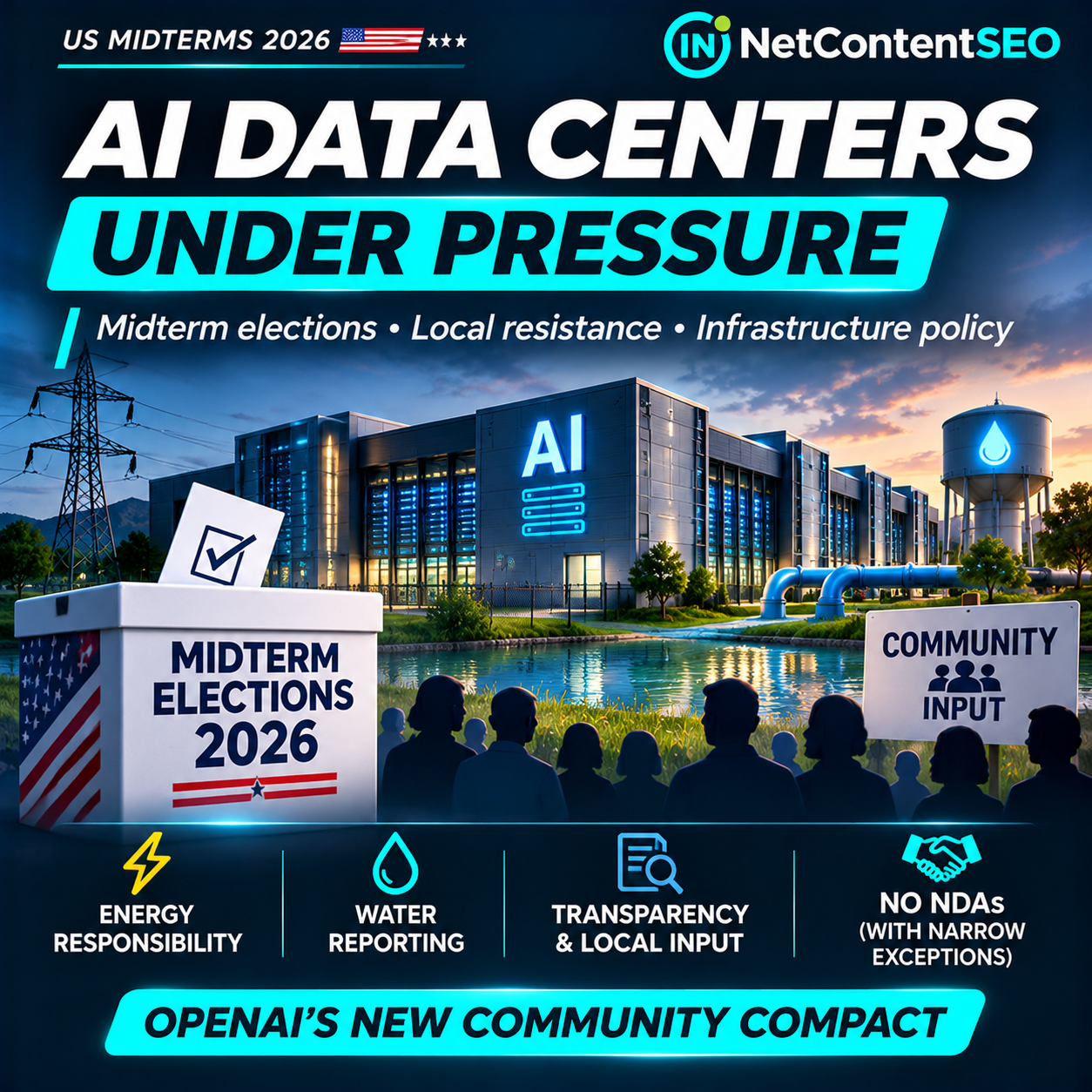

November 8, 2026. The debate over artificial intelligence is moving beyond model regulation and into the physical infrastructure that makes AI possible. Following this week's US midterm elections, local resistance to data center projects has become harder for technology companies to dismiss. Voters backed restrictions or moratoriums in many local ballot measures, while candidates who campaigned on tighter oversight won important races. For companies planning large-scale AI infrastructure, the message is increasingly clear: access to electricity, water, land and permits cannot be treated as purely technical or commercial questions.
TechCrunch explored the implications in its November 7 Equity podcast discussion, “After the midterms, things are looking rocky for Elon Musk and data centers”. The conversation focused on Elon Musk's political spending, the changing political environment in Texas, local opposition to data center development and the financial pressure surrounding the next wave of AI infrastructure investment.
The bigger story is not simply whether Musk or one political party gained or lost influence. It is the growing collision between AI infrastructure ambitions and the communities expected to host the facilities.
Data centers have become a local political issue
For years, data center development was often discussed as an issue for technology companies, utilities, investors and regional economic development agencies. That is changing. Large facilities can require substantial electricity capacity, grid upgrades, water planning, land and construction work. Their effects are experienced locally, while the AI services they support may be used across the country or around the world.
In the TechCrunch discussion, Equity host Kirsten Korosec described data center opposition as an increasingly grassroots issue. She pointed to the way some projects have been pursued: limited public information, confidentiality agreements involving public officials, uncertainty about project scale and concerns about water use in environmentally sensitive or water-stressed areas.
The election results should not be reduced to a single-issue referendum on AI. The hosts cautioned that opposition to data centers was not the sole reason for the broader Democratic gains. But the local votes and campaigns show that infrastructure approvals can become politically consequential, and that concern can cross party lines.
What the midterms could mean for Elon Musk
TechCrunch's Sean O'Kane pointed to Musk's substantial financial support for Republican candidates and questioned what political return it produced. The discussion also highlighted the position of Musk's companies in Texas, where governor-elect Gina Hinojosa campaigned on tighter scrutiny of data center development after defeating Greg Abbott.
Those comments are political analysis from the podcast, not proof that a particular project has been blocked or that Musk's companies have lost a specific permit. The practical issue is that a more skeptical state and local political environment could increase uncertainty around approvals, utility arrangements and construction timelines.
For large infrastructure developers, the relevant risk is not limited to one election. Permitting decisions, zoning rules, environmental reviews and utility agreements can extend across multiple years and administrations. A shift in local political priorities can therefore affect projects long after campaign season ends.
OpenAI's response: a National Community Compact and policy blueprint
One of the most concrete developments discussed by TechCrunch is OpenAI's November 5 announcement, “Setting a new standard for responsible AI infrastructure”. OpenAI published two documents: a National Community Compact describing commitments for future campuses it owns and operates, and a Compute Campus Policy Blueprint proposing broader rules for policymakers.
The distinction matters. The Community Compact sets out what OpenAI says it will do at future facilities it owns and operates. The policy blueprint asks federal, state and local policymakers to establish rules that could apply more broadly to large data center developers. These are company commitments and policy proposals, not proof that every operator has adopted the same standards.
OpenAI's stated commitments include:
- Paying the full cost of electricity and required infrastructure. The company says it will cover the power it uses and the infrastructure needed to serve its campuses, with financial assurances before major spending so other customers are protected if a project is delayed, reduced or canceled.
- Publishing local water and electricity information. Each campus is to have a water plan, prioritize closed-loop or low-water cooling, and publish site-level reporting.
- Disclosing construction and noise impacts. OpenAI says it will publish construction plans and independent noise studies before operations begin and annually afterward.
- Ending NDAs with public officials, subject to narrow exceptions. The company says it will not use non-disclosure agreements with public officials, while retaining limited protections for legitimate security information, trade secrets and proprietary or competitively sensitive information.
- Reporting jobs and local opportunities. OpenAI says it will publish expected job creation, work with unions and training providers, and report on hiring and apprenticeships.
- Giving residents a role in local priorities. Each future campus will have a local compact, early community engagement, a local point of contact and annual public progress reporting.
OpenAI also described community investment examples in Georgia and Ohio, including school meal and childcare commitments shaped by local priorities. These examples illustrate the company's approach, but should not be mistaken for a universal payment formula or a guarantee that every community will receive the same package.
Why the scope of OpenAI's promises matters
The compact applies to future compute campuses that OpenAI owns and operates. It does not automatically cover every facility from which OpenAI obtains computing capacity, including projects owned by other companies or developed through separate partnerships. That limitation is important when assessing how much of the wider AI infrastructure supply chain is covered.
The policy blueprint is broader in ambition because it asks policymakers to establish protections for large electricity users and local communities across the industry. Among its proposals are rules requiring large customers to pay the grid costs they create, public reporting of energy and water impacts, transparent tax incentive terms and mechanisms to recover benefits if developers fail to meet commitments. Whether lawmakers adopt those proposals, and how they define and enforce them, remains an open question.
The infrastructure challenge is also an energy and water challenge
AI data centers require reliable power, cooling and network connectivity. Large new loads can require substations, transmission upgrades and long-term utility planning. In areas facing water scarcity, cooling choices and water consumption can become central questions in local approval debates.
OpenAI's announcement says its planned Effingham County campus agreement with Georgia Power allows the utility to reduce electricity delivered to the site by up to 1,000 megawatts during periods of high demand. That is a specific example cited by OpenAI, not a general capability available at every data center.
For communities, the question is not only how much electricity a facility consumes, but who pays for additional infrastructure and what happens if a project is delayed or canceled after upgrades have begun. Financial assurances and clearer cost allocation are intended to address that risk.
Wall Street is adding another source of pressure
The Equity hosts also discussed investor appetite for enormous infrastructure spending. AI companies and hyperscalers have announced ambitious plans for data center capacity, but those plans require substantial capital and long development timelines. If investors become less willing to reward spending without a clear path to returns, the economics of expansion become more difficult.
This is a point raised in the podcast discussion, not a claim that all investors have stopped funding data centers or that a broad construction freeze has begun. The pressure is more nuanced: developers may face tighter local approval processes at the same time that financial markets ask harder questions about the scale, timing and expected returns of infrastructure commitments.
“Compute campus” or data center: does the name change anything?
OpenAI's use of the term compute campus was another point of debate. Anthony Ha suggested that the terminology also serves as an effort to reframe data centers at a time when the phrase has become politically unpopular. Sean O'Kane was more skeptical, arguing that a new label would not resolve the underlying concerns.
The substance is more important than the terminology. Residents are likely to judge a project by its electricity demand, water use, noise, construction impacts, local jobs, transparency and effect on utility bills. Calling a facility a compute campus does not change those physical characteristics. Credible reporting, enforceable commitments and meaningful local participation are more likely to determine whether trust improves.
What AI infrastructure companies should watch next
- Local approval risk: zoning, permitting, ballot measures and elected officials may create new conditions or delays.
- Utility cost allocation: regulators and communities will scrutinize who pays for generation, transmission and distribution upgrades.
- Water and environmental reporting: site-specific disclosure and independent assessments may become expected parts of project planning.
- Community engagement: early consultation and accessible project information can influence whether a proposal receives local support.
- Financing and utilization: capital-intensive projects will need credible demand forecasts and a clearer path to sustainable returns.
- Supply-chain geography: companies may compare locations based on power availability, permitting certainty, water conditions and political risk—not simply land prices.
For technology buyers and AI developers, these developments could also affect where computing capacity becomes available and how quickly new infrastructure can be brought online. The scale and timing of any effect will depend on individual projects, local rules and the ability of operators to secure reliable power.
What the election does not prove
The midterms do not establish that US AI infrastructure expansion will stop, that every data center project will face a moratorium or that Musk's companies have lost access to power or land. Nor does OpenAI's announcement prove that its voluntary commitments will be adopted by competitors or converted into law.
The more defensible conclusion is that data center development has become a more visible public policy issue. Local opposition, election outcomes, utility constraints and investor scrutiny are converging. That creates additional uncertainty for the companies building the physical foundations of AI.
Frequently asked questions
Why are US data centers facing more opposition after the 2026 midterms?
Local concerns include electricity demand, grid infrastructure costs, water use, noise, land use and the transparency of project approvals. The election results gave greater visibility to candidates and ballot measures focused on restricting or scrutinizing data center development.
Did voters reject all data center projects?
No. The TechCrunch discussion refers to dozens of local ballot measures, many involving restrictions or moratoriums. Results varied by jurisdiction, and the article does not establish a nationwide ban on data center construction.
What is OpenAI's National Community Compact?
It is a set of commitments OpenAI says it will apply to future compute campuses it owns and operates, including energy cost responsibility, water and electricity reporting, construction and noise disclosure, limits on NDAs with public officials, local engagement and job reporting.
Does OpenAI's compact cover every data center it uses?
No. The published commitment is scoped to future campuses OpenAI owns and operates. It does not automatically cover all third-party or partner-operated facilities.
Will OpenAI stop using NDAs in every situation?
OpenAI says it will not use NDAs with public officials, while allowing narrow protections for legitimate security information, trade secrets and proprietary or competitively sensitive information.
What does the Compute Campus Policy Blueprint propose?
It asks policymakers to establish clearer rules for large electricity users, grid cost responsibility, public reporting, local accountability and transparent tax incentives. It is a policy proposal, not an enacted nationwide law.
Could the election slow AI development?
It could make some infrastructure projects harder or slower to approve. The effect on AI development will depend on whether companies can secure power, permits, financing and community support in other locations.
Why does Wall Street matter to data center construction?
Large facilities require substantial capital. If investors demand stronger evidence of returns or become less willing to finance rapid expansion, developers may reconsider project timing, scale or location.
Does calling a data center a compute campus change its environmental impact?
No. The terminology does not change electricity use, water requirements, noise or land use. Those impacts need to be evaluated through project-specific data and commitments.
Conclusion: AI's next infrastructure battle will be local
The midterm results do not signal the end of US data center construction. They do show that the politics of AI infrastructure are changing. Communities are asking who benefits, who pays for grid upgrades, how water is used and whether residents have a meaningful voice before projects are approved.
OpenAI's National Community Compact and Compute Campus Policy Blueprint are an early corporate response to that pressure. Their real significance will depend on implementation, transparency and whether policymakers turn voluntary principles into enforceable standards. Meanwhile, Musk and other infrastructure builders face a more complicated political and financial environment than the one many expected when the current AI buildout accelerated.
The next phase of AI infrastructure will not be decided only by chips, models and capital. It will also be decided by local communities, utilities, regulators and the public's willingness to host the facilities behind the AI economy.
Sources
- TechCrunch — After the midterms, things are looking rocky for Elon Musk and data centers (November 7, 2026).
- OpenAI — Setting a new standard for responsible AI infrastructure (November 5, 2026).
- OpenAI — Building AI infrastructure that works for America.
- Reuters — OpenAI to press ahead with data-center expansion despite midterm sweep, CFO tells CNBC (November 6, 2026).
- Data Center Dynamics — OpenAI promises to drop NDAs and increase community transparency (November 5, 2026).