

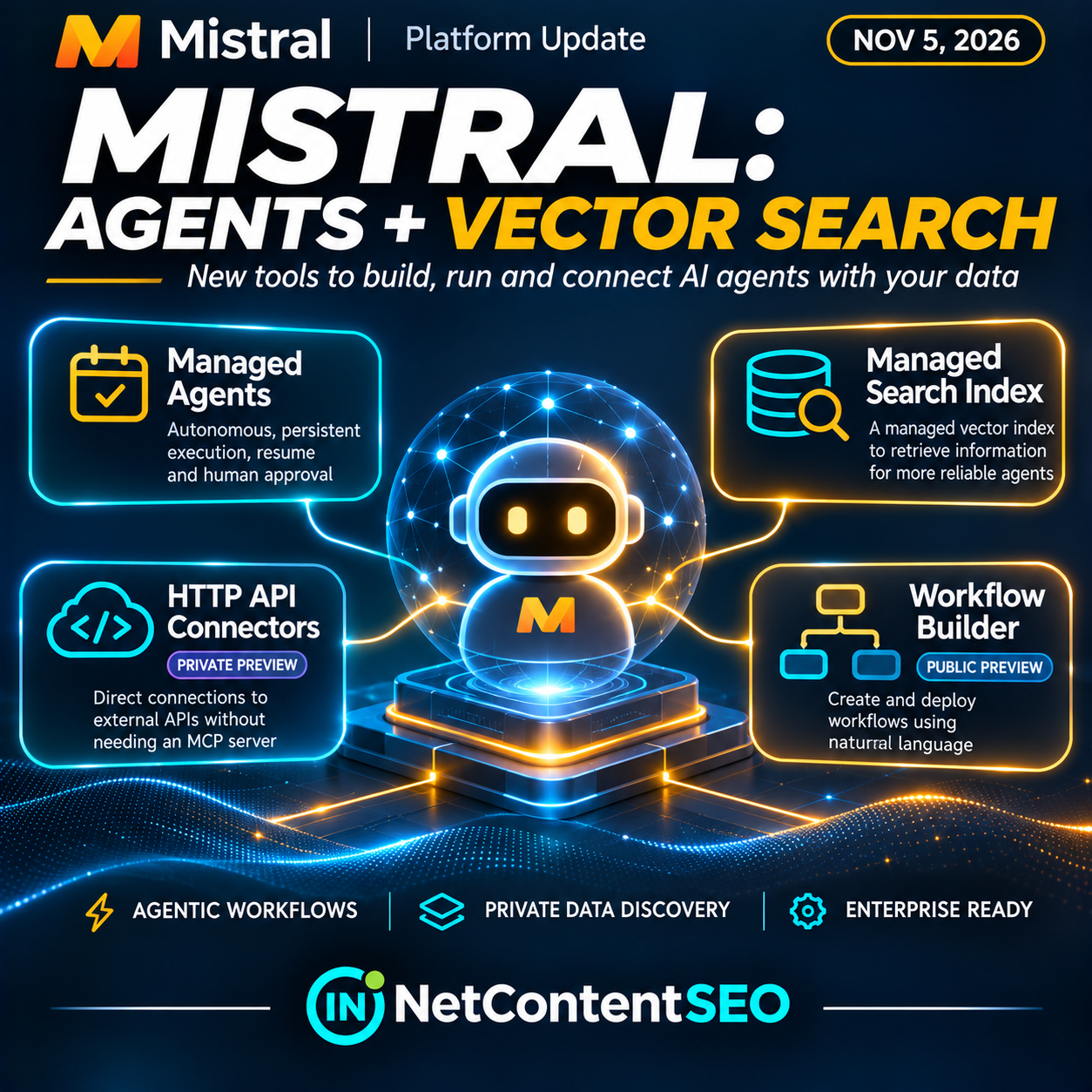

November 6, 2026. France-based Mistral AI has released a coordinated set of platform features designed to help developers build, deploy, connect and evaluate AI agents. Announced in the company's November 5 release notes, the updates include Managed Agents, Managed Search Index, HTTP API Connectors and a natural-language Workflow Builder.
The implications extend beyond chatbot development. These tools make it easier for organizations to build their own retrieval and decision systems: an agent can search a private index, call approved APIs, carry out a multi-step task and pause for human authorization. For SEO and generative engine optimization (GEO), this illustrates a growing distinction between visibility in public search engines and discoverability inside private, agent-operated knowledge environments.
Availability matters. Managed Agents, Managed Search Index and Workflow Builder are in public preview, while HTTP API Connectors are in private preview. These are confirmed product releases, but not a declaration that every feature is generally available to every Mistral account.
Four updates, one enterprise-agent architecture
| Capability | What it does | Availability on Nov. 5 |
|---|---|---|
| Managed Agents | Runs durable Python agents with background execution, resumable sessions and approval gates | Public preview |
| Managed Search Index | Hosts a vector index for ingesting and retrieving enterprise data | Public preview |
| HTTP API Connectors | Connects agents and workflows to described HTTP APIs without requiring an MCP server | Private preview |
| Workflow Builder | Turns a natural-language description into inspectable, testable and deployable workflow code | Public preview |
Mistral also released supporting capabilities on November 5, including tracing for managed agents, evaluation datasets, offline and online evaluations, webhook triggers and new Studio application tooling. Taken together, these releases address more of the operational stack than a model API alone: deployment, data access, orchestration, observability and quality control.
Managed Agents: long-running tasks that survive interruptions
Managed Agents is built around Mistral's Python Agents SDK, mistralai-agents. Developers define models, instructions, tools and environment once, then run the same agent in their own process, self-host it with agents serve or deploy it on Mistral's infrastructure with agents deploy. The agents init command scaffolds a starter project.
The defining feature is durable execution. Mistral says deployed agents can work for hours or days in the background and resume from the last completed step after a crash or interruption. Sessions are stored by Mistral, reducing the need for developers to operate a separate session database. The platform supports human approval for selected tool calls, live steering, interruption and later resumption.
Consider an agent that audits hundreds of product pages, checks inventory through an API, searches internal policies and prepares a report. A conventional request-response chatbot may time out or lose context when the application closes. A durable agent can preserve task state and continue through multiple stages, subject to resource limits and application safeguards.
Persistence does not guarantee correct results. An agent that resumes reliably can still make the wrong choice, retrieve stale data or call an inappropriate tool. Teams need permission boundaries, checkpoints, audit logs and validation before high-impact actions.
Managed Search Index: retrieval without operating a vector database
Mistral's Managed Search Index lets developers provision a hosted vector index by specifying a name, an embedding model and optionally a schema. They can ingest and query enterprise information through the SDK, using the same Search Toolkit ingestion pipelines, QueryEngine and retrievers supported by other backends. Mistral operates the underlying storage.
This is an infrastructure release, not a new consumer search engine. A vector index supports semantic retrieval: information can be found based on meaning rather than only exact keyword matches. An agent can use retrieved documents as grounding for an answer, reducing the need to rely solely on the model's internal knowledge.
However, a vector index does not automatically ensure factual accuracy. A well-written answer can still be grounded in the wrong document, an outdated version or content the user should not have permission to access. A production implementation needs access controls, document versioning, source attribution, relevance evaluation and a policy for what happens when retrieval confidence is low.
HTTP API Connectors: using services without an MCP wrapper
HTTP API Connectors allow developers to register a web API by describing its operations, then make those operations available to agents and workflows. Mistral says this avoids the requirement to build and host a Model Context Protocol (MCP) server for every integration. It also keeps the underlying API's operation surface visible instead of hiding functionality behind a wrapper.
The feature is in private preview, so businesses should not assume immediate self-service access. It also does not make MCP obsolete. MCP remains an interoperability option; direct HTTP connectors are another integration path, potentially useful when a company already has well-documented REST APIs.
For an ecommerce operation, a connector might let an authorized agent retrieve current inventory or check order status. For a travel publisher, it might query a verified events database or transport timetable. These are architectural examples, not integrations Mistral has confirmed with any specific ecommerce or travel provider.
API access introduces security responsibilities. Teams should use least-privilege credentials, separate read operations from write actions, validate arguments, apply rate limits and require approval before transactions or changes to customer records.
Workflow Builder: from a description to deployable automation
Mistral's Workflow Builder lets users describe an automation in natural language. Vibe then generates workflow code, tests it and deploys it, while exposing the code for inspection and editing. Mistral describes this as a way for non-programmers to build workflows and for developers to reduce setup work.
For example, an editorial team might describe a process that retrieves approved source documents, checks publication dates, flags conflicting information and creates a draft for human review. The builder could generate the underlying workflow, but the team still needs to inspect the logic, test error handling and verify that the output follows editorial policy.
Natural-language generation is not a substitute for software quality assurance. Before deployment, confirm trigger behavior, authentication, retry policies, data retention, exception handling and how to stop a runaway workflow.
What this changes for GEO: private discovery versus public visibility
Most GEO discussions focus on whether a brand or publisher appears in answers from public-facing AI systems. Managed retrieval infrastructure introduces another environment: enterprise agents that search an organization's own selected information.
Imagine a procurement agent with access to an approved supplier database, contracts and product catalogs. It might recommend a vendor based on the records available inside its index. A supplier could rank highly on Google yet remain invisible to this agent if its information is absent from the enterprise dataset. Conversely, a vendor might be discoverable inside that private system without receiving any public search traffic.
This is not evidence that Mistral has introduced a new public ranking factor. It is a reminder that visibility depends on the data boundary and selection logic of the actual system. In private retrieval, the key questions are which sources were ingested, which users can access them, whether the documents are current and how the retriever selects evidence.
Why RAG architecture matters more than the model brand
Retrieval-augmented generation (RAG) combines search with generation. A typical workflow ingests documents, chunks them into retrievable units, creates embeddings, retrieves relevant passages and supplies those passages to a language model. The quality of the final answer depends on each stage.
A managed index reduces operational complexity but does not solve poor document structure, ambiguous identifiers or inconsistent metadata. A product catalog with missing SKUs, outdated availability and duplicate descriptions can still produce misleading answers. In fact, retrieval quality becomes more important when an agent can take action on the result.
For SEO and content teams, the transferable lesson is to make information unambiguous, attributable and maintainable. Clear product attributes, canonical source records, versioned policies, documented updates and consistent entity identifiers are valuable inside both public and private discovery systems, even though optimization tactics and access rules differ.
A practical enterprise discovery workflow
- Define the task. Choose a bounded use case, such as answering internal product questions or preparing a supplier comparison.
- Inventory authoritative sources. Identify approved documents, database records and APIs, with clear ownership and update frequency.
- Design the index. Select an embedding model and useful metadata fields such as document ID, category, language, version and access scope.
- Test ingestion. Verify that updates, deletions and permission changes are reflected in the searchable corpus.
- Evaluate retrieval. Build representative questions and check whether the correct evidence appears among retrieved results.
- Add the agent. Give it narrowly scoped tools and instructions to cite sources, acknowledge uncertainty and avoid unsupported actions.
- Connect APIs cautiously. Use read-only access first; require approval for write operations, purchases or external communications.
- Test persistence. Simulate interruptions and verify that a resumed agent does not repeat irreversible actions.
- Monitor production. Review traces, retrieval failures, tool errors, user feedback and evaluation results before expanding the deployment.
This is a reference workflow, not a claim that Mistral's preview products automatically implement every governance requirement. Teams must check account eligibility, preview limits, pricing, data residency and security terms before using sensitive information.
How to measure discovery quality inside an agent
Traditional rank tracking is insufficient for a private retrieval system. Instead, build a test set with known relevant documents and expected outcomes. Measure retrieval recall (whether needed evidence is found), precision (how much retrieved material is relevant), citation accuracy, answer correctness, freshness and task completion.
For tool-using agents, also measure wrong-tool selection, unauthorized action attempts, approval frequency, recovery after interruption and cost per successful task. Compare the same evaluation dataset before and after changing an embedding model, chunking strategy, prompt or connector.
Mistral's November 5 updates include offline evaluations, online evaluations, tracing and datasets derived from production telemetry. These tools can help teams detect regressions, but they require well-defined success criteria and representative samples. A favorable dashboard score is not a substitute for independent validation.
Public SEO and private RAG: what is actually different?
| Question | Public search | Private enterprise retrieval |
|---|---|---|
| Who controls the corpus? | Search engine indexes accessible web content | Organization selects and ingests sources |
| How is visibility measured? | Search appearances, rankings, referrals and citations | Retrieval, selection, answer attribution and task outcomes |
| Who controls access? | Public crawling and platform policies | Enterprise permissions and index configuration |
| What improves discoverability? | Useful accessible content and supported search practices | Accurate ingestion, metadata, access controls and retrieval quality |
| Does inclusion guarantee selection? | No | No |
Both environments involve interpretation and selection, but their technical and commercial mechanisms are different. A company should not advertise private vector-index optimization as a proven way to rank in Google or to appear in public AI answers.
What remains uncertain in the previews
The November 5 release notes confirm the features and their availability labels, but they do not establish general availability dates, universal regional access or a single fixed price for every configuration. Enterprises should consult current Mistral documentation and contractual terms for quotas, billing, hosting regions, compliance requirements and preview limitations.
There is also no published evidence in these release notes that the new stack improves public search rankings, generates referral traffic or guarantees higher citation rates. Those would require separate tests of deployed products and user-facing discovery interfaces.
Frequently asked questions
What did Mistral launch on November 5, 2026?
It announced Managed Agents, Managed Search Index, HTTP API Connectors and Workflow Builder, alongside additional tracing, evaluation and workflow infrastructure features.
Are Managed Agents generally available?
No. The November 5 release notes label Managed Agents as a public preview.
Is Managed Search Index a search engine like Google?
No. It is a hosted vector index for searching ingested data and grounding agents or workflows.
Can Managed Agents resume after a crash?
Mistral says durable sessions can resume from the last completed step after interruption. Developers should still test retries and side-effect handling.
Do HTTP API Connectors require an MCP server?
No. They are designed to connect directly to described HTTP APIs, although MCP remains a supported integration approach.
Are HTTP API Connectors open to everyone?
No. Mistral labels them private preview as of November 5.
Can Workflow Builder deploy code generated from plain English?
Mistral says the builder generates, tests and deploys workflows from natural-language descriptions, with code available for inspection and editing. It is in public preview.
Does this change SEO rankings?
No public search ranking change was announced. The GEO relevance concerns how enterprises retrieve, select and use information inside their own AI systems.
What should a business test first?
Start with a narrow, read-only retrieval task. Evaluate source accuracy and access permissions before introducing external API actions or autonomous changes.
The takeaway: discovery infrastructure is becoming agent infrastructure
Mistral's releases show how AI vendors are moving beyond standalone models toward complete operational systems. Managed agents can continue long-running tasks; managed vector search can ground them in selected data; connectors can provide access to external services; and workflow generation can make automation easier to build.
For SEO and GEO, the most important implication is conceptual but practical: being indexed on the public web is only one form of discoverability. As organizations build their own agent-driven retrieval and decision systems, information quality, source governance, structured metadata and measurable selection become increasingly important inside private environments as well.
Sources
- Mistral official release notes — November 5, 2026, including Managed Agents, Managed Search Index, HTTP API Connectors, Workflow Builder and related evaluation updates.
- Mistral developer documentation — SDK, Studio and API reference.