

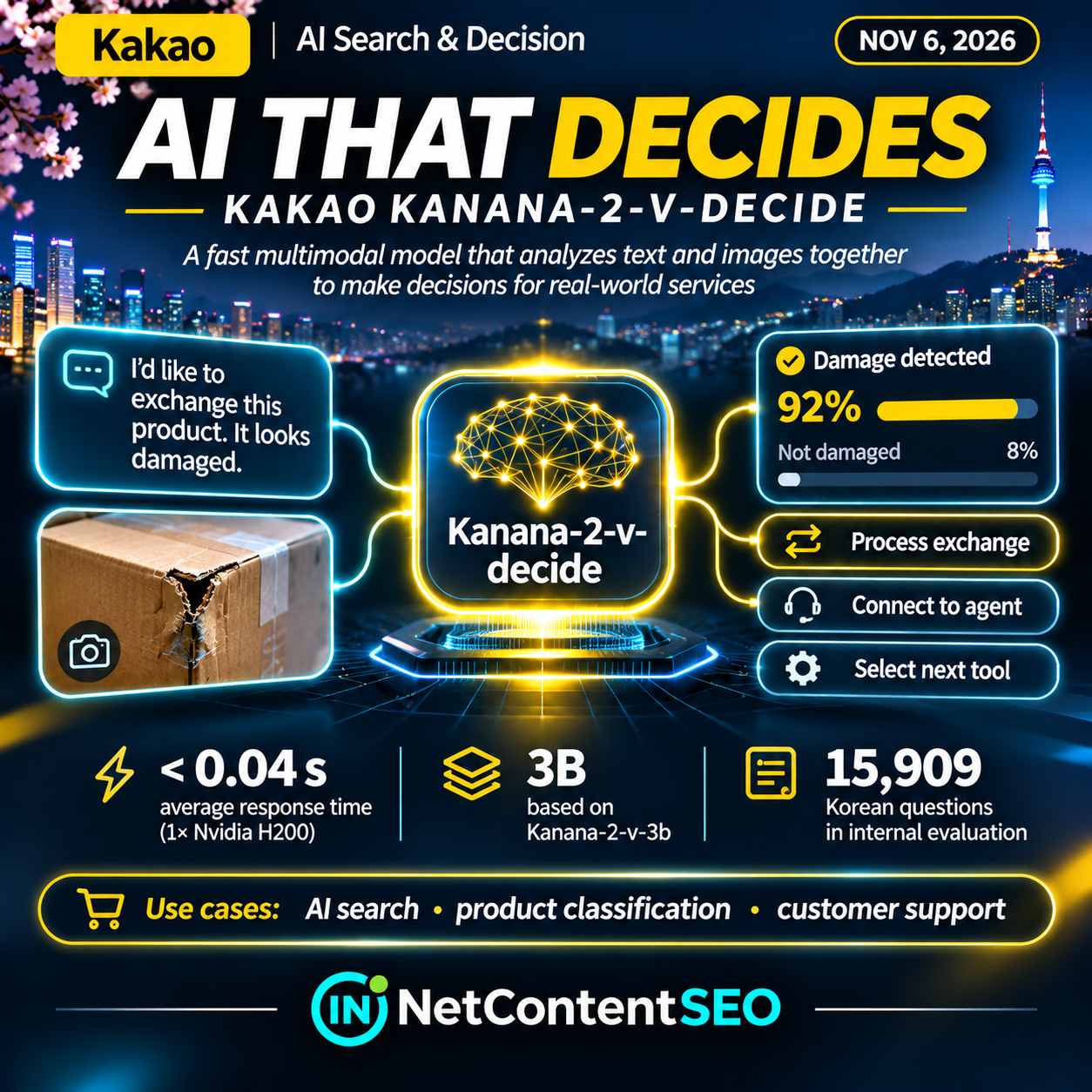

November 6, 2026. Kakao has released Kanana-2-v-decide, a compact multimodal decision model that analyzes text and images together and returns probabilities, choices or scores instead of writing a conventional chatbot answer. The Korean technology company has made the model available on Hugging Face under its Kanana Open License, which permits commercial use subject to the license terms. Kakao plans to apply it first to internal web search and product-category classification.
The significance for AI Search is architectural: not every stage of an agent's workflow requires a fluent language model generating paragraphs. Some steps need a fast, structured decision about which category fits, which tool to invoke or which result is most relevant. A specialized decision model can potentially handle those repetitive steps while a separate model handles explanations and user-facing dialogue.
What Kakao announced
Kakao's November 6 press release and technical blog describe Kanana-2-v-decide as a multimodal model built on the company's Kanana-2-v-3b foundation. The system processes textual questions and images, compares them against candidate decisions and returns machine-readable outputs that applications can use directly.
Rather than asking a generative chatbot to explain whether a product is damaged and then extracting a yes-or-no conclusion from the prose, a service can ask the decision model for a score or a probability distribution over predefined options. The surrounding application still needs rules, validation and escalation logic before taking action.
Key numbers and their limitations
| Metric | Reported value | Interpretation |
|---|---|---|
| Base model | Kanana-2-v-3b | Compact multimodal foundation |
| Average response time | Under 0.04 seconds | Kakao's test using one NVIDIA H200 GPU |
| Relative speed | Approximately 43× faster than GPT-6 Luna | Vendor-reported comparison on a decision task, not overall model superiority |
| Internal Korean benchmark | 15,909 questions | Kanana Decision Bench, designed by Kakao |
| Public text benchmark | 61.35 | Decision Index 0.4.1 public text score reported by Kakao |
| Korean text benchmark | 72.62 | Kanana Decision Bench text score reported by Kakao |
The speed and benchmark results are Kakao's measurements. The approximately 43-fold comparison with GPT-6 Luna concerns the tested decision workflow and should not be used to claim that the smaller model is 43 times faster at every AI task, or more capable at reasoning, writing or multimodal generation. Hardware, batching, input length, candidates and evaluation methods all affect latency.
How the model produces decisions instead of sentences
According to Kakao's engineering write-up, the model uses an embedding-based approach to represent a question and its candidate answers as vectors. It compares those representations and produces probabilities or scores. Candidate representations can be reused across repeated calls, reducing computation when the same set of options appears again and again.
For example, an ecommerce support system might define three possible outcomes: likely damaged, unclear and not damaged. The model considers a customer's message and attached photograph and returns relative scores. A business rule can then request a human review if confidence is low or if the request involves a high-value item. The model's output is a decision signal, not evidence that a refund should be automatically approved.
Probabilities also need calibration. A displayed score of 0.92 should not automatically be interpreted as a 92% real-world probability of correctness unless that interpretation has been validated on representative data. Kakao discusses calibration and safety-focused training in its technical post, but organizations must test the model against their own distribution of cases.
Three useful output formats
The model supports decision patterns described as choice, noul and score in the technical documentation. A choice task selects among candidates, a binary or truth-oriented task estimates whether a condition applies, and a scoring task assigns graded values according to defined options. These formats can feed routing, ranking or classification systems without requiring a second language model to parse a narrative response.
For developers, the important design decision is defining good candidate labels and the action policy around them. Ambiguous categories, overlapping labels or missing fallback options can produce unreliable outcomes even when the model itself responds quickly.
What the benchmarks actually show
Kakao compared its model with decision-focused alternatives including Microsoft's Decision-1, TypeSafe AI's Jev, Perplexity's decider models and Upstage's Solar Decide. Its technical report describes competitive results on the Korean-focused Kanana Decision Bench and the public Decision Index benchmark. In the published text comparisons, Kanana-2-v-decide scores 72.62 on the Korean benchmark against 71.98 for Decision-1 and 71.66 for Jev, and 61.35 on public Decision Index text against 60.70 for Jev and 60.13 for a Perplexity decider.
Those are relatively narrow differences in some comparisons. A reported lead on selected tests is not a universal claim of superiority, especially without independent replication and uncertainty estimates. Kakao's benchmark tables are dated November 4, 2026; rankings may change as other models and evaluation versions evolve.
Why Korea-facing AI Search is a logical use case
Kakao says it is applying the model to internal web-search and product-categorization projects. A search system routinely makes small decisions: determine intent, identify candidate results, classify images, select a specialized tool or decide whether a request needs another retrieval step. These operations may benefit from a fast, compact model optimized for structured judgments.
The model's Korean-language evaluation is especially relevant in a market where local linguistic nuance and service-specific categories matter. However, a strong Korean decision benchmark does not automatically demonstrate better Korean web-search relevance. Search quality requires evaluation of retrieval, freshness, relevance, diversity, factual grounding and user outcomes across the complete pipeline.
Kakao has stated an ambition to integrate search and decision functions into a single model. That is a future research direction, not evidence that a unified public search engine has already launched or that the company's consumer search rankings have changed.
From retrieval to selection: the AI Search implications
Conventional search discussions often focus on which pages rank. Agentic systems introduce another layer: after retrieving possible sources, a model may decide which item to inspect, which tool to use and which recommendation to present. The same information can be available to the system without being selected for the final answer.
That distinction matters for AI visibility. Retrieval is not selection, and selection is not necessarily a click. A page can be discovered but discarded during filtering; a product can be considered but not recommended; a business can be named in an answer without receiving a referral. Kakao's model is not proof of any particular ranking formula, but it illustrates how specialized decision components can sit between discovery and user-visible output.
For SEO practitioners, this reinforces the need to measure more than keyword position. Where observable, test whether relevant entities and products are understood, whether accurate attributes are available, and whether AI interfaces recommend them in appropriate contexts. Avoid claiming that adding schema or repeating a brand name guarantees selection by an AI agent.
Ecommerce: combining product images and customer intent
One of Kakao's own examples is a damaged-product exchange request. A customer supplies a photo and explanatory text. The decision model evaluates both signals and returns a structured judgment that the service can combine with policy rules. Similar approaches could assist with catalog categorization, image-based product matching, content moderation or support triage.
Real-world deployment requires representative tests: different lighting conditions, damaged packaging versus damaged goods, multiple products in one photo, poor image quality and ambiguous customer messages. A false positive may cost a business money; a false negative may unfairly reject a valid customer request. Human escalation is particularly important where outcomes affect consumer rights.
Tool selection for AI agents
An agent might have access to search, inventory, booking, account lookup and customer support tools. Rather than generating an elaborate internal explanation for every step, it can use a decision model to score candidate tools against the current task. The selected tool must still be subject to permissions and validation.
Fast selection is useful only when it is correct and safe. A wrong tool call can be more expensive than a slower model response, especially if it modifies records or initiates payments. Production agents should use allowlists, least-privilege access, logging, timeouts and approval gates for sensitive actions.
How developers can evaluate Kanana-2-v-decide
Kakao has published the model collection on Hugging Face and technical implementation guidance. Developers should review the exact model card, Kanana Open License, runtime dependencies and hardware requirements before deployment. The license allows commercial use, but that does not eliminate the need to comply with its terms.
- Choose a bounded task. Start with one clear classification or routing problem, not a fully autonomous workflow.
- Define candidate options. Make labels mutually understandable and include an uncertain or escalate outcome where appropriate.
- Build a representative test set. Include Korean-language examples, images, edge cases, difficult negatives and real service variations.
- Measure accuracy and calibration. Evaluate false positives, false negatives and confidence reliability, not just aggregate benchmark scores.
- Benchmark your own infrastructure. Record hardware, batch size, image resolution, number of candidates and end-to-end latency.
- Compare alternatives fairly. Use the same inputs, output requirements and quality thresholds for each model.
- Apply business rules outside the model. Do not let an unverified score directly authorize refunds, payments or irreversible changes.
- Log and monitor outcomes. Track drift, customer appeals, failure cases and human override rates.
- Review security and licensing. Restrict access to personal data and inspect the downloaded model's license and dependencies.
What SEO teams can learn without deploying the model
Even if a publisher never runs Kanana-2-v-decide, the release offers a useful conceptual framework. AI Search is not one monolithic language model reading a page and writing an answer. A production system may combine retrieval, classification, ranking, tool routing, generation and policy checks. Different components can influence whether information reaches the user.
Content teams should therefore prioritize accurate entity descriptions, clear product attributes, trustworthy visual information, up-to-date policies and evidence that answers real user questions. These practices improve information quality, but no public evidence establishes that they directly optimize Kakao's internal decision model or guarantee inclusion in a future AI Search interface.
What remains unverified
Kakao's latency and performance claims are vendor-reported and need independent reproduction under matched conditions. The public sources do not disclose the complete production architecture for Kakao's internal search applications, user-facing rollout dates or the impact on search traffic and conversions. The model's confidence values should not be assumed to represent calibrated real-world probabilities without testing.
The announcement also does not establish that Kakao has replaced its existing search ranking systems, that every business can achieve 40-millisecond decisions on ordinary hardware, or that a decision-only model can replace a general-purpose assistant for writing, reasoning and conversation.
Frequently asked questions
What is Kanana-2-v-decide?
It is a multimodal decision model from Kakao that analyzes text and images and produces structured probabilities, choices or scores for applications and AI agents.
When was it released?
Kakao announced and released the model on November 6, 2026.
Is it open source and commercially usable?
Kakao published the model on Hugging Face under its Kanana Open License, which permits commercial use subject to the license conditions.
How fast is it?
Kakao reports an average response time below 0.04 seconds on one NVIDIA H200 GPU for its tested workload. Real-world performance depends on the deployment and inputs.
Is it really 43 times faster than GPT-6 Luna?
That is Kakao's comparison for a specific decision workload. It does not imply a general 43-fold advantage across all model capabilities.
Can it analyze product photos?
Yes. It is designed to use image and text inputs together, including tasks such as damage assessment and product categorization.
Does it generate chatbot answers?
Its primary purpose is structured decision output rather than open-ended natural-language generation.
Will it change Kakao search rankings?
Kakao says it is testing the model in internal web-search projects and plans further integration. It has not announced a specific public ranking-system change.
What does it mean for AI SEO?
It illustrates the importance of intermediate selection decisions in AI workflows. Visibility can depend on being retrieved, correctly interpreted and chosen for a task, not only on ranking in a conventional results page.
The bigger shift: AI that decides before AI that answers
Kanana-2-v-decide shows why the next stage of AI infrastructure may rely on specialized models rather than routing every task through a large generative system. For repetitive classification, candidate selection and tool routing, speed, predictable output and controllable decision boundaries can matter more than eloquent prose.
For AI Search, the strategic question is increasingly not just what an AI system can say, but what it decides to retrieve, trust, select and act on. Kakao's release is a concrete technical example of that direction, while the real-world benefits still need to be measured beyond the vendor's benchmarks.
Sources
- Kakao official press release, November 6, 2026 — release, applications, speed and licensing.
- Kakao technical blog, November 6, 2026 — architecture, benchmarks, calibration and implementation.
- Kakao's Hugging Face model collection — model downloads and license details.
- ChosunBiz, November 6, 2026 — original news reporting.
- ETNews, November 6, 2026 — independent Korean reporting.