

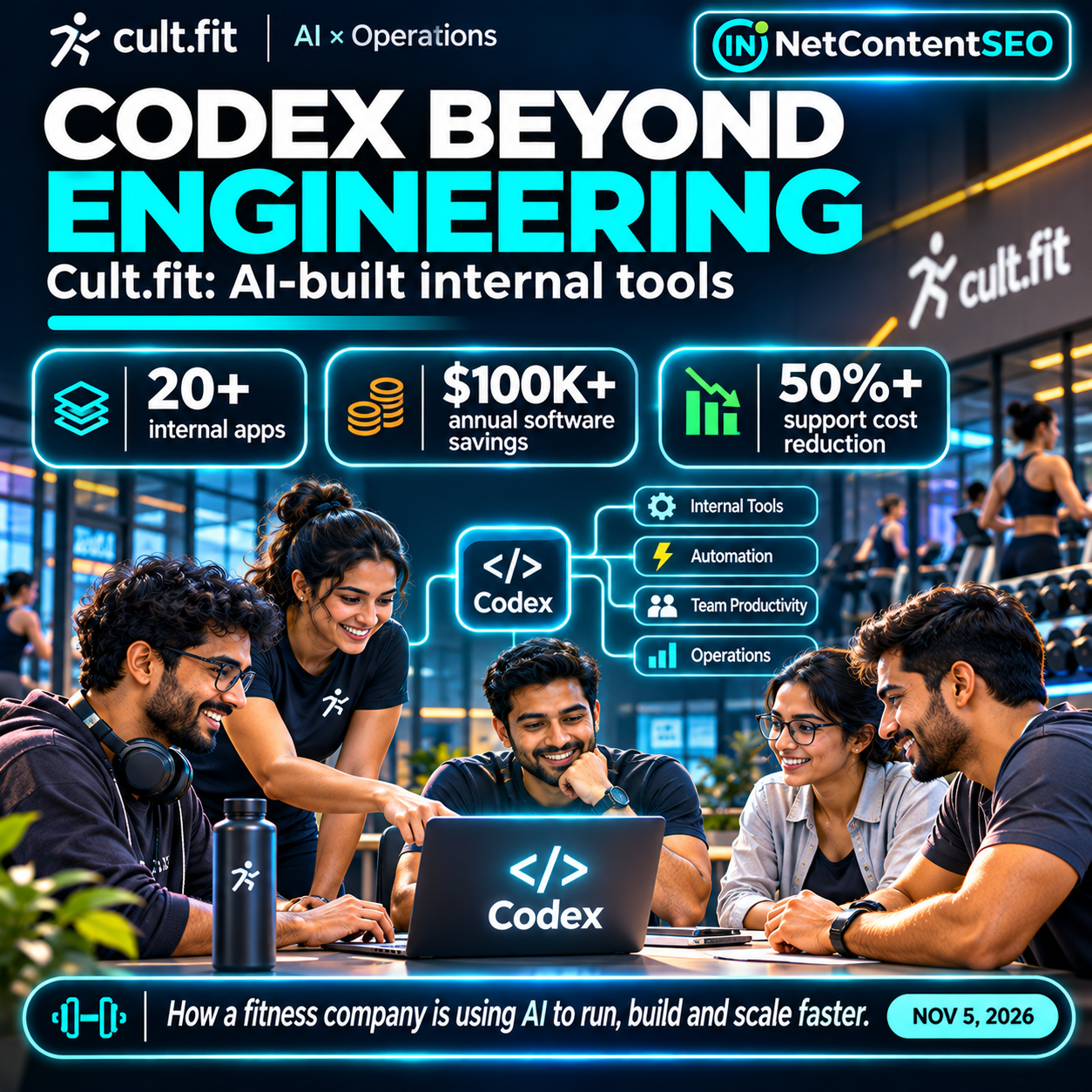

November 6, 2026. The most interesting part of Cult.fit's Codex rollout is not that a fitness company has adopted an AI coding assistant. It is that people outside its engineering department are now building operational software themselves. According to a November 5 OpenAI customer story, non-engineering teams at the India-based fitness business have created more than 20 internal applications in recent months, while the company reports over $100,000 in annual software savings from rebuilding one internal capability and a reduction of more than 50% in customer support costs.
These are company-reported results presented in a vendor case study, not independently audited productivity measurements. Even with that limitation, the underlying operating model deserves attention: Codex is being used for software development, data access, support automation and frontline operations, with engineering standards and human review intended to keep that expansion manageable.
Cult.fit's Codex rollout: the figures
| Reported metric | Value | What it measures |
|---|---|---|
| Applications built by non-engineering teams | 20+ | Internal tools created in recent months |
| Annual software savings | More than $100,000 | A replaced internal dashboard capability |
| Customer support cost reduction | More than 50% | Reported change in support operations |
| Fitness locations | 708 | Centers operated across India |
| Cities served | 77 | Reported geographic footprint |
| Paid members | Nearly 1 million | Company-reported membership scale |
The company also says it shipped a new social feed for its app in two months, a project its CTO estimated would previously have taken more than a year. That comparison is an internal estimate rather than a controlled before-and-after experiment.
Why standardizing on one coding agent mattered
Before choosing Codex as a common engineering platform, Cult.fit developers used several coding assistants with different repository conventions, instructions and workflows. That made it harder to share reusable knowledge and maintain a consistent development process.
The company standardized on Codex and aligned repository structures, reusable skills, testing, code review and feedback loops. In practical terms, the goal was not to let AI write arbitrary code without supervision. It was to make AI-assisted work follow recognizable software engineering practices.
One example is a site reliability engineering agent that gathers information from logs and observability platforms, investigates incidents and can create a pull request proposing a fix for an engineer to review. Other agents support security investigations and recurring on-call problems. The distinction between proposing a change and autonomously deploying it is important: the case study describes engineer review as part of this workflow.
From technical teams to HR and operations
Cult.fit's more consequential experiment is extending Codex beyond software engineers. The company made business data more accessible to Codex so employees could answer routine questions without always waiting for a central analyst team. Its HR department built a workflow for performance reviews, scheduling, feedback collection and consolidation.
OpenAI reports that non-engineering teams built more than 20 applications in recent months. This suggests that domain experts can increasingly translate operational knowledge into useful internal software, provided they have approved access to data, tools and technical support.
Cult.fit did not simply distribute licenses and hope for adoption. It ran a company hackathon, a one-day management workshop, twice-weekly engineering office hours and embedded engineering support in selected functions. These details are central to the case: lowering the cost of producing code does not remove the need to define requirements, check outputs and maintain applications.
How one internal tool reportedly saved $100,000 a year
When the price of its internal dashboard software increased, Cult.fit had an engineer rebuild the needed functionality using Codex over a weekend. The company says running the replacement internally now avoids more than $100,000 in annual software costs.
That figure is compelling, but it should not be generalized into a claim that every company can replace a commercial dashboard in a weekend. The case study does not publish the former vendor contract, infrastructure expenses, maintenance burden, security review costs or a detailed total-cost-of-ownership calculation. The reported saving is a useful case-specific outcome, not a universal return-on-investment formula.
Before replacing a subscription platform, a team should calculate the full cost of development, hosting, authentication, data access, observability, updates, compliance, user support and the engineering time needed to keep the replacement working. A lower license bill is not automatically a lower long-term operating cost.
AI Trainer: Codex is not the only OpenAI product involved
Cult.fit is also using the OpenAI API for customer-facing experiences. The company says more than 45% of its members are first-time gym users and that approximately 20% of gym users use its AI Trainer product. The latest version is designed for voice-first workouts, using GPT Realtime through an API integration to provide conversational coaching cues and support workout logging.
This distinction matters: the case study describes Codex for development and internal tooling and the OpenAI API for customer-facing AI interactions. The two should not be collapsed into a claim that Codex itself is a real-time fitness coach.
Any health or fitness advice generated by an AI system needs appropriate safeguards. Conversational guidance should not be treated as a substitute for individualized medical assessment, and companies should consider privacy protections for member information and clear escalation paths for situations the system cannot safely handle.
Automating customer support decisions
Another use case concerns requests to waive penalties for missed group fitness classes. Cult.fit says an AI agent can consider contextual signals, such as local weather and attendance patterns, before deciding whether a waiver is appropriate. These agents are integrated into the company's existing Sprinklr customer support platform and backend systems.
The company reports a reduction of more than 50% in customer support costs. The source does not establish precisely which share of the reduction is attributable to the waiver agent, the timeframe over which costs were measured or whether customer satisfaction improved. Those questions matter before concluding that automation necessarily produces better service.
A responsible support workflow should define eligibility rules, record the evidence used, allow users to challenge decisions and provide human escalation for unusual or sensitive cases. An automated decision that is cheaper but consistently unfair is not a successful operational improvement.
What makes this an agentic operating model?
The shift from a chatbot to an operational agent occurs when software can access tools, retrieve business context and perform bounded tasks. Cult.fit's examples span several levels of autonomy: generating code for review, analyzing data, creating internal applications and evaluating support requests using live operational signals.
These activities require different permissions. A read-only analytics agent should not be able to modify customer records. A code-writing agent should not automatically gain production deployment privileges. A support agent that waives penalties needs defined authority, decision logs and a way to reverse mistakes.
That is why the company's emphasis on shared engineering conventions is more important than the mere number of generated applications. The operating model must be reproducible, testable and governable.
A practical implementation plan for companies adopting Codex
- Choose one measurable bottleneck. Start with a repeatable internal task such as report preparation, a data reconciliation workflow or a small dashboard. Document current time, cost and error rates.
- Define ownership. Assign a business owner responsible for requirements and an engineering owner responsible for security, deployment and maintenance.
- Limit data and permissions. Provide only the information and API scopes the workflow needs. Keep production credentials out of prompts and source repositories.
- Write acceptance criteria. Specify expected inputs, outputs, edge cases, failure handling and who approves changes before the agent generates code.
- Use version control and tests. Require code review, automated tests and a rollback plan before deploying an internal application.
- Keep human review for high-impact actions. Financial changes, employee assessments, customer account modifications and production deployments need appropriate approval controls.
- Train non-engineering teams. Provide office hours, reusable examples and clear escalation routes instead of assuming every employee can independently maintain software.
- Measure total cost. Include infrastructure, model usage, maintenance, security and support, not just saved subscription fees.
- Track outcomes. Compare task completion, accuracy, incidents, employee adoption and user satisfaction against the baseline.
- Scale only after validation. Expand to additional departments when the pilot is reliable and its governance model can be reused.
What SEO and digital marketing teams can learn
The lesson for SEO teams is not that AI-generated software automatically improves rankings. Cult.fit's case contains no evidence of changes to Google's search algorithms, organic traffic or AI Search citations. Its relevance is operational: teams can build narrowly scoped tools around their own data and workflows without waiting for every request to enter a central engineering backlog.
Potential applications include combining Search Console exports with content inventories, monitoring redirect and canonical changes, checking publishing workflows, or generating draft issue reports from verified crawl evidence. The same caution applies as in technical SEO auditing: collecting data is easier than correctly interpreting what matters.
A marketing operations team might build an internal dashboard that reconciles campaign metrics across approved sources. An SEO team could create a change-monitoring application that flags unusual shifts in indexability. Both should retain source data, show uncertainty, respect API limits and require review before making live website changes.
AI-assisted development can reduce the friction of experimentation, but it also increases the number of applications an organization must maintain. The long-term challenge becomes governance of the growing internal software portfolio.
How to calculate whether an AI-built tool is worth keeping
Use a simple annualized model: net benefit = avoided software or labor costs − AI usage − infrastructure − development − maintenance − security and support costs. Record the assumptions separately and revisit them after deployment. Labor savings should reflect actual changes in work rather than multiplying an estimated time saving by a salary and treating it as realized cash.
Also evaluate nonfinancial outcomes: turnaround time, error rates, employee satisfaction, auditability and customer experience. A tool that saves money but creates untracked access to sensitive records may introduce more risk than value.
What remains unverified in the Cult.fit case
The public customer story provides useful examples and headline figures but not a complete independent audit. It does not disclose the number of active users per internal application, detailed software cost accounting, a controlled productivity study, the precise measurement window for support savings or the full security architecture of each agent.
These omissions do not make the results false. They mean readers should treat the figures as company-reported outcomes and evaluate whether their own organization has similar workflows, data quality, engineering support and governance.
Frequently asked questions
How many applications has Cult.fit built with Codex?
OpenAI reports that non-engineering teams built more than 20 internal applications in recent months. The source does not publish a complete application inventory.
Did Codex save Cult.fit $100,000?
Cult.fit reports more than $100,000 in annual software savings after replacing an internal dashboard capability built with Codex. The public case study does not provide a full total-cost-of-ownership breakdown.
How did customer support costs fall?
The company describes AI-first support workflows integrated with Sprinklr, including agents that assess missed-class penalty waivers. It reports more than a 50% reduction in support costs but does not provide a detailed attribution study.
Can non-programmers build useful software with Codex?
They can contribute to building internal tools, particularly when they understand the business process and receive engineering support. Security, testing, maintenance and production approval still require appropriate expertise.
Is the AI Trainer powered by Codex?
The case study associates Codex with software development and internal tooling. The conversational AI Trainer uses the OpenAI API and GPT Realtime.
Should every company replace SaaS products with AI-generated apps?
No. Compare total costs, reliability, vendor support, compliance, integration needs and long-term maintenance before replacing a mature service.
What does this mean for SEO?
It demonstrates a potential way to build internal analytics and workflow tools faster. It does not establish a new ranking factor or guarantee higher search visibility.
The bigger lesson: software becomes an organizational capability
Cult.fit's experience illustrates a practical change in the economics of internal software. Domain experts can describe problems and increasingly participate in building solutions, while engineers focus on shared standards, security and the path to production.
The strongest takeaway is not simply that Codex makes coding faster. It is that AI-assisted development becomes valuable when the organization changes how ideas are tested, governed and maintained. Cult.fit's reported results are promising, but the repeatable lesson is its combination of common tools, employee training, measurable workflows and human oversight.
Source
OpenAI, November 5, 2026 — Cult.fit builds operational muscle with Codex. All company metrics and deployment examples in this article originate from the customer case study unless otherwise noted. No independent audit of the reported savings was available in the reviewed sources.